In the midst of #AcademicPatentGate, @Nicole_Paulk and I started talking more broadly about the ideal relationship between #Academia and for-profit in the field of #biotechnology. Should ties be stronger or weaker? What happens when #OpenAccess meets the global economy?
One side: For-profit companies license academic innovations that used public research #funding, then charge the public for the products.
Other side: Public research funding has the goal of fueling innovation. Restricting discoveries to the academic community is not beneficial.
But #Academia is also seen as an objective source of truth (increasingly important these days). At its best, scientists engage in a disinterested search for truth, and ideas are made to be tested. This has been very good for civilization so far.
Professors now often have financial interests based on research in their labs, particularly in fields which are very translational (like #GeneTherapy). The degree to which this compromises neutrality depends on their character, but objectivity can be doubted.
There are advantages to making #BasicResearch seem translational. Industry may supplement your lab’s funding. Grant review panels view translation research positively, even if it means repeating model organism work in a “questionable but best available” mouse model.
With these incentives in place, disinterested truth-seeking and curiosity-driven research feel beleaguered. Science has hardly been corrupted, but researchers are leaving poorly paid academic jobs, and finding unbiased observers is hard.
There is nothing wrong with researchers commercializing their findings, and we should still support this. But the current trend towards a continuous spectrum of commercial interests has the potential to deplete the wellspring of commercialization.
A proposed solution: funders, including the NIH, could delineate ‘Basic’ and ‘PreTranslational’ research, and allocate funding separately. #BasicResearch should receive much more funding (2/3), and pay higher salaries (by 30-50%).
The purpose of this skew is to counterbalance the natural #PreTranslational incentives of royalties, equity, sponsorship, consulting fees … and cementing #BasicResearch as intrinsically valuable reduces the motivation to feign translatability.
Drawing such a line is non-trivial. But since the goal is balanced incentives, we can just look at whether there’s a healthy equilibrium between curiosity-driven and pre-translational research efforts. If scientists flock to one side of the equation, incentives are imbalanced.
(Note that neither of us would benefit from this funding structure)
• • •
Missing some Tweet in this thread? You can try to
force a refresh

Finding new medicines is getting more and more expensive, and AI won't help much unless we can generate physiological data at scale.
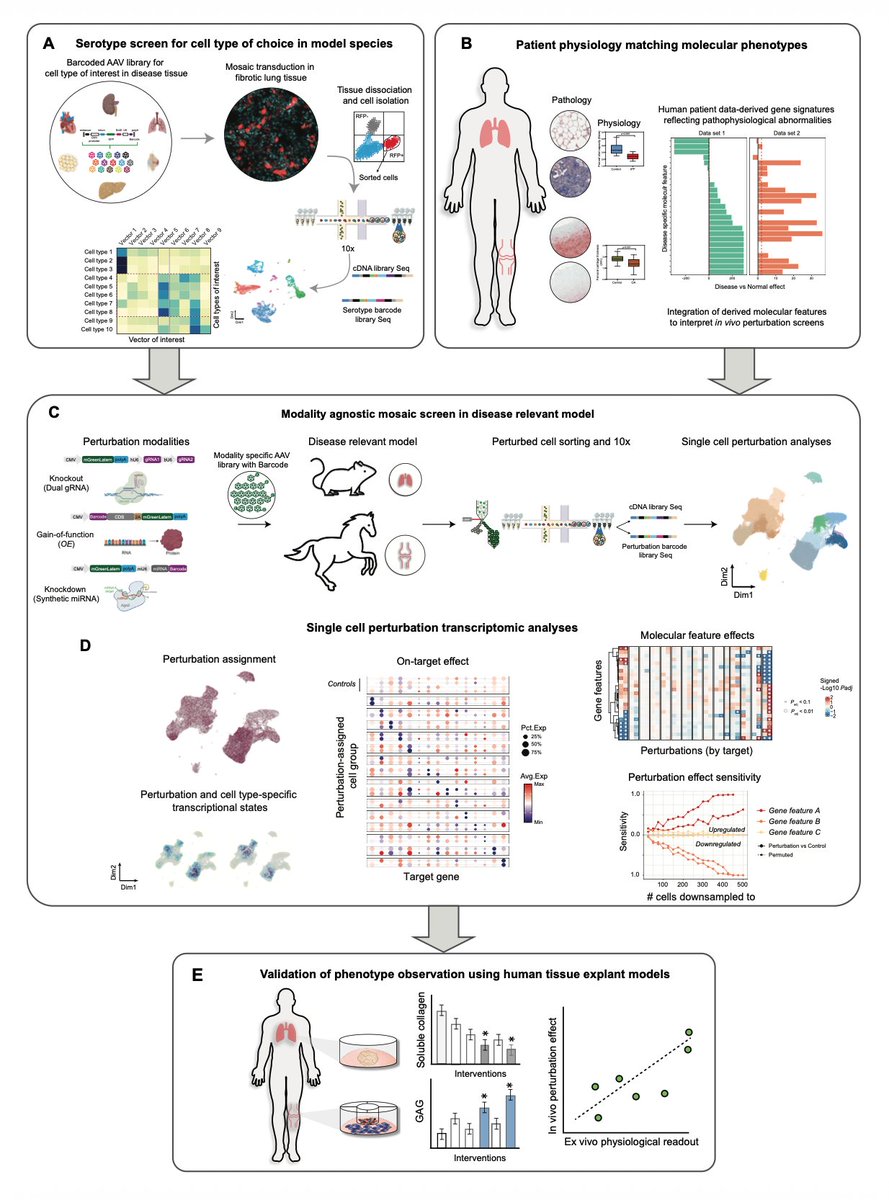
In our new preprint, @GordianBio extends the progress of the functional genomics community to run pooled in vivo screens at scale, in a way that answers questions about physiology and therapeutic potential.
We show screens in mice and horses, fibrotic and degenerative disease, with a framework for physiological predictions validated in human ex vivo tissues.
Very proud of @v_sontake, @vkartha88, Neety and the rest of the team. Tweetorial follows:
Perturbation is how we extract rules from the organized chaos of biology, and high-throughput pooled screens have become a major source of new insights.
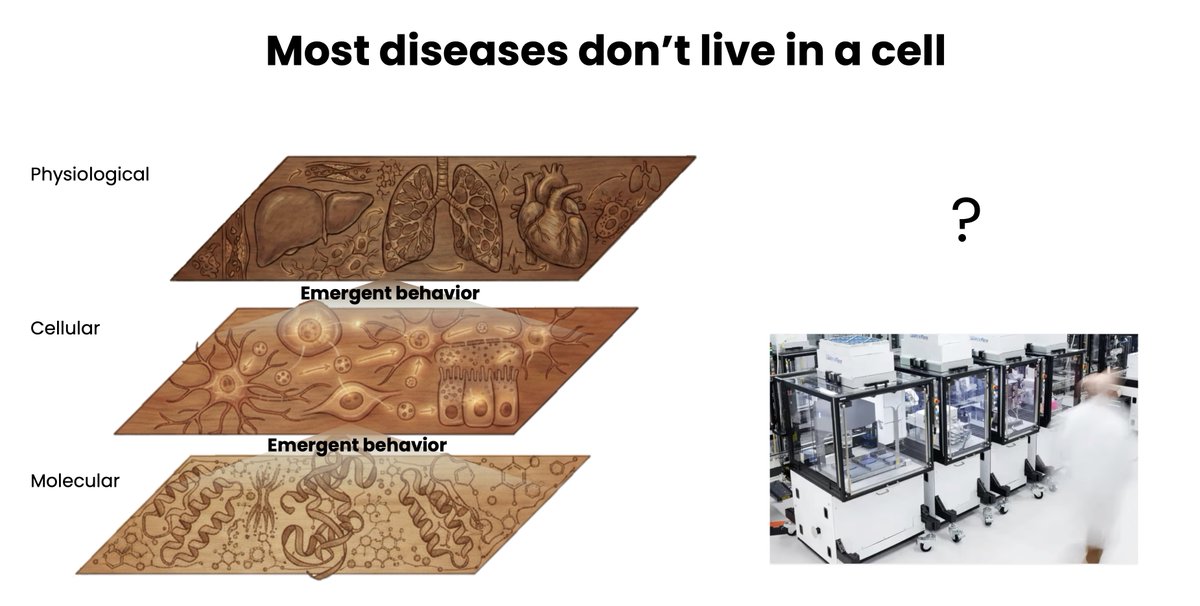
But when we screen cells outside the body, we're missing a lot of what drives disease: no immune system, no real metabolism, no structural environment.
Diseases of aging happen at the organ level. So we need screens that can ask cells about the organ they're in. This means screening in vivo.
We had to solve three challenges for pooled screening in diseased organs: delivering different perturbation modalities even in organs with structural damage, scaling this to large perturbation libraries, and a way to analyze scSeq data that ranks targets' therapeutic potential.
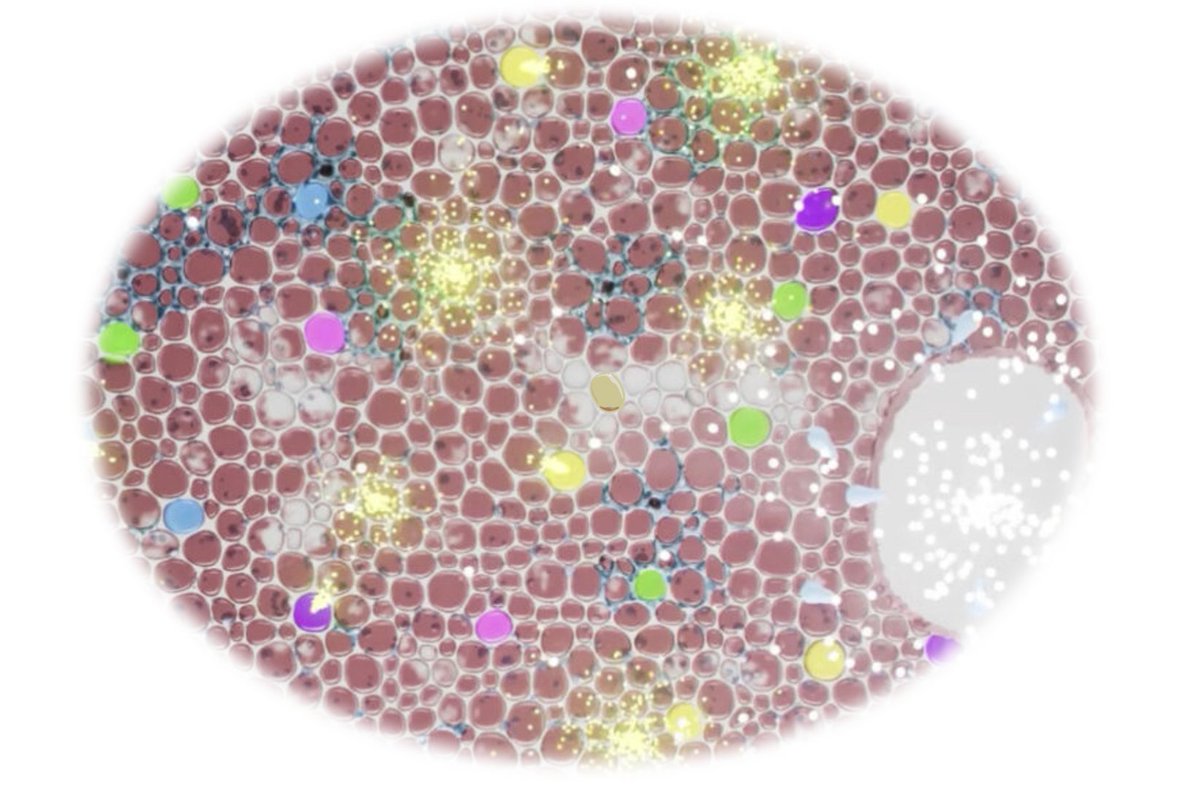
The result is what we call Mosaic Screening, because you end up with a mosaic of different perturbations inside a living, diseased organ.
I'm struggling to wrap my head around the new Weissman lab myHSC depletion paper:
The first authors don't seem to be on twitter but hoping I can crowdsource a fun discussion. @dbgoodman @ImmunoFever @Jeff_Mold @Satpathology @CalebLareau...nature.com/articles/s4158…
The premise of the paper is that immune function declines with age in part because a haematopoetic stem cell (HSC) population skewed towards myeloid lineage increases in prevalence, and that targeting this population with antibodies can restore function. Cool idea!
❓1⃣: How well defined are myHSCs?
Here myHSC seems to be defined as CD150 high, based mainly on Beerman 2010 .
But looking at Figure 3, CD150 expression is a continuous distribution. Is this a clear cell population with somewhat understood behavior? pnas.org/doi/full/10.10…
If you want to build a career in biotech, should you get a PhD after college or join a company directly (as a Research Associate/RA, usually)?
There's no single answer, but I have the conversation often enough that I thought I'd share some pros/cons... (1/n)
First, see this thread about different types of biopharma companies. For reasons I'll get into, I think early stage (probably founder led) biotech is your best bet unless you still want to do PhD later.
(PS if you want to be a professor, it's 💯 PhD) 2/n
PhD will give you more options.
Some companies (incl. @GordianBio) will help you grow from RA to Scientist role (and beyond). But many, esp larger, companies have a glass ceiling if you don't have a PhD. Even if you pick one w/o glass ceiling, you'll be worse off it if fails. 3/n
All these points resonate, for early stage biotech at least. @erlichya touches on this, but I think worth separating "industry" into different clusters that will feel quite different to someone coming from academia (still oversimplified, of course):
Pharma (eg Pfizer) vs biotech:
You wear fewer hats, see less of the company but company as a whole spans wider range of expertise, fewer changes in direction, often higher income but no chance of getting rich. Both have job insecurity: pharma doesn't go die but programs do.
Clinical vs R&D stage biotech:
Clinical may still have R&D but it's no longer the biggest driver of success vs failure. Assay validation/rigor > assay development/invention. Clinical can feel more like pharma, but with more urgency/stakes: one program = life or death of co.
#SciTwitter After a lot of research and asking around, I'm making the lab equipment recommendations 🧵 I wish I'd had 2 months ago. RT/share with a #newPI or startup 🔬⚗️🛒
Note, much of the equipment hasn't arrived yet, will add comments after actual use.
-20 #freezer
Less clear, many viable options. We ended up getting a split of PHC MDF -30 (recommended as quieter) and much cheaper Corepoint Scientific/@VWR, will see which we prefer. Thermo hasn't failed #MBCbiolabs, but $$$ and several people said poor customer support.
As with all experiments, I expect that some of these will disappear and that others will be a central part of science in ten years.
But them happening at all is enough to renew a conversation about how science is funded and conducted.