I haven’t done a properly geeky cricket post for a while, but I was intrigued recently thinking about who would be my openers in a test team of the year.
One of the key skills required of an opener is seeing off the new ball. But we often don't measure it.
1/25
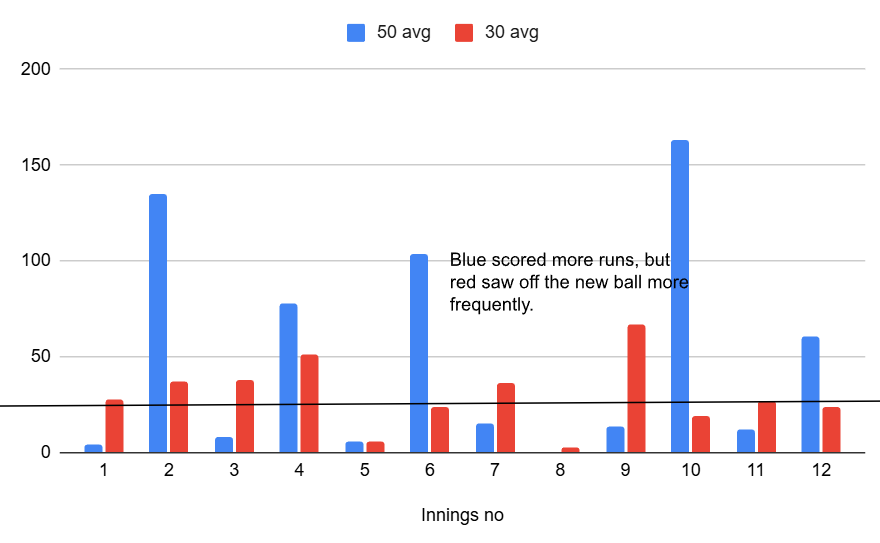
Now we’d assume an opener who averages 50 will do that very well, very often. But an opener who scored 4, 135, 8, 78, 6,104, 15, 0, 14, 163, 12, 61 would average 50, but would have only seen off the new ball 5 times in 12 innings.
2/25
And so there’s a point where an average isn’t necessarily the best gauge for the value of an opener.
That caused me to get my geek on...
Here's my first graph. Two players one averaged 50, the other averaged 30, but one saw off the new ball more often.
#cricket#stats#geeky thread alert - don't bother reading this thread if you're not interested in either cricket or statistics.
A few people have asked me why I never talk about a batter's average in particular countries. There's a really simple reason for that.
There just isn't enough international cricket played - particularly not international test cricket - to make most of those "averages in a country" statistics meaningful in any way.
There's so much randomness in results that looking at a sample size of (say) 12 innings is nuts.
What do I mean "randomness?" Well let's think about it this way. Each ball there's a chance that a batter will get runs, not get runs or get out. For the best batters, that risk of getting out will generally be lower, and it will fluctuate throughout an innings.
At the moment, the #SuperSmash is the poor cousin to the global T20 competitions. And that's by design. NZC looked at the global market and said "trying to compete on this playing field will bankrupt us."
And so the SuperSmash is just a competition to bring through local talent.
There's nothing particularly wrong with that, and it has done its job to a degree. We've found a number of local players, for whom the SuperSmash has prepared them reasonably well for international cricket.
However, I can't help feeling that it could be much more.
One issue that the @BLACKCAPS have had over the years is that they've not gone so well in knock-out matches. Some of that is due to just not being as good as the teams they've been playing. But some of it feels like a psychological issue, too.
My thoughts on the #BBL catch. It is the law and I think it's a good one. The issue wasn't the law. It was that there was so much room outside the boundary.
If the rope wasn't in so close, that would have been an easy catch.
The idea that somehow bringing in the ropes is good for cricket is completely bizarre. The administrators need to stop homogenising cricket.
Some grounds should have big boundaries. Others should have short ones. Asymmetric boundaries are good, not bad.
Having differing boundary sizes results in better captaincy, better bowling, and better batting. It's a bad idea to keep bringing in the boundaries.
Have a 2-3m safety zone between the boundary route and the physical boundary. But no more than that.
This #ENGvNZ test series is just bizarre. You can count on one hand series in history where the two teams have been as even a these two in the 1st innings.
No team has had a 50 run 1st innings lead in any test.
The difference in collective 1st innings batting averages is 0.77.
And yet, England have already won the series and are looking at a whitewash.
And it's not like NZ have batted particularly badly in the 3rd innings.
In every match, England have been set between 275 and 300.
Teams don't normally chase scores in that range successfully.
So what has gone wrong?
1. England has batted very well.
It's important to give credit where it's due. There are two teams on the field, and England have been extraordinary.
There was another really interesting innings in the #IPL match today. This time by Kane Williamson.
He scored 41(26) at Abu Dhabi. That's a strike rate of 157.7, which is the second highest for any score over 40 at Abu Dhabi this IPL. (Top was Suryakumar Yadav's 47(28) SR 167.9)
That, in itself, isn't particularly interesting. What is interesting is how he scored those runs.
He faced only 3 dot balls. He scored off the other 23. Those three dots were a ball he hit too hard to a fielder, one that hit him and they got a leg bye and the ball he got out on.
He scored 5 boundaries, all fours. So he scored 20 runs in boundaries, and 21 in non-boundaries.
He scored at a strike rate over 150, despite scoring fewer boundary runs than run runs. This graph is every innings this IPL with 30+ runs at 135+ Strike rate.