1) For the first time in the #pandemic, #COVID19 is intensifying at the same time in both Montreal and outlying regions, with outbreaks now occurring in schools, businesses and homes, amid an uptick in hospitalizations. In this thread, I will examine the latest ominous trends.
2) During the first wave in the #pandemic, #COVID19 was concentrated in Montreal and Laval, rampaging through eldercare homes. Outlying regions were largely spared, and travel was restricted from Montreal. The current resurgence is unfolding much differently.
3) As I’ve reported in earlier threads, #coronavirus transmission is now being driven largely by young people, with #COVID19 cases being confirmed even among preschoolers as well as among elementary and high school students. But there are still outbreaks in nursing homes.
4) For several days this week, at least five regions outside of Montreal have reported numbers of new #COVID19 cases that are higher than those they declared at the peak of the first wave of the #pandemic. Quebec City even counted more cases than Montreal on Friday.
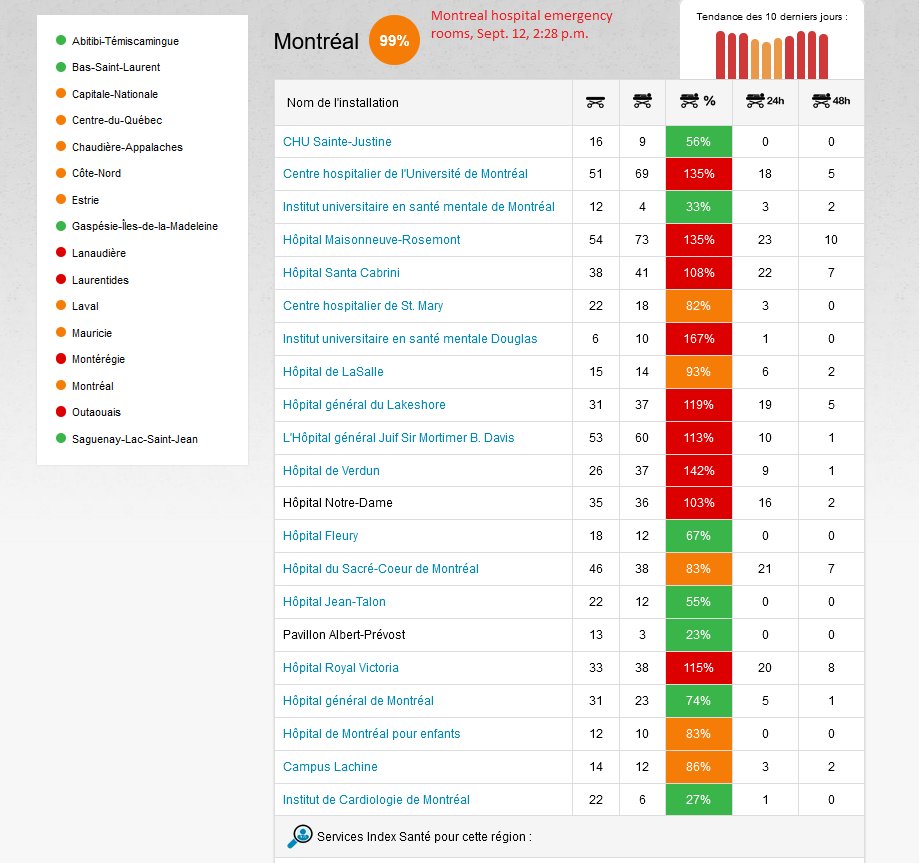
5) During the first wave, schools were closed, and people were afraid to go to hospital emergency rooms, resulting in an eerie quiet in ERs. Now schools have reopened, overcrowding has returned to ERs and thousands of nurses are burned out, 800 quitting in Montreal.
6) Quebec posted 244 cases Saturday (compared with 232 in Ontario), and likely the highest in the country. The province’s rolling seven-day average inched up to 23.83 #COVID cases per million inhabitants, up from 22.68 on Friday. The province is monitoring seven regions closely.

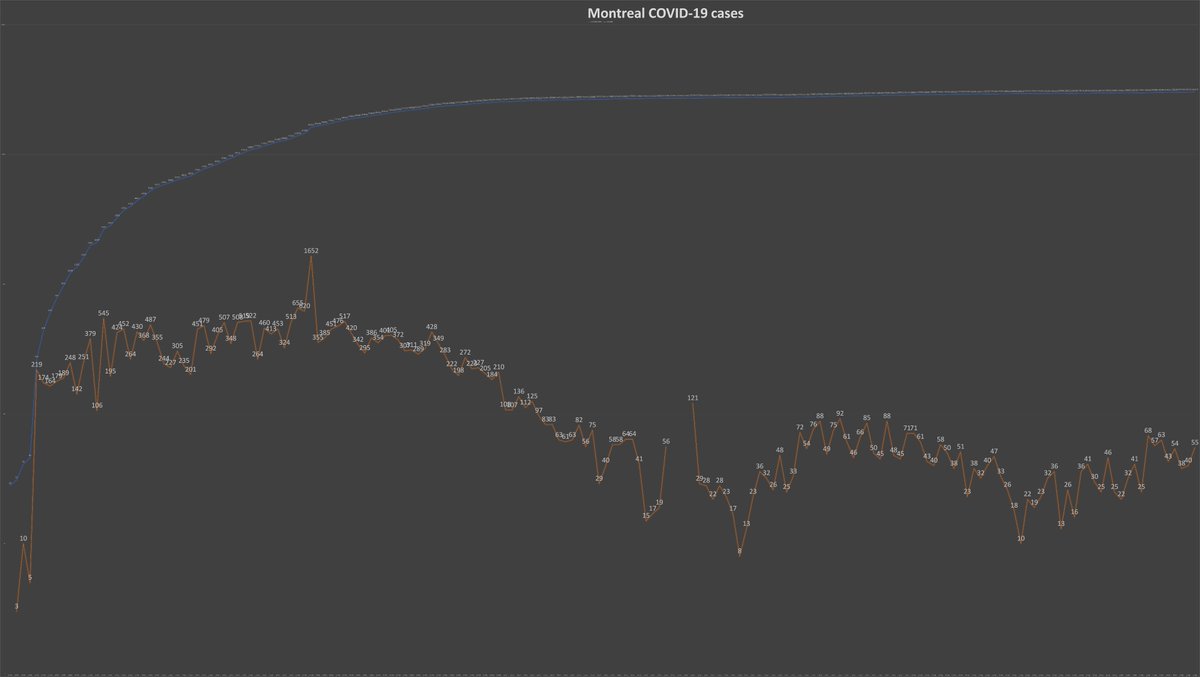
7) Montreal posted 55 cases Saturday, up from 40 the day before, amid record testing. See the chart below. The city’s rolling average was 24.39 #COVID cases per million population, slightly down from 25.3 the day before. Montreal is likely to be coded a yellow-risk zone Monday.
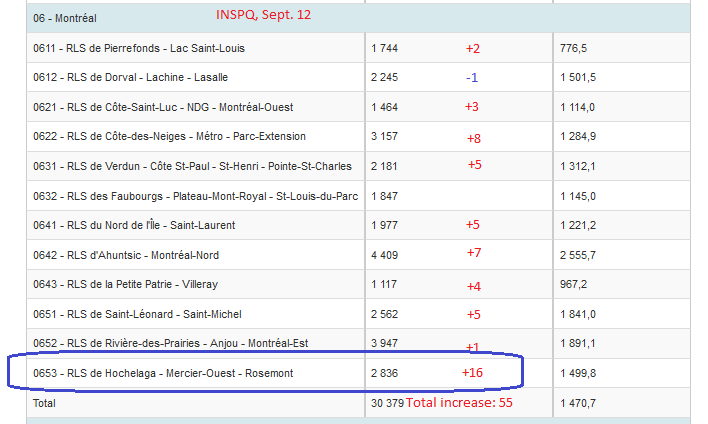
8) At the neighborhood level, densely populated Hochelaga-Maisonneuve, Mercier-Ouest and Rosemont counted a combined total of 16 cases, the highest by far in the metropolis, as the chart below makes clear. The spike is being driven by community transmission of the #coronavirus.
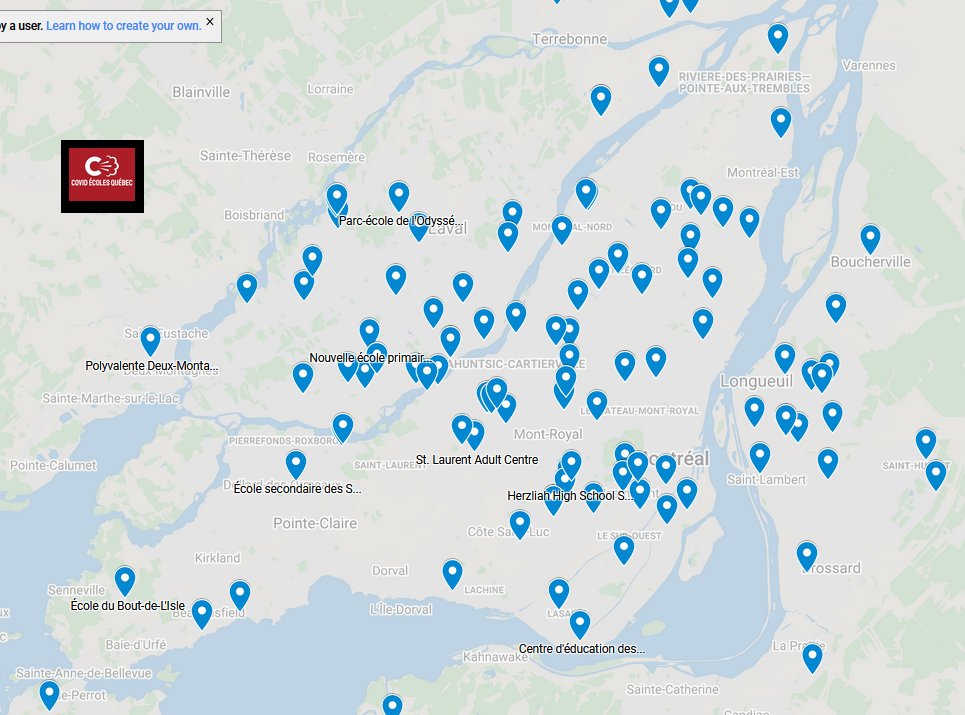
9) The number of Montreal schools where at least one teacher or student has tested positive increased to 60 Saturday from 57 the day before. Authorities have officially confirmed two school outbreaks, but I’ve been informed of a third unofficially. See the map below.
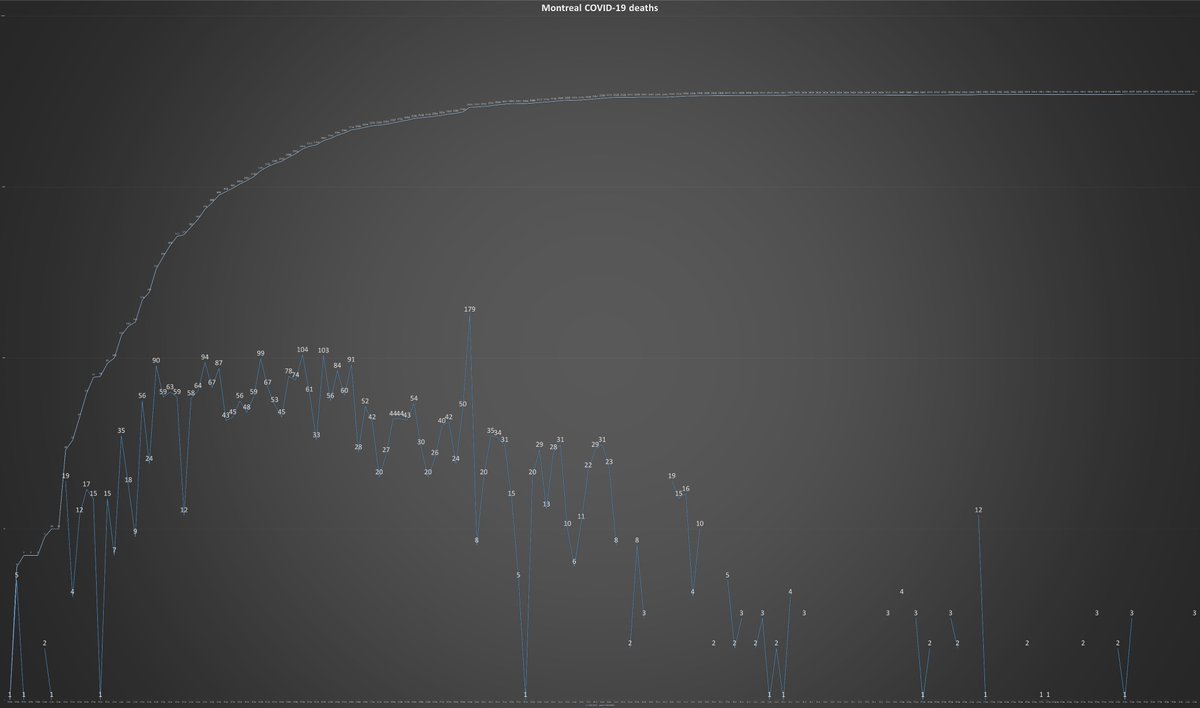
10) After not declaring any #COVID19 fatalities for eight days, Montreal added three ones retroactively to its death toll, which now stands at 3,477, higher than those of the nations of Ukraine (3,148), Japan (1,412), Portugal (1,860) or Guatemala (2,929).
11) Montreal’s #COVID cases numbers are still far below those in the 600-plus range during the peak of the first wave. But for a fourth day in a row, Quebec has been reporting net increases in hospitalizations. The total stands at 125, up from 94 on Sept. 4.
12) Is the uptick in hospitalizations a trend? It’s still too early to tell. But the resurgence across Quebec calls for the imposition of new restrictions, not just more monitoring. Yet on Monday, Quebec will permit after-school sports between classes. End of thread. Stay safe.
• • •
Missing some Tweet in this thread? You can try to
force a refresh

1) BREAKING: Santé Québec has authorized 246 doctors' requests since April to become "non-participants" of the medicare system — and thus legally allowed to charge patients from hundreds to tens of thousands of dollars for services. See my exposé below. montrealgazette.com/news/health/ar…
2) This accelerated exodus of doctors from the public system to private-for-profit side comes despite the Coalition Avenir Québec government adopting Law 83 last April to try to reverse this trend. But as my investigation shows, it appears that the law still has a huge loophole.
3) That's because Santé Québec was actually given the power to let doctors opt out of medicare. Supporters of medicare are truly dismayed that the new Crown corporation that is in charge of health care in the province has let so many doctors go fully private in so short a period.
1) BREAKING EXCLUSIVE: Record numbers of Quebec heart patients are dying while waiting for their surgery. This crisis has become exacerbated as the newly-created Santé Québec and the provincial health ministry squabble over jurisdiction. My exposé below.👇 montrealgazette.com/news/health/ar…
2) Yet the health ministry appears to be downplaying this crisis, claiming hearts surgeons' warnings amount to a bargaining tactic. The facts show the problem has been growing worse. Nearly two-thirds of heart patients now wait past medically acceptable delays. See below. 👇
3) As the orange line in the chart below indicates, the number of cardiac patients waiting beyond medically acceptable delays is rising, and the blue line shows the number undergoing life-saving operations on time is declining. The chilling result: more and more sudden deaths.
1) Author @GadSaad, who has taken an unpaid leave from Concordia University, has just written this commentary in the New York Post, headlined: "How Montreal became the antisemitism capital of North America." Here are my thoughts on this topic.
2) Obviously, it's debatable as to whether Montreal is indeed the antisemitism capital of the continent. As many Jews are painfully aware, antisemitism sadly exists everywhere. But recent events in Montreal have caused many Jews here to feel unsafe. montrealgazette.com/news/local-new…
3) A friend just sent this text: "Recently, several of my Jewish friends - lifelong Montrealers - have made the difficult decision to leave the city. They’re not leaving for better opportunities or a change of scenery, but because they and their children no longer feel safe...+"
1) BREAKING: The lengthy #COVID19 summer wave is continuing unabated in Quebec, along with other parts of North America and even around the world. Here in Quebec, it has been associated directly and indirectly with 1,100 hospitalizations for the past 12 days in a row.
2) As you can glimpse from the chart below, the #COVID testing positivity rate in Quebec was 20.9 per cent as of Aug. 11, the most recent date available. The trend line suggests the positivity rate has yet to peak.
3) Although nowhere near as fatal as it was back in 2020 (when vaccination was unavailable), #COVID this year has nonetheless been linked to 675 deaths, 38.7 per cent of which have occurred in octogenarians. But 30 Quebecers in their 50s have also died from #COVID in 2023-2024.
1) On Tuesday, the Quebec government unveiled its 2024-2025 budget, with the biggest expenditure to be made on health and social services. In this Twitter thread, I assess whether this "Health/Education Priorities" budget lives up to its hype, especially when it comes to seniors.
2) As you can see from the chart below, the lion's share of spending in the budget is for health and social services, pegged at $61.9 billion — up by 4.17% from the year before. In contrast, spending on education — so vital to Quebec's future — will rise 9.35% to $22.3 billion.
3) But as far as health and social services is concerned, Tuesday's budget may be indulging in a bit of spin. The chart below states that Quebec will spend an extra $3.7 billion over the next five years to "support a humane and effective organization of health care."
1) "The pandemic is far from over," one of the preeminent experts on #COVID19, Dr. Eric Topol, declared today, Jan. 4, 2024 — three years after the world first learned of a novel virus that was killing people in China. In this thread, I take stock of what's going on in Quebec.
2) "The pandemic is far from over, as evidenced by the rapid rise to global dominance of the JN.1 variant of SARS-CoV-2," Topol noted in a Los Angeles Times op-ed. In Quebec, nearly one in two genetic samples collected was from JN.1 as of two weeks ago. It's likely higher now.
3) "Clearly this virus variant, with its plethora of new mutations, has continued its evolution ... for infecting or reinfecting us," Topol added. Although the updated booster is considered 60% protective against hospitalization, only 17% of the Quebec population has taken it.