If actions match these words, this #SFT will be a historic step forward in Canadian social policy in several key areas: childcare, disability GIS, pharmacare, and a new EI system. All ambitious, and necessary. #BuildBackBetter#cdnpoli ...2
Somewhat reminiscent of Pearson's minority governments in the mid-60s, which brought in CPP, medicare, and the Canada Assistance Plan. Minority government can work well! ...3
Conservatives' predictable rant on deficits & debt will go nowhere, esp. as Canadians are losing sleep over COVD 2nd wave & continuing recession (not debt bogeymen). And CPC won't whisper about what they'd cut for a smaller deficit: they know that would be the end of them. #SFT
One important thing missing from #SFT: fulfilling Libs' promise to implement a $15 / hour minimum wage in the federal sector. Was supposed to happen this year. It is an important step, would reinforce provincial min wage goals, and doesn't cost govt much at all. ...
Perhaps that is another item for @theJagmeetSingh to raise in his discussions over the next week??
• • •
Missing some Tweet in this thread? You can try to
force a refresh

PSA: When the price of gasoline jumps this week, remember it was refined from oil (mostly Canadian) produced weeks ago, only ~2% of which came from the Middle East. It's a policy choice, not 'market forces', that explains why you'll pay more (and oil profits will soar). /2
We've seen this movie before: Feb 2022, Russia invades Ukraine (a country that doesn't produce oil), oil prices jump 65%--biggest single cause of the resulting inflation spike (that peaked at 8% in June in Canada). That cost Canadians $200b over next 3yrs ($12K per household). /3
That war had no impact on real oil supply; the price spike was driven purely by financial speculation on futures markets. Oil profits set records, but the rest of us paid for it: higher direct and indirect prices, higher interest rates, disemployment. /4
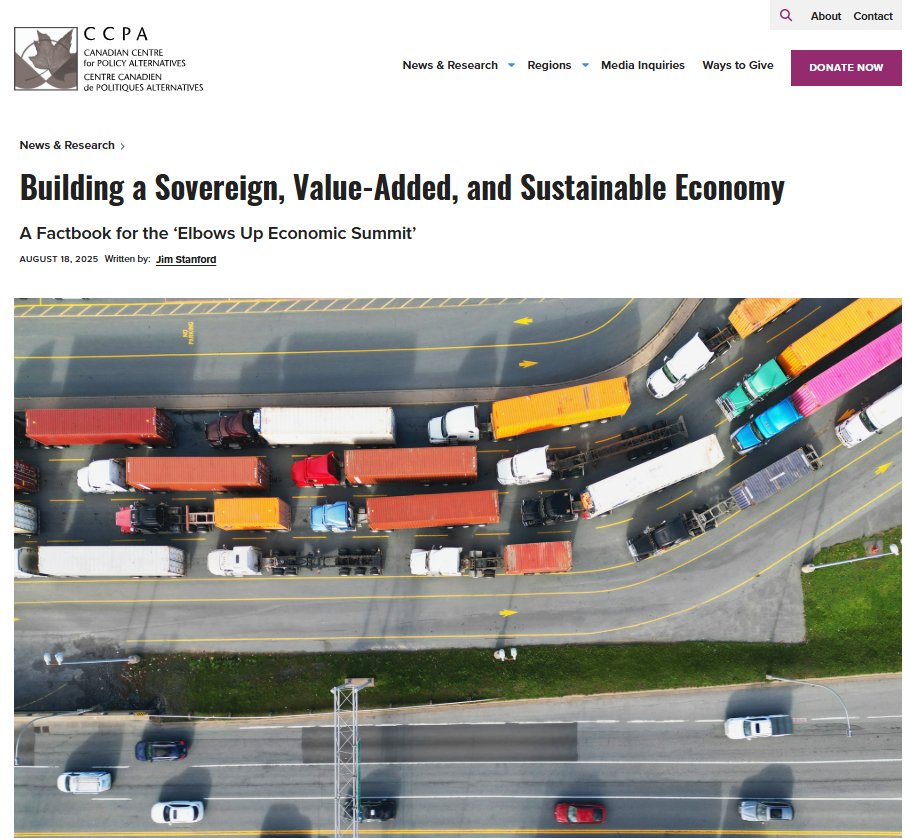
In this existential 'Elbows Up' moment for Canada's economy, public discourse has been overly influenced by loud demands from corporations & their political backers to implement their age-old agenda: deregulate (especially environmental rules), cut taxes, build more pipelines. /2
That agenda will definitely NOT build a Canada that is more self-reliant, sovereign, and sustainable. To achieve genuine economic independence we need a holistic strategy to maximize the potential of our people, our skills, ALL our natural resources, and our social capital. /3
To broaden the discourse over Canada's economic strategy under Trump, @ccpa and @futurework_cda have released a new 'Factbook'. See it at . #canlab /4 policyalternatives.ca/news-research/…
Just in time for Prime Minister Carney's meeting with Donald Trump, I have analyzed new U.S. Census Bureau data on bilateral Canada-U.S. trade (now including full-year 2024 results). Full analysis here: . #cdnecon #cdnpoli /2progressive-economics.ca/2025/05/latest…
The U.S. bilateral trade deficit with Canada shrank 12% in 2024, to just $35.7b (U.S.). That's a small fraction of the inflated numbers ("$100 billion, $200 billion, $300 billion") that Trump just makes up. /3
Relative to U.S. GDP, which has been growing quickly in nominal terms, that bilateral deficit has been halved since 2022 (largely due to lower oil prices), falling to 0.12% in 2024. Even the U.S. global deficit is a much smaller share of GDP (3.1% in 2024) than in the 2000s. /4
Certain partisans have been citing Canada's performance on per capita GDP as evidence of a supposed 'lost decade' and economic mismanagement. In @IRPP Policy Options, I deconstruct this arbitrary and misleading statistic, in two parts. #cdnecon #cdnpoli /2
Part I: The numerator of 🇨🇦's per capita GDP has done reasonably well: 2nd best GDP growth in the G7 over the last decade. The denominator (population) has grown unusually fast (esp. since 2021), and that is what has suppressed the value of the ratio. /3policyoptions.irpp.org/magazines/apri…
I also show flaws in the methodology of calculating per capita GDP. The world leaders in per capita GDP are all tax havens: that's phony. In Canada, Newfoundland & Labrador has above-avg per capita GDP (hence no equalization) despite lower personal incomes. A flawed measure! /4
Mr. Poilievre is resuscitating COVID-era arguments that inflation is a 'tax' (caused by Justin Trudeau's deficits and Tiff Macklem's ATM), and that he can 'cancel the tax' with federal spending cuts. Here are the top 4 reasons his economics are all wrong: #cdnecon #cdnpoli /2
1. International Comparisons: Post-COVID inflation was a global phenomenon, affecting almost all countries, with no correlation to deficits or government spending. Canada's inflation since 2019 has been relatively mild, well below the US and the OECD average. /3
2. Timing: The federal deficit (huge during COVID lockdowns) was approaching balance (in national accounts terms, which is what matters for macroeconomics) by the time inflation accelerated in latter 2021 and 2022. Purported 'excess demand' from CERB benefits was long gone. /4
Crude oil prices are down $14/b (20%) in the last week. Apart from acute embarrassment for Danielle Smith (who called Trump's tariffs last week a "big win for Alberta & Canada"), there's an important lesson to be learned here about how crude oil futures markets work. #cdnecon /2
This thread draws on analysis of oil futures markets from @futurework_cda's recent report, "Counting the Costs": . It computes the costs of the 2022 oil price spike: directly & indirectly it cost the average Canadian household $12,000 over 3 years. /3 falseprofits.ca/reports
Prices for various specific crudes are set in relation to key benchmarks (mostly WTI & Brent) which are set on futures markets. Futures markets are financial markets. They don't trade in oil; they trade in contracts which are promises to deliver oil at some time in the future. /4