.@jacob_feldgoise & I have a new deep dive into 📊 on Chinese STEM students in the US: cset.georgetown.edu/research/estim…
Sadly, despite how prominent debates about Chinese students are today, there’s little good data on even basic questions — and lots of misperceptions.
* thread * [1/x]
Sadly, despite how prominent debates about Chinese students are today, there’s little good data on even basic questions — and lots of misperceptions.
* thread * [1/x]
We asked two basic questions:
(1) How many Chinese STEM students are there across degree levels and fields (e.g. how many in CS master's programs)?
(2) What % of total US students in STEM programs are Chinese, across these degree levels and fields? [2/x]
(1) How many Chinese STEM students are there across degree levels and fields (e.g. how many in CS master's programs)?
(2) What % of total US students in STEM programs are Chinese, across these degree levels and fields? [2/x]
Our first takeaway was that answering these questions is much more difficult than it should be.
Because the US government does not have a centralized database on both domestic and int'l students, we had to use 4 different sources in our analysis. [3/x]
Because the US government does not have a centralized database on both domestic and int'l students, we had to use 4 different sources in our analysis. [3/x]
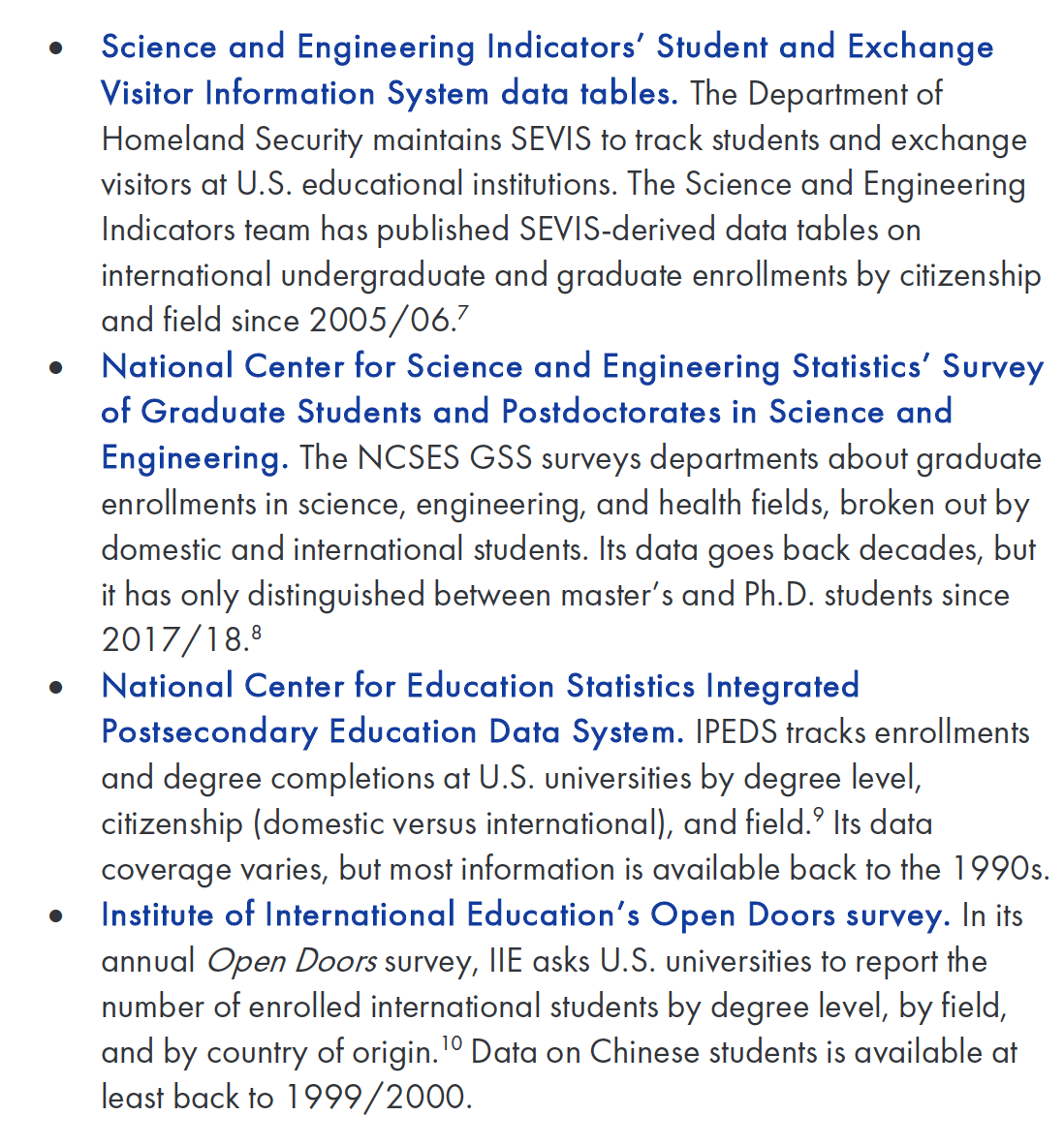
And there are gaps even across those 4 sources. We only had data going back two years (to 2018) and had to make some assumptions to produce our estimates. The assumptions we made are supported by research, but making assumptions shouldn't even be necessary here. [4/x]
So — /datarant — what did we find?
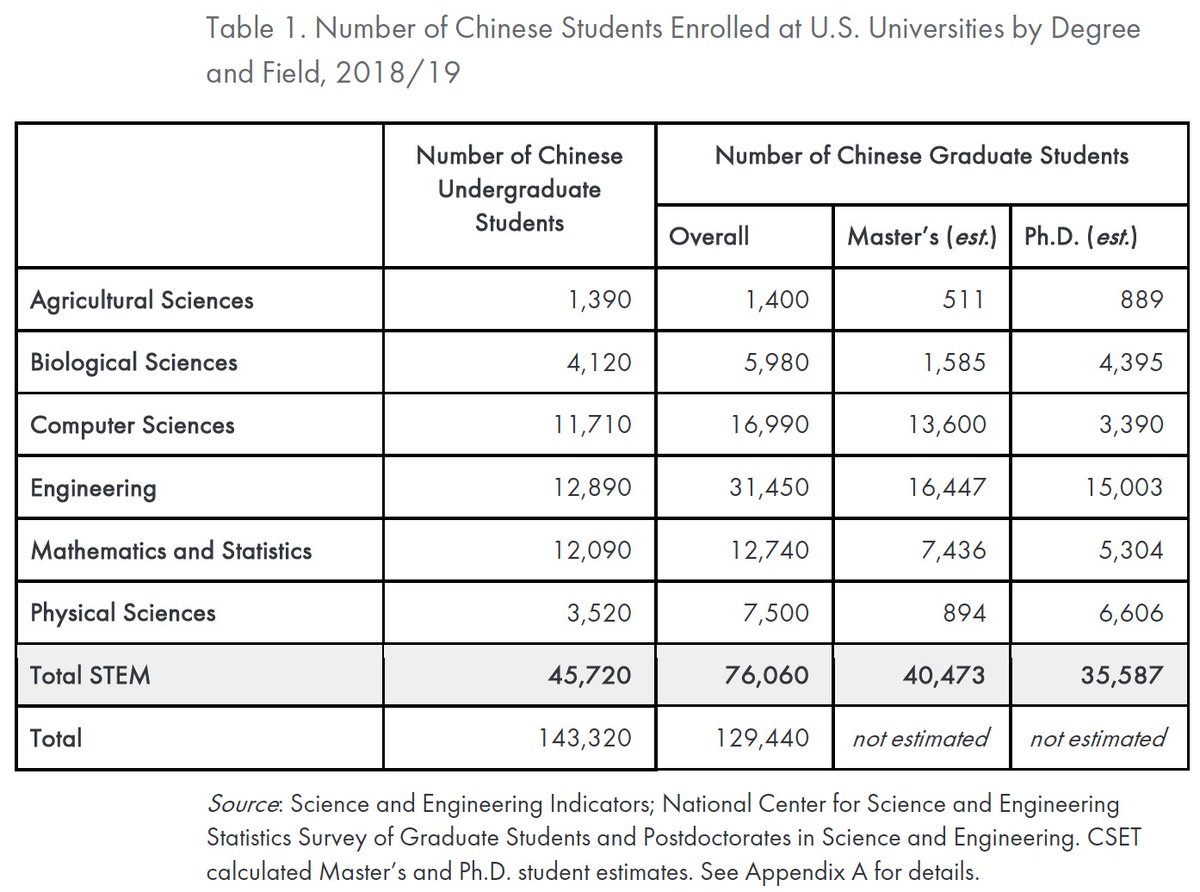
(1) There are ~45K Chinese STEM undergrads.
(2) There are 76K Chinese STEM grad students, of whom we estimate 40K are in master's and 36K are in PhD programs.
(3) CS, Engineering, and Math+Stats are the most popular fields.
[5/x]
(1) There are ~45K Chinese STEM undergrads.
(2) There are 76K Chinese STEM grad students, of whom we estimate 40K are in master's and 36K are in PhD programs.
(3) CS, Engineering, and Math+Stats are the most popular fields.
[5/x]
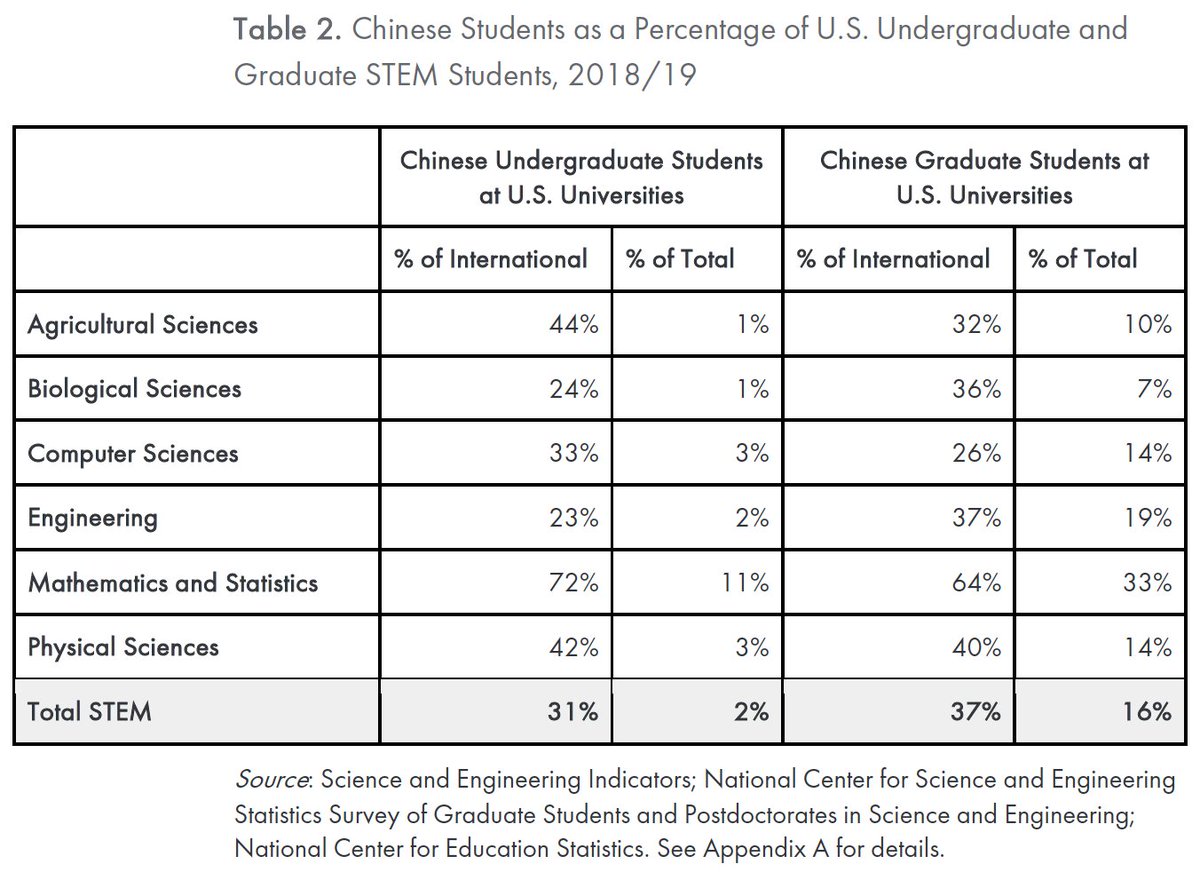
And when we compared these #’s against US totals, we found Chinese students make up:
(1) about 2% of all US STEM undergrads
(2) about 16% of all US STEM grad students
Those numbers are different from what past USG studies have said and what lots of people think. [6/x]
(1) about 2% of all US STEM undergrads
(2) about 16% of all US STEM grad students
Those numbers are different from what past USG studies have said and what lots of people think. [6/x]
In a prominent 2018 paper, DIUx (now DIU) said that 25% of US STEM grad students were Chinese, and implied that 15% of undergrads were.
We found those numbers were off: as noted above, they're 16% (not 25%) and 2% (not 15%) respectively. [7/x]
admin.govexec.com/media/diux_chi…
We found those numbers were off: as noted above, they're 16% (not 25%) and 2% (not 15%) respectively. [7/x]
admin.govexec.com/media/diux_chi…

The differences appear to be due to misreading of secondary sources. For example, the DIU claim that 45% of undergrads in STEM are foreign cited to a source that actually said 45% of int'l undergrads are in STEM.
In reality, only 7% of STEM undergrads are int'l students: [8/x]
In reality, only 7% of STEM undergrads are int'l students: [8/x]


Back when we first got our results, we also did a little informal Twitterverse poll on the undergrad numbers.
A plurality were right, but nearly half of the ~100 responses said Chinese students made up 16%+ of all US STEM undergrads, compared to the actual answer of 2%. [9/x]
A plurality were right, but nearly half of the ~100 responses said Chinese students made up 16%+ of all US STEM undergrads, compared to the actual answer of 2%. [9/x]

None of this translates straightforwardly into some kind of policy takeaway (except: improve USG data pls!).
But we *do* think this data is important to policy analysis. Which makes it all the more unfortunate that we've lacked consensus on even these simple #'s. [10/x]
But we *do* think this data is important to policy analysis. Which makes it all the more unfortunate that we've lacked consensus on even these simple #'s. [10/x]
We actually started the paper as a side project b/c I needed this data to analyze Chinese student stay rates, $ implications of int'l enrollments for US universities, etc., and I was confused that we couldn't find it anywhere. Hopefully we've saved others some time! [11/x]
Check out the paper itself for an extensive discussion methodology and data sources and gaps (for future analysts working on this topic) and for background trend data on Chinese STEM enrollments: cset.georgetown.edu/research/estim…
[12/x]
[12/x]
Thanks to @jacob_feldgoise for being an awesome co-author and analyst, to many @CSETGeorgetown colleagues for their input and editing help, and to @jnbaer, Josh Trapani, Michael Brown, and Pav Singh for their data assistance and reviews! [13/13]
Guessing this may be interesting to: @rorytruex @mattsheehan88 @ericfish85 @ElizRedden @karinfischer @dwertime @EmilyZFeng @Kate_OKeeffe @yingyi_ma @MaraHvistendahl @GWilliamThomas @jjding99 @jessicacweiss @BethanyAllenEbr @jordanschnyc @EBKania
• • •
Missing some Tweet in this thread? You can try to
force a refresh