

Just finished up @RoamResearch notes on "Working in Public" by @nayafia and corresponding Anki deck. Here's a thread of my favourite insights as well as links to my notes / Anki deck 👇 #roamcult 


[[Nadia Eghbal]] examines how [[Open Source] works today, how it has evolved over time, and where it may be headed. Although it's specifically about open source on the surface, much of it applies to all [[online content creation]] and [[online creators]]. Big themes include...
1. Creator attention as a [[common pool resource]] that must be protected through [[curation]] and filtering, rather than blindly encouraging more open participation.
2. Key [[open source contributions]] coming from a small number of very important creators / maintainers, rather than a large community.
3. Trends toward [[modularity]] of code and other online content.
4. Increased importance of [[curation]] for creators as the key problem to solve as they grow.
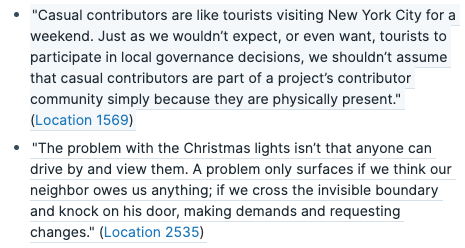
5. The extractive nature of many activities masked as "contributions", such as low-quality comments, questions, [[feature requests]], or [[pull requests]] **that consume the limited** [[attention]] of creators. #[[extractive contributions]] #[[casual contributors]]
6. Trends toward following creators themselves rather than particular artifacts (e.g. code repositories) produced by creators.
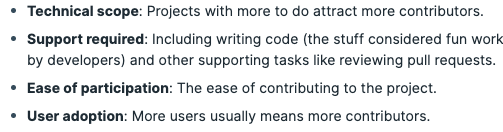
Nadia also expounds a valuable nomenclature for talking about open source and online content. I particularly liked her categorization of open-source projects based on the ratio of contributors to users
The book is also filled with lots of interesting stories and quotes from open-source developers. Highly recommended.
Here are my @RoamResearch notes, that you can easily copy and paste into your personal Roam database.
marknagelberg.com/roam-notes-on-…
marknagelberg.com/roam-notes-on-…
The notes are optimized for Kindle, as you can click on the Location links and it should bring you to the relevant location in the book. The print version of the book is beautiful, so buy both!
amzn.to/3fjViJI
amzn.to/3fjViJI
Thank you @nayafia for the great resource! cc @stripepress
By the way, if you're interested in the method I use for note taking and spaced repetition, here is a summary - I use the "Triple Pass Method"
marknagelberg.com/the-triple-pas…
marknagelberg.com/the-triple-pas…
• • •
Missing some Tweet in this thread? You can try to
force a refresh


