Ok, so here is a short thread on what this data really shows which is:
1. We are now making steady (but still slow) progress on ACM remediation ONLY 2. The wider problem of building safety won't be solved until there's up front funding
So first, what do these numbers relate to? We're talking here about ACM cladding (the material on Grenfell) on towers above 18m only. That constitutes 462 buildings. And 216 of them (46%) have now been remediated.
This is a TINY FRACTION of the building safety crisis which incorporates an estimated 2,500 buildings over 18m of other types and an as-yet-uncounted number of medium rise buildings. Govt doesn't even record stats showing progress on these.
Even with this, you could spin these stats as saying "less than half of buildings with Grenfell-style cladding remediated three and a half years after fire". But unsurprisingly, MHCLG has picked a different line.
Of the 462, 156 are social housing towers and 54 are student housing. These are the easiest to fix because you (should) have a professional building manager and there's been public funding available since May 2018.
The government's brag is that the last two social housing blocks and the last one student block STARTED work in December meaning all are now onsite. That's obviously good, but does the beg the question as to why they've waited 3.5 years from a fire which killed 72 people.
Of the 214 private buildings, we have 64 complete, 112 onsite and 38 yet to start. Again, the line could easily be "less than a third complete", but government is keen to not to emphasise this point. Bear in mind, their completion target for all these buildings was June 2020.
What the stats clearly do show is (finally) some forward momentum. 75 buildings completed in the year and 159 got onsite. This is good news and shows an end may finally be in sight for this subsection of the building safety crisis. BUT...
... the reason for the forward momentum is that this is first full year when we've had public funding in place for all buildings that needed it. What these stats prove is that you CAN get the process moving but only when you provide the finance up front.
Government initially refused to put any central govt funding into removing ACM cladding until Grenfell United pushed them into releasing £400m for social housing in May 2018, and cladding campaigners pressured them to release £200m for private housing in May 2019
Before this point, progress was basically stalled. Ministers were calling on buildings owners to "do the right thing" and building owners were threatening to pass costs to leaseholders. Sound familiar?
So really, we see from this that steady cladding remediation is possible (with careful management) once the funding question is resolved. I would suggest that should be a lesson for the government, not a brag.
I'd add to this that the govt say they have focused on ACM because it poses a unique risk. All I'll say for now is this is something you can only say if you close your eyes to several inconvenient facts, but it would take another 20 tweets to explain properly.
• • •
Missing some Tweet in this thread? You can try to
force a refresh
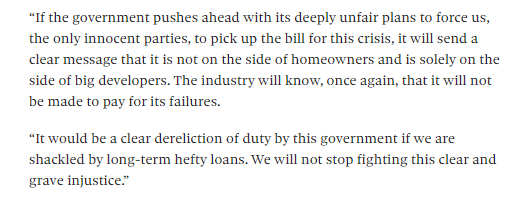
I am hearing an increasing volume of whispers that an announcement of #CladdingTax forced loans to leaseholders to pay for remediation work is imminent.
This is what the End Our Cladding Scandal campaign said when the proposal was first mooted
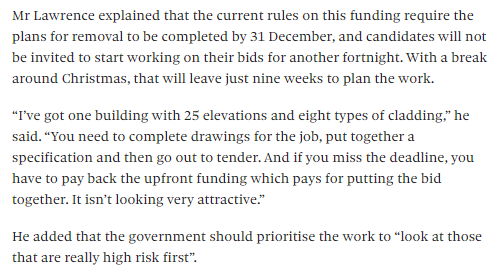
Background: govt advisor Michael Wade has designed a proposal that would see long-term loans offered to freeholders to pay for remediation work. Repayment costs would then be passed down through service charges to leaseholders who would have no choice insidehousing.co.uk/news/news/gove…
Govt has not formally adopted the proposal but has said it is "considering a range of options" (including this one). Loans would be long-term (30 years) and the plan would be to use a state guarantee to limit the interest costs.
Six people (inc three children) died in a fire at Lakanal House in 2009, amid serious internal and external building failures.
Marie Curie, its neighbouring block is built to the same design. Residents were alarmed before Christmas when a 'waking watch' was imposed.
The January 2020 risk assessment shows the assessor discovered panels which comprise 50% of the facade were made of a combination of aluminium and combustible phenolic foam. They do not comply with regs and had been approved by a 'desktop study'
There's quite a lot to unpack with this story, but let's start with inquiry chair Sir Martin Moore-Bick's recommendations in his report in October 2019.
Having heard months of evidence about the difficulties people (including those with disabilities) had evacuating, he said...
- All disabled residents of high rises should be offered a personal emergency evacuation plan (PEEP)
- All high rises should have a 'plan b' evacuation plan developed
- Blocks should be fitted with devices to enable fire service to send an evacuation signal to all or part
But when a government consultation on implementation came out in July this year, it rowed back substantially. Alarms were kicked into the long grass, the evacuation plan could be a 'stay put' strategy and PEEPs should only be provided in buildings with known dangerous cladding
New: Government sought to water down Grenfell Inquiry recommendations for the evacuation of disabled people after industry lobbyists called them "costly" and "impracticable", new documents reveal
This being misunderstood by people due to the wording of the top tweet, so just to be clear:
- The recommendations made by the inquiry were not interfered with by govt or industry
- But Home Office sought to reinterpret and limit their impact when it came to implementation
Government has announced a £30m Waking Watch Relief Fund top open in January, intended to help fund the installation of fire alarms in blocks with dangerous cladding
- Deadlines for applications to Building Safety Fund pushed back to June, which will be welcome relief for many who were struggling. This deadline has looked tough for some time, as we reported in October:
On the alarms funding, recent quotes I saw put it at a range of £123,000 for a block of 50 flats, to £19,500 for block of 15. So a very loose estimate would say this would cover full costs on 250 large buildings, 1,500 small ones, or a proportion of the work on a greater number
New: Key witnesses from Grenfell cladding company Arconic confirm they will continue to refuse to attend despite an assurance from the French government that French laws should not stop them
- French embassy wrote to British Foreign Office on December 7 confirming they do not believe an arcane law known as the 'French blocking statute' should prevent witnesses attending. Inquiry forwarded this note to witnesses lawyers on December 9
- But today letter from the inquiry to participants confirmed two of the four have said they will continue to refuse to give evidence. One more has asked for conditions which the inquiry is considering, and the fourth is yet to make up his mind