

"I really want to start a side hustle / become a creator / earn income online... But first I need to learn more about [topic]... Then I need to research the best tools... And I'm really busy right now, so I'll start later when things calm down."
Sound familiar? 🧵👇
Sound familiar? 🧵👇
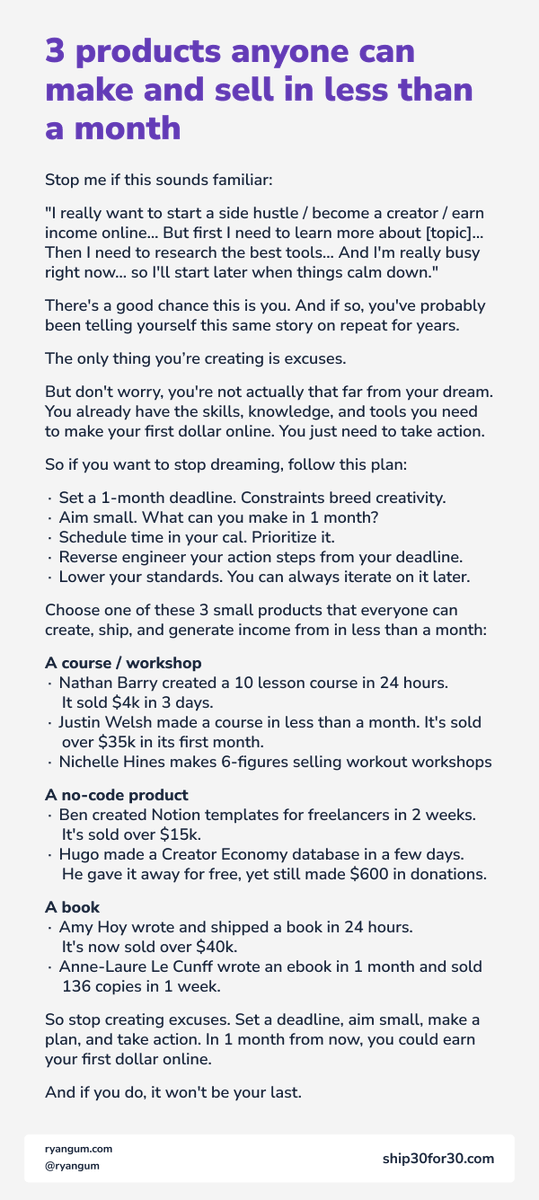
There's a good chance this is you. And if so, you've probably been telling yourself this same story on repeat for years.
The only thing you're creating is excuses.
The only thing you're creating is excuses.
But don't worry, you're not actually that far from your dream. You already have the skills, knowledge, and tools you need to make your first dollar online. You just need to take action.
So if you want to stop dreaming, follow this plan:
So if you want to stop dreaming, follow this plan:
∙ Set a 1-month deadline. Constraints breed creativity.
∙ Aim small. What can you make in 1 month?
∙ Schedule time in your calendar. Prioritize it.
∙ Reverse engineer your action steps from your deadline.
∙ Lower your standards. You can always iterate on it later.
∙ Aim small. What can you make in 1 month?
∙ Schedule time in your calendar. Prioritize it.
∙ Reverse engineer your action steps from your deadline.
∙ Lower your standards. You can always iterate on it later.
Choose one of these 3 small products that everyone can create, ship, and generate income from in less than a month:
🎥 A course / workshop
∙ @nathanbarry created a 10 lesson course in 24 hours. It sold over $4k in 3 days.
∙ @JustinSaaS made a course in less than a month. It's sold over $35k in its first month.
∙ Nichelle Hines makes 6-figures selling @LumaHQ workshops
∙ @nathanbarry created a 10 lesson course in 24 hours. It sold over $4k in 3 days.
∙ @JustinSaaS made a course in less than a month. It's sold over $35k in its first month.
∙ Nichelle Hines makes 6-figures selling @LumaHQ workshops
🤖 A no-code product
∙ @creative_ben created a Notion templates pack for freelancers in 2 weeks. It's sold over $15k.
∙ @HugoAmsellem made a Creator Economy database in a few days. He gave it away for free, yet still made $600 in donations.
∙ @creative_ben created a Notion templates pack for freelancers in 2 weeks. It's sold over $15k.
∙ @HugoAmsellem made a Creator Economy database in a few days. He gave it away for free, yet still made $600 in donations.
📖 A book
∙ @anthilemoon wrote an ebook in 1 month and sold 136 copies in 1 week.
∙ Amy Hoy wrote and shipped a book in 24 hours. It's now sold over $40k.
∙ @anthilemoon wrote an ebook in 1 month and sold 136 copies in 1 week.
∙ Amy Hoy wrote and shipped a book in 24 hours. It's now sold over $40k.
So stop creating excuses. Set a deadline, aim small, make a plan, and take action. In 1 month from now, you could earn your first dollar online.
And if you do, it won't be your last.
And if you do, it won't be your last.
Further reading / case studies from examples above:
- nathanbarry.com/24hours/
- gumroad.com/theofficialjus…
- lu.ma/jbgnld9n
- supercreative.design/download/notio…
- gumroad.com/l/creatorecono…
- medium.com/women-make/how…
- stackingthebricks.com/24-hour-produc…
- nathanbarry.com/24hours/
- gumroad.com/theofficialjus…
- lu.ma/jbgnld9n
- supercreative.design/download/notio…
- gumroad.com/l/creatorecono…
- medium.com/women-make/how…
- stackingthebricks.com/24-hour-produc…
If you enjoyed this thread and want to learn more about creators and the creator economy, follow @ryangum and subscribe to my newsletter: ryangum.com
• • •
Missing some Tweet in this thread? You can try to
force a refresh


