

Why aiming to control your own destiny can be a superpower for founders 💪🏽
An atomic essay on moonshots & escape velocity 🚀
An atomic essay on moonshots & escape velocity 🚀
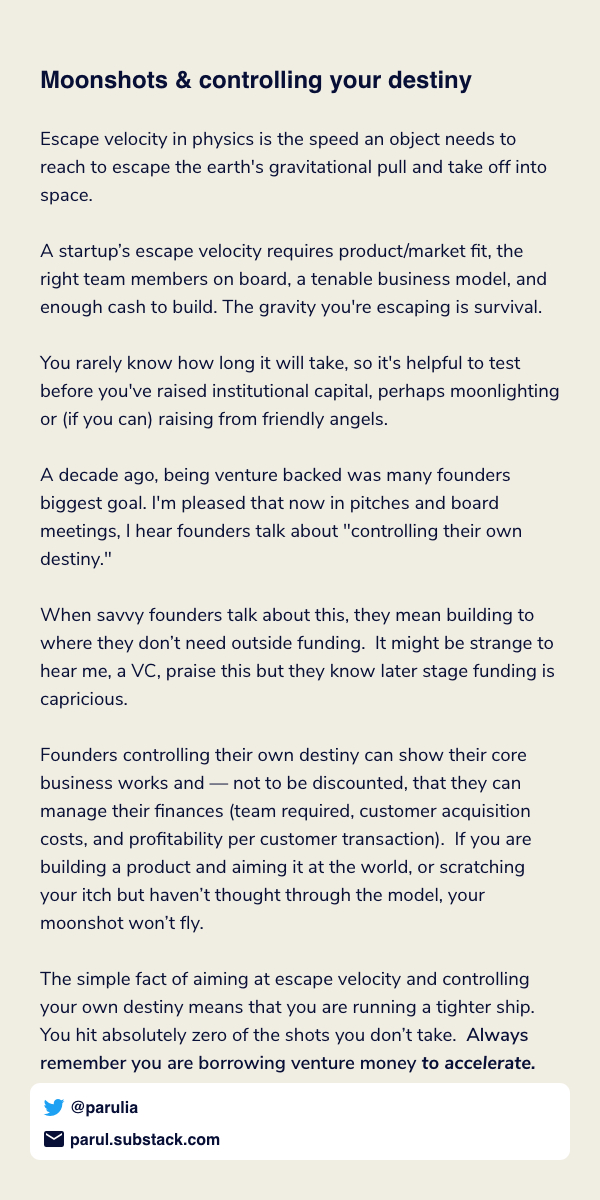
Escape velocity in physics is the speed an object needs to reach to escape the earth's gravitational pull, and take off into space.
Investors sometimes talk about a startup reaching escape velocity, which is the speed and milestones the team needs to reach before they can start accelerating.
Key components include having product/market fit and the right team members on board, finding a tenable business model, and enough cash to build.
Before acceleration = Survival
Before acceleration = Survival
TBH you never know how long it will take (esp de-risking P/M fit) and so second-time founders may initially stay under the radar and first raise from friendly angels — or moonlighting — before raising institutional capital (that's us).
You never used to hear it, but I’m thrilled now to hear many founders talk about “controlling their own destiny.” This is getting to the point where they don’t need outside capital.
Founders who control their own destiny know that their core business works:
💰 They can handle their finances
🔥 The team can build something customers want
🛒 Customer acquisition costs are known
💎 They have reasonable (even attractive) profitability per customer transaction
💰 They can handle their finances
🔥 The team can build something customers want
🛒 Customer acquisition costs are known
💎 They have reasonable (even attractive) profitability per customer transaction
These are important milestones.
Yes, we live in interesting funding times, but if you’re not building an audio social networking app 🎙 *controlling your own destiny* can be important leverage to raise money.
Yes, we live in interesting funding times, but if you’re not building an audio social networking app 🎙 *controlling your own destiny* can be important leverage to raise money.
Our best teams don’t NEED us for the basics of their businesses. Outside capital wants to help you *accelerate* 🏎
Escape velocity is being able to survive in flight. Don't be afraid to walk -> run -> fly 🚀
Escape velocity is being able to survive in flight. Don't be afraid to walk -> run -> fly 🚀
• • •
Missing some Tweet in this thread? You can try to
force a refresh


