"We need to see biological hazards as an existential threat to the 21st century in the same way that atomic science was to the 20th century” ft.com/content/e625f1…
"While chemical facilities are closely monitored by the Organisation for the Prohibition of Chemical Weapons, there is no such designated body to police biological labs."
"The biological weapons convention says you should adhere to these rules, you should follow these guidelines and if there's an accident, you should report it, but people have only paid lip service to that”
The WHO’s difficulties in establishing basic facts about safety and security at the Wuhan Institute for Virology “indicates that we do not have sufficient oversight over these facilities and the activities happening inside them”.
• • •
Missing some Tweet in this thread? You can try to
force a refresh
Dangerous Practices of Sovereign Science: "Little has been done to alter a pattern in which scientists decide for themselves what risky research is warranted, and confront controversy only after the work is done and disseminated." somatosphere.net/forumpost/dang…
“When outsiders have raised concerns, scientific experts have tended to dismiss them as expressions of ignorance. Ambivalence from within science tends to be suppressed lest it imply to outsiders that science cannot adequately regulate itself.”
"Was the virus that has wrecked such damage on humanity brought into being upon a laboratory bench? The simple fact of the matter is, the established norms of international scientific make this scenario plausible."
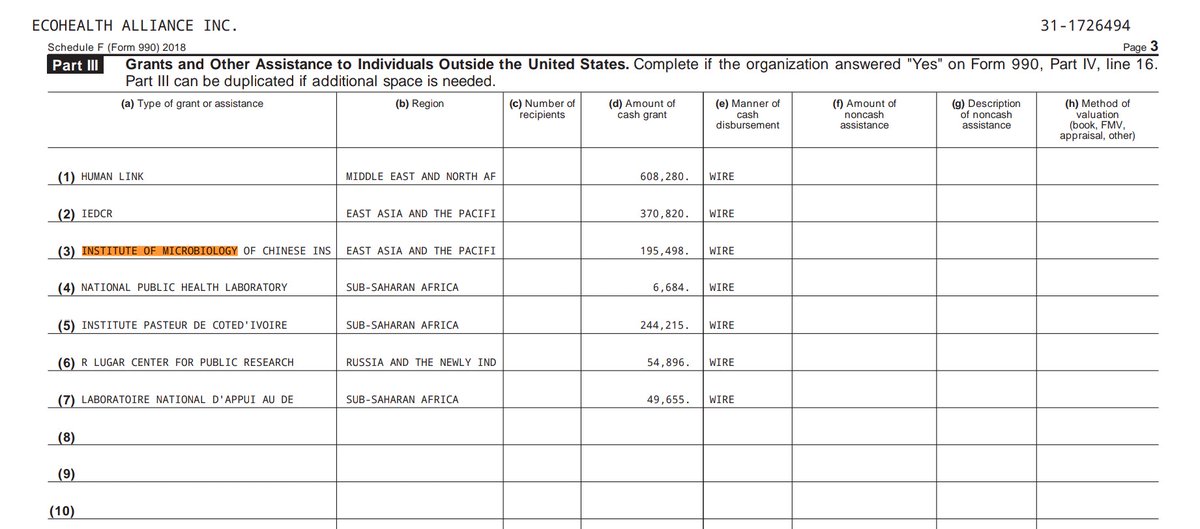
In 2019, EcoHealth Alliance, for the first time, made a wire transfer of $195K to the Institute of Microbiology, CAS.
It's the same institute which was leading the CAS Special Project "Pathogen Host Adaptation and Immune Intervention". ecohealthalliance.org/wp-content/upl…
"To the puzzlement of some overseas experts, China’s authorities seemingly failed to follow up with this testing in supply routes (for animals sold in Wuhan market) leading back to farms and animal breeders in certain regions of the country."
"I was a bit surprised that this work that you would expect to be done hasn’t been done" said @YanzhongHuang.
Daniel Lucey of Georgetown University in Washington said it was “frankly implausible” that such testing had not been done.
What more surprising is why some experts still believe the wet market theory holds up, when the earliest cases weren't even directly linked to the market, and China CDC itself abandoned the market origin theory.
The number, and genetic sequencing, of the first cases identified by China suggest coronavirus was spreading before early December 2019. wsj.com/articles/covid…
"Many of the 174 cases had no known connection to the market that was initially considered the source of the outbreak, according to information gathered by WHO investigators" archive.is/jgylx
"In examining 13 genetic sequences of the virus from December, Chinese authorities found similar sequences among those linked to the market, but slight differences in those of people without any link to it, according to the WHO investigators."
For those still following the sordid tale: It's more than a year, and there's no trail of the virus until it caused an outbreak in Wuhan. No precursor strains or intermediary host, earlier patients had no market connection, & none of the animal samples tested positive for SARS2.
In the mean time, the closest know virus to SARS-CoV-2 was traced to samples collected from a mineshaft, 1000 miles away from Wuhan, where 3 miners died in 2012.
Doctors who treated the miners concluded that their illness was "caused by a SARS-like coronavirus."
Shi Zhengli's team went on multiple expeditions to collect viruses from the mine. They were brought back, stored and studied in the Wuhan labs.
I can hardly imagine them missing out on new SARS-like pandemic viruses.