The best "real-world" mobile crash reporting resources I've found.
How do large/well-known mobile apps reduce their crash rates?
A thread.
How do large/well-known mobile apps reduce their crash rates?
A thread.
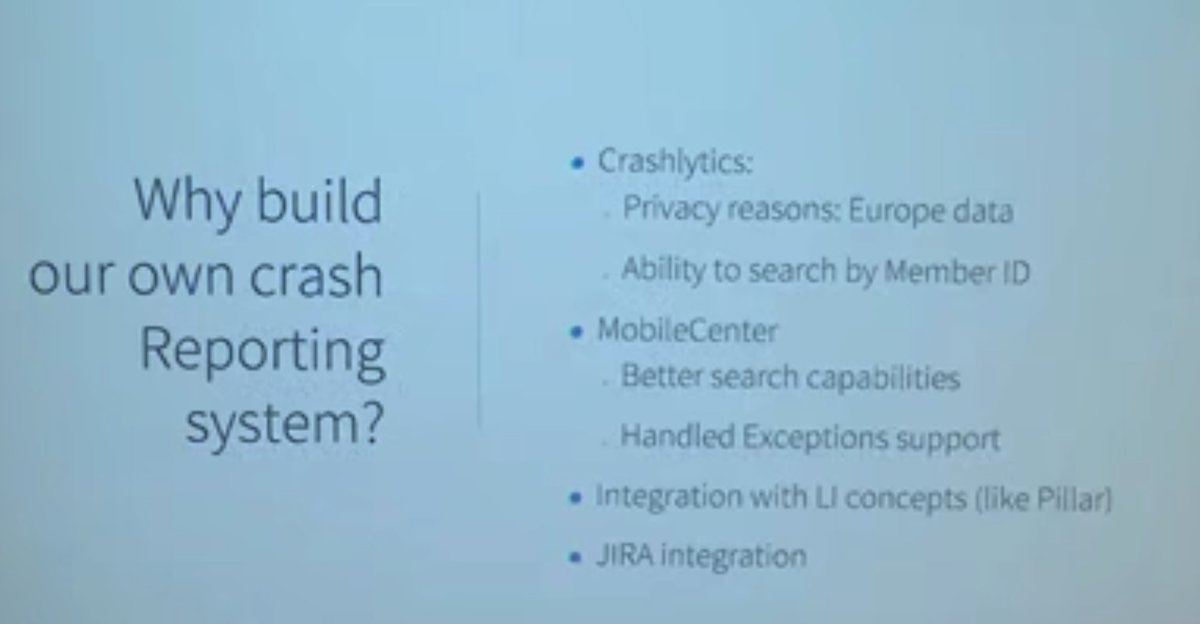
1. Mobile crash reporting at LinkedIn (engineering.linkedin.com/blog/2017/05/m…) and a video of their crash reporting pipeline ()
LinkedIn built their own crash reporting solution, and explain why they did it, and what benefits they saw.
LinkedIn built their own crash reporting solution, and explain why they did it, and what benefits they saw.


2. At Uber, similar to LinkedIn, the mobile platform team built an internal crash reporting tool called Healthline that supported signals like ANR, non-fatal, OOM and memory leaks.
It was/is a really nice tool, with many internal integrations.
It was/is a really nice tool, with many internal integrations.
3. Crash & error monitoring at @ZyngaEngineers (note: Bugsnag is a sponsor for mobileatscale.com)
The most "real-world" example I've seen. Gives you an idea on tooling you could build / put in place and steps to react to crashes.
The most "real-world" example I've seen. Gives you an idea on tooling you could build / put in place and steps to react to crashes.
4. Scalable statistical anomaly detection to resolve app crashes faster from @fb_engineering engineering.fb.com/2019/11/26/dev…
You won't do this at home, but it gives an example on where you can go when you have massive number of events, and want to detect crashes/issues rapidly.
You won't do this at home, but it gives an example on where you can go when you have massive number of events, and want to detect crashes/issues rapidly.
5. The path to 99.99% crash-free rate on iOS from @turo medium.com/turo-engineeri…
I like this writeup as it starts from not crashes, but code reviews and monitoring. A pragmatic approach to lower your crash rates (and measure them)
I like this writeup as it starts from not crashes, but code reviews and monitoring. A pragmatic approach to lower your crash rates (and measure them)
6. Conquering our Android crash count from @StravaEng medium.com/strava-enginee…
This one is from 2014, but the steps Strava took to improve crashes won't change even today.
This one is from 2014, but the steps Strava took to improve crashes won't change even today.
7. Debugging native crashes on Android from @proandroiddev google.com/url?q=https://…
Debugging crash reports *well* gets complex: hence why most teams will opt for a vendor like @crashlytics, @bugsnag, or others.
It's good to understand how to do it without these tools, though.
Debugging crash reports *well* gets complex: hence why most teams will opt for a vendor like @crashlytics, @bugsnag, or others.
It's good to understand how to do it without these tools, though.
8. There's surprisingly little information on how most eng teams do crash reporting. There are some really good vendor solutions who do the heavy lifting, though.
I'll publish the updated App Crashes chapter in the free-to-download mobileatscale.com
I'll publish the updated App Crashes chapter in the free-to-download mobileatscale.com
• • •
Missing some Tweet in this thread? You can try to
force a refresh