It's been a year since the pandemic started, so let's do a "Peanuts" thread on the character who most fully embodies this strange time: Spike.
Spike is Snoopy's rail-thin brother who lives along among the cacti in Needles, California, a town that Charles Schulz spent some unhappy time as a child.
Loneliness is a persistent theme in "Peanuts," but Spike suffers from a different type of it: the literal version, of being marooned by yourself, alone with your thoughts, talking to inanimate objects Castaway-style.
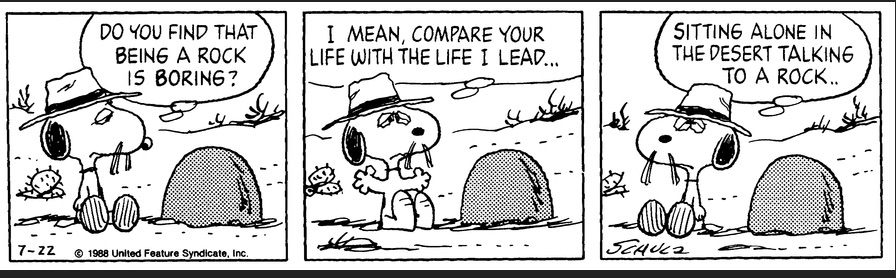
As a result, the strips with Spike, which came late in the "Peanuts" run, are perfect for the pandemic. Even Spike's sense of time has become scrambled by isolation and loneliness.
There's tremendous melancholy in the Spike strips, a low-key lament of a life in limbo, perhaps not even fully lived.
There are many strips where Spike writes to his relatives, trying to put his best face forward, but even those can't mask his utter loneliness.
As elsewhere in "Peanuts," some of the saddest strips are when Spike pines for his mother, which I've always interpreted as autobiographical with Schulz.
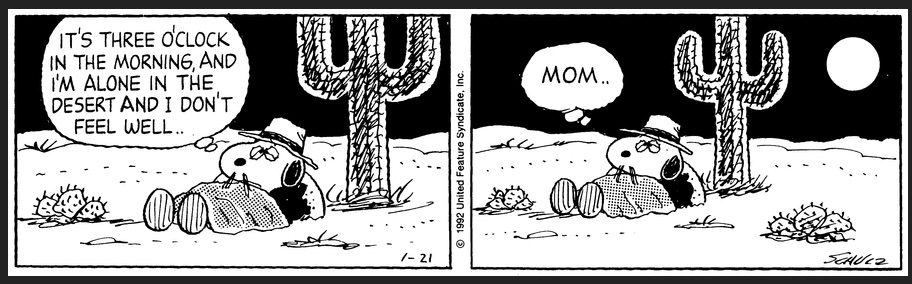
In the last decade of the strip, Spike is sometimes shown in the infantry, but even then, he's nearly always alone, separate from the troops, in conversation with himself or writing to family members. The sadness is almost suffocating.
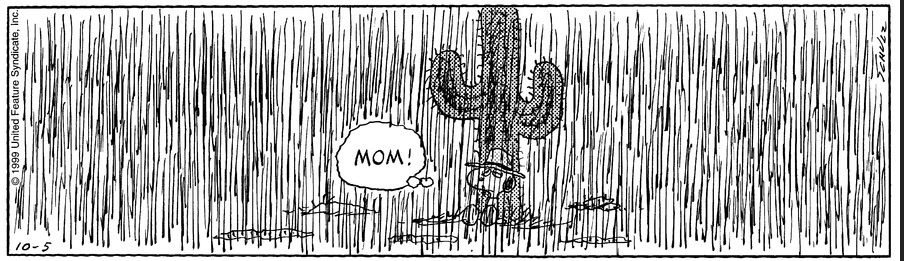
This strip was published on October 5, 1999, about four months before Charles Schulz passed away. It dispenses with humor altogether and becomes almost unbearable in its melancholy.
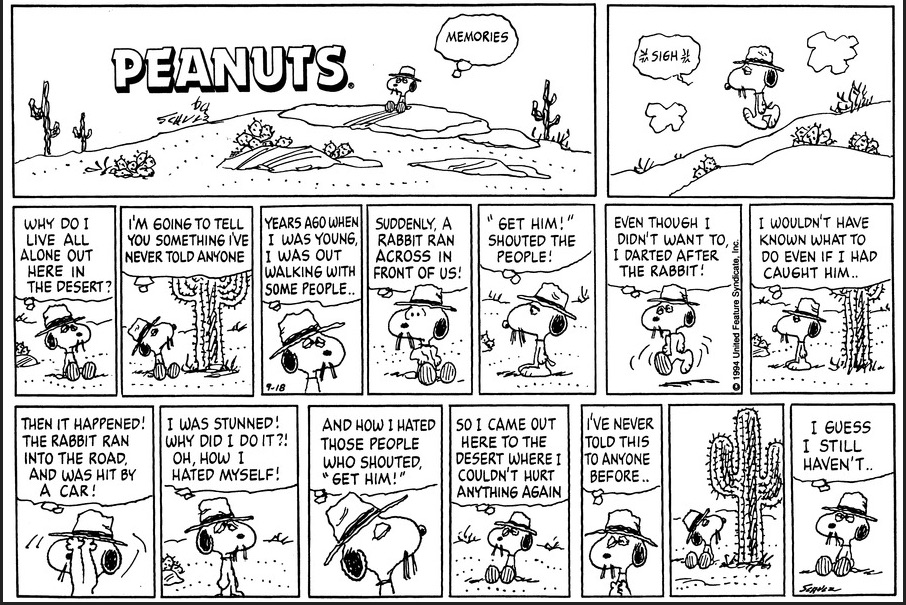
Anyway, the strips with Spike are my favorite of the last two decades of "Peanuts." He provided a new vehicle for Schulz to explore an old topic. This is the best one, in my opinion, a sort of Samuel Beckett play in miniature (from September 18, 1994).
An addendum to this thread: In his final two decades, Schulz often foregrounded two minor characters: Spike and Rerun. The Rerun strips always struck me as an exploration of early childhood, while Spike was a reflection of the loss and isolation that sometimes accompanies old age
• • •
Missing some Tweet in this thread? You can try to
force a refresh
Surprisingly, given how directly he dealt with other holidays, Charles Schulz did few Fourth of July strips, and no TV specials. Perhaps his own sense of patriotism was the cause. Here's a telling letter he sent in 1970.
Everyone who's seen "A Charlie Brown Christmas" or read the Peanuts strip in depth knows how important religion was to Schulz. But he did *not* care for current trends of equating Christianity with Americanism, which has only gotten worse. Here's an interview snippet.
It's hard to know what he would've made of our current predicament. I imagine we'd have seen perhaps a strip or two like this one from May 2, 1958.
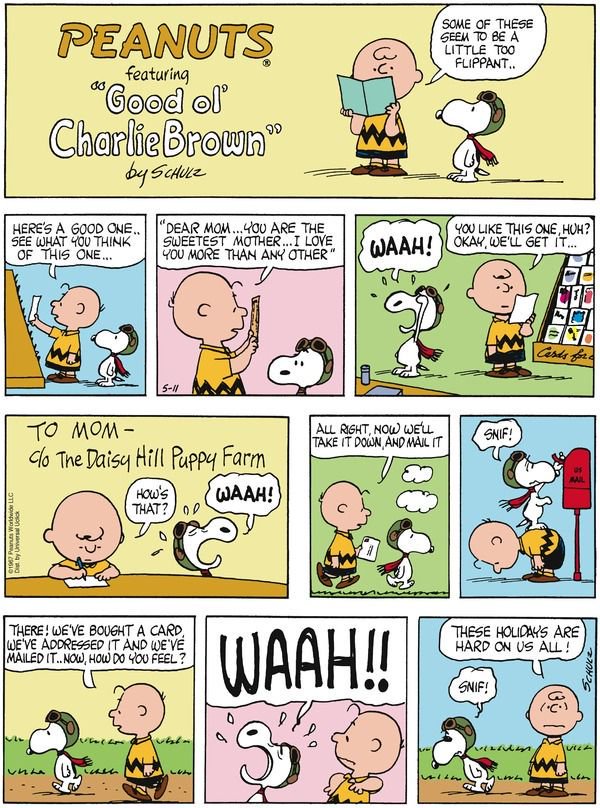
Let's do a mini-Mother's Day thread: When Charles Schulz got drafted in WWII, his mother was dying of cancer. He never saw her again. Mother's Day in Peanuts is often a sad occasion, none more so than this autobiographical strip.
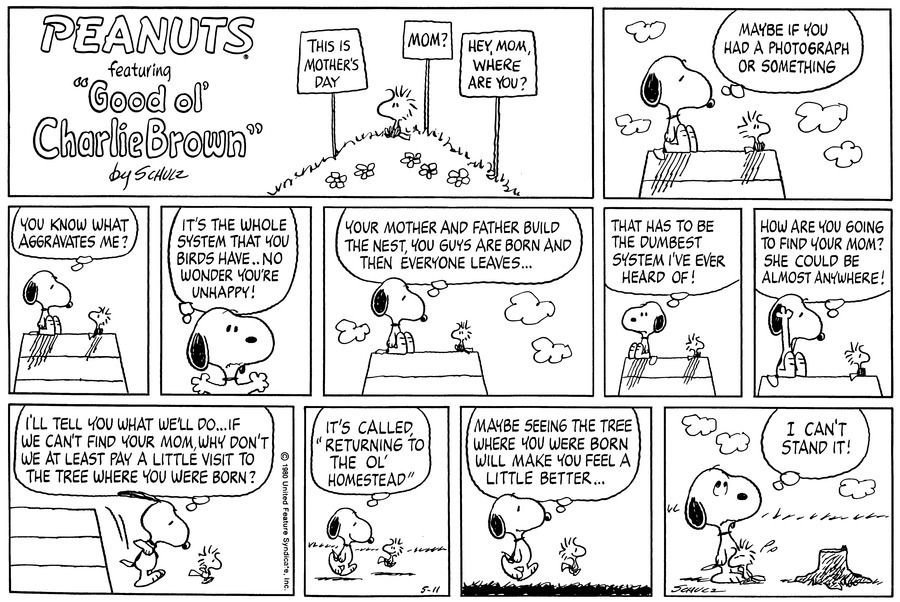
2) In the 70s and 80s, it was often Woodstock who was looking for his mother on this day. In keeping with the sadness of this day in Peanuts, he not only never found her, but often ended up heartbroken.
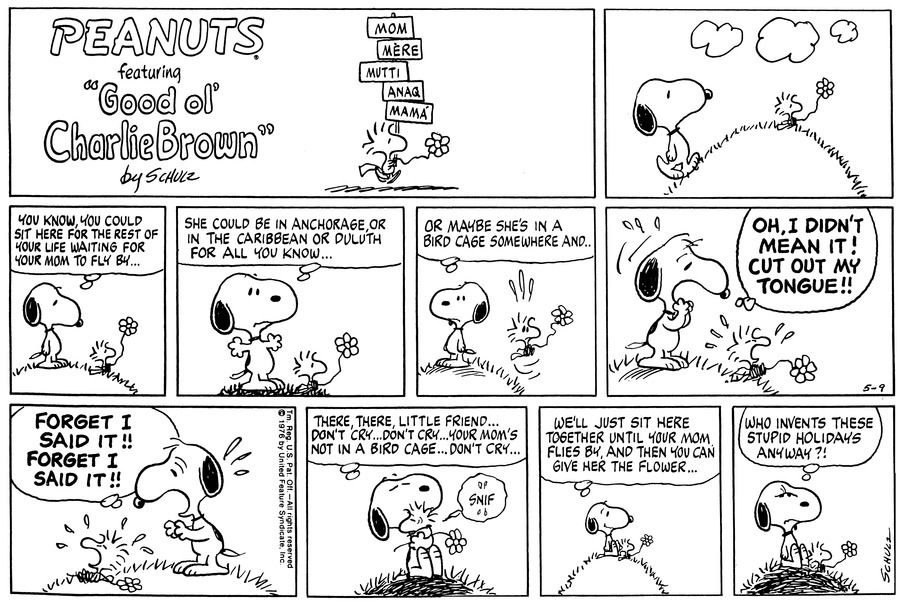
3) A recurring trope was for Woodstock to sit at the top of a hill with a flower in his hands in the hope that his mother would fly by. Much like how the Great Pumpkin never comes, his mother is nowhere to be found.
It's Charles Schulz's birthday, and at the risk of turning my Twitter into nothing but Peanuts' strips, I want to touch briefly on how extraordinary it was at the time for the main character to talk so openly about depression.
Charlie Brown began speaking freely about his depression just a few years into the strip, roughly the late 50s and early 60s. It was a theme that ran particularly strong up until the mid 70s.
The other characters recognize it in him, sometimes trying to offer him advice, and sometimes not exactly knowing how to handle his open anguish.
Charles Schulz had a specific tradition every Veterans Day--he'd draw a strip about Snoopy, usually decked out in a non-WWI Flying Ace uniform, going over to cartoonist Bill Mauldin's house for some root beers.
Mauldin was a cartooning sensation during WWII, but by the time I was growing up, I'd never even heard of him. I think Schulz knew that--look at this one, where Linus basically acts as an interpreter for the audience.
This particular strip, for example, was incomprehensible to me as a kid. I'd never seen Mauldin's work, so the Willie and Joe punchline didn't land.