
4/ 
5/
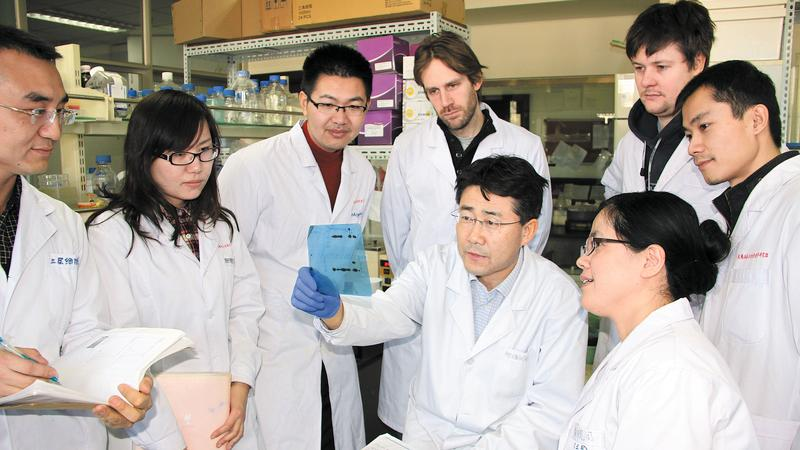
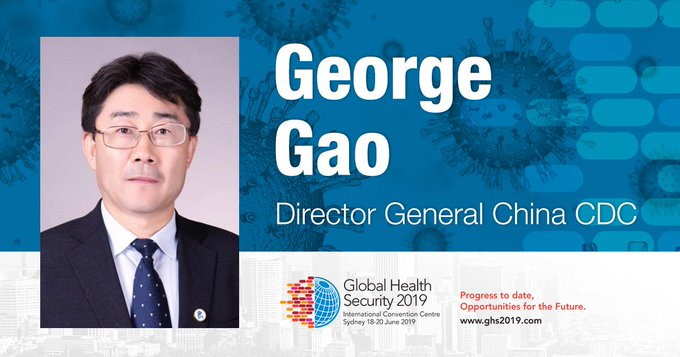
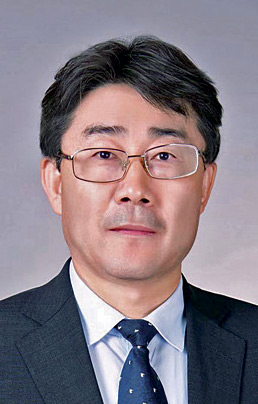
Gao Fu, also known as George Gao, an academician at the Chinese Academy of Sciences, studies how viruses invade cells.
But the 57-year-old scientist jokes about his work, saying: “My study, on the surface, is superficial.”
archive.is/kN2zk
Gao Fu, also known as George Gao, an academician at the Chinese Academy of Sciences, studies how viruses invade cells.
But the 57-year-old scientist jokes about his work, saying: “My study, on the surface, is superficial.”
archive.is/kN2zk
6/
His research interests include the molecular mechanism of inter-species transmission of pathogens, molecular virology and molecular immunology.
His research interests include the molecular mechanism of inter-species transmission of pathogens, molecular virology and molecular immunology.
7/
He completed his master’s at Beijing Agricultural University and stayed on as a teaching assistant and lecturer in virology until 1991.
Gao got the chance to study for his doctoral degree at Oxford and did his post-doctorate work at both Oxford and Harvard universities.
He completed his master’s at Beijing Agricultural University and stayed on as a teaching assistant and lecturer in virology until 1991.
Gao got the chance to study for his doctoral degree at Oxford and did his post-doctorate work at both Oxford and Harvard universities.
8/
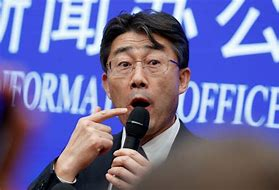
In 2013, the Middle East respiratory syndrome coronavirus began to spread, and within weeks Gao’s team found out how it invades cells, which provided insights to develop a vaccine and an effective therapeutic agent.
In 2013, the Middle East respiratory syndrome coronavirus began to spread, and within weeks Gao’s team found out how it invades cells, which provided insights to develop a vaccine and an effective therapeutic agent.
9/
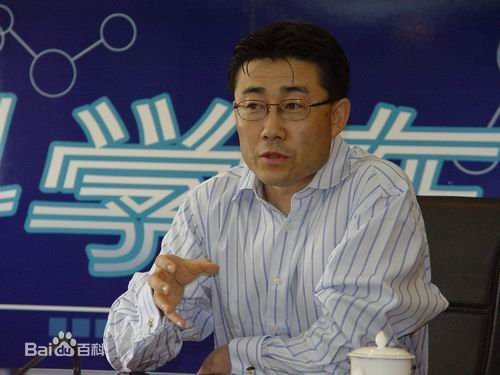
According to Song Hao, who was Gao’s doctoral student from 2011 and is now a member of Gao’s team, Gao follows the news of all viruses in the world and is a stickler for detail.
According to Song Hao, who was Gao’s doctoral student from 2011 and is now a member of Gao’s team, Gao follows the news of all viruses in the world and is a stickler for detail.

10/
“That’s why we can react so fast when a virus starts to spread, because we begin researching the virus from the moment it appears,” said Song.
“That’s why we can react so fast when a virus starts to spread, because we begin researching the virus from the moment it appears,” said Song.

12/
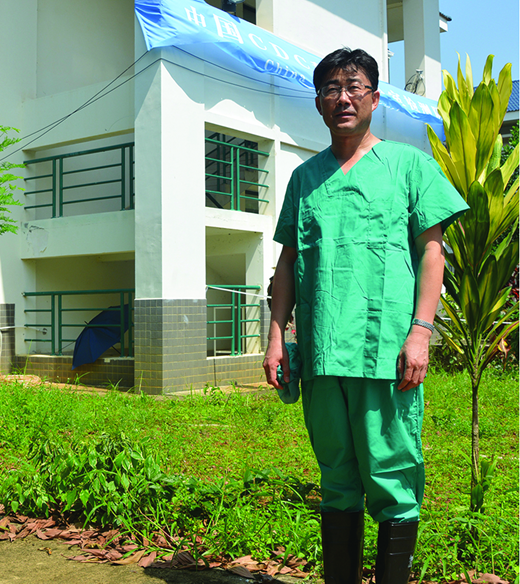
On Sept 16, 2014, Gao led the 63-member China Mobile Laboratory Testing Team to the front line of the fight against the Ebola outbreak in Sierra Leone.
On Sept 16, 2014, Gao led the 63-member China Mobile Laboratory Testing Team to the front line of the fight against the Ebola outbreak in Sierra Leone.
13/
TWO WEEKS AFTER ARRIVING, GAO GOT A FEVER. HE COULD HAVE BEEN INFECTED BY EBOLA, BUT GAO WAS NOT WORRIED. FROM HIS EXPERIENCE, HE ESTIMATED THERE WAS ONLY A SLIM CHANCE HE WAS INFECTED, BECAUSE OF ALL THE PRECAUTIONS HE HAD TAKEN.
TWO WEEKS AFTER ARRIVING, GAO GOT A FEVER. HE COULD HAVE BEEN INFECTED BY EBOLA, BUT GAO WAS NOT WORRIED. FROM HIS EXPERIENCE, HE ESTIMATED THERE WAS ONLY A SLIM CHANCE HE WAS INFECTED, BECAUSE OF ALL THE PRECAUTIONS HE HAD TAKEN.

14/
URL: www dot chinaxinhuaglobaldailytimes dot cn
Search Word: "china scientist reckless stupid fuck up"
Results: over 9000 pages
URL: www dot chinaxinhuaglobaldailytimes dot cn
Search Word: "china scientist reckless stupid fuck up"
Results: over 9000 pages
15/
Director of China CDC to intelligent too be worried by developing a fever handling world's deadliest pathogens because he took several precautions
Director of China CDC to intelligent too be worried by developing a fever handling world's deadliest pathogens because he took several precautions
16/
He recovered a few days later, but the story was not revealed until four years later.
He recovered a few days later, but the story was not revealed until four years later.

17/
From September to November 2014, when Ebola was spreading in Sierra Leone, Gao led the team that monitored 1,635 blood samples and treated 274 patients.
From September to November 2014, when Ebola was spreading in Sierra Leone, Gao led the team that monitored 1,635 blood samples and treated 274 patients.
18/
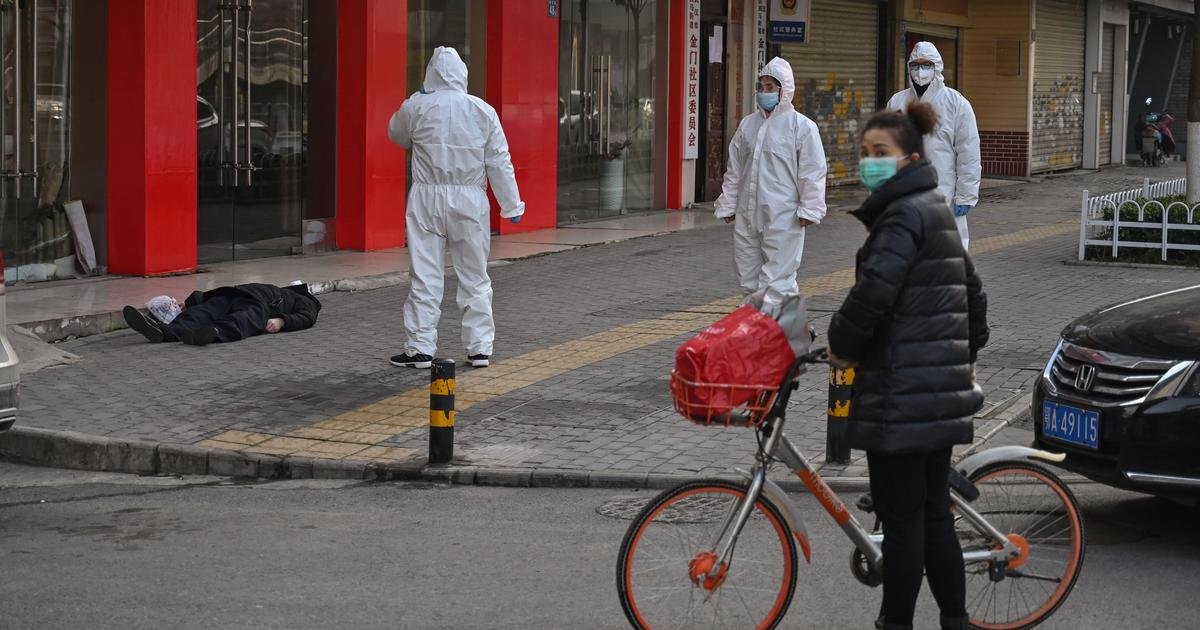
"Speaking about those days, Gao recalled that he once witnessed an Ebola-infected young man stumbling to his death on the street."
Uhhh bros...
"Speaking about those days, Gao recalled that he once witnessed an Ebola-infected young man stumbling to his death on the street."
Uhhh bros...
19/
Additionally, Gao is either a foreign associate or corresponding fellow of numerous scientific bodies and medical organizations, including the Third World Academy of Sciences, the African Academy of Sciences, the American Academy of Microbiology...
Additionally, Gao is either a foreign associate or corresponding fellow of numerous scientific bodies and medical organizations, including the Third World Academy of Sciences, the African Academy of Sciences, the American Academy of Microbiology...
20/
... the European Molecular Biology Organization and the Royal Society of Edinburgh, among others.
As well as being a scientist, Gao has other duties. He is the director of the Chinese Center for Disease Control and Prevention (often referred to as the China CDC)...
... the European Molecular Biology Organization and the Royal Society of Edinburgh, among others.
As well as being a scientist, Gao has other duties. He is the director of the Chinese Center for Disease Control and Prevention (often referred to as the China CDC)...
21/
... the dean of the Savaid Medical School of the University of Chinese Academy of Sciences, and the vice-president of the National Natural Science Foundation of China.
... the dean of the Savaid Medical School of the University of Chinese Academy of Sciences, and the vice-president of the National Natural Science Foundation of China.
22/
“Science builds logical relationships. So, you need to find the problem, design experiments and prove the problem,” said Gao.
“Similarly, management also needs you to create logical relationships, through which we can make the work more efficient.”
“Science builds logical relationships. So, you need to find the problem, design experiments and prove the problem,” said Gao.
“Similarly, management also needs you to create logical relationships, through which we can make the work more efficient.”

23/
"Gao uses his day for management and his night for lab work.
Before he sleeps, he walks 10,000 steps each day, and it is a time for him to think."
Somebody, name no names, could learn a lesson from this
"Gao uses his day for management and his night for lab work.
Before he sleeps, he walks 10,000 steps each day, and it is a time for him to think."
Somebody, name no names, could learn a lesson from this
24/
Popularization of science is also one of Gao’s interests. In December, Gao and viral immunology specialist Liu Huan published a book titled Influenza Virus — An Unavoidable Enemy, which recounts the history and spread of the influenza virus.
Popularization of science is also one of Gao’s interests. In December, Gao and viral immunology specialist Liu Huan published a book titled Influenza Virus — An Unavoidable Enemy, which recounts the history and spread of the influenza virus.

25/
“Chinese scientists are facing two problems — one is bottlenecks in core technology compared with the rest of the world, and the other is a lack of subversive technological change, which is also a problem for the whole world,” said Gao.
“Chinese scientists are facing two problems — one is bottlenecks in core technology compared with the rest of the world, and the other is a lack of subversive technological change, which is also a problem for the whole world,” said Gao.

27/
Patents
4. Potent peptide inhibitors for SARS coronavirus, 2003, China application No.03136220.6 (with Tien, P., Zhu, J., Xiao, G. & Zheng, C.).
Patents
4. Potent peptide inhibitors for SARS coronavirus, 2003, China application No.03136220.6 (with Tien, P., Zhu, J., Xiao, G. & Zheng, C.).
28/
Gao, G.F. , Zanotto, P.M.A., Holmes, E.C., Reid, H.W. & Gould, E.A., 1997, Molecular variation, evolution and geographical distribution of louping ill virus. Acta Virologica 41: 259-268.
Gao, G.F. , Zanotto, P.M.A., Holmes, E.C., Reid, H.W. & Gould, E.A., 1997, Molecular variation, evolution and geographical distribution of louping ill virus. Acta Virologica 41: 259-268.

29/
30 January 2020
"In a recent talk I attended by George Gao, the director-general of China’s CDC, much was made of the country’s state-of-the-art surveillance infrastructure"
Might be worth tapping Robert Peckham up @BillyBostickson
independent.co.uk/voices/coronav…
30 January 2020
"In a recent talk I attended by George Gao, the director-general of China’s CDC, much was made of the country’s state-of-the-art surveillance infrastructure"
Might be worth tapping Robert Peckham up @BillyBostickson
independent.co.uk/voices/coronav…
31/
RSTMH Annual Meeting
Emerging Diseases and Outbreaks
13 – 14 October 2020
11:10 Insights on COVID-19
rstmh.org/sites/rstmh/fi…
RSTMH Annual Meeting
Emerging Diseases and Outbreaks
13 – 14 October 2020
11:10 Insights on COVID-19
rstmh.org/sites/rstmh/fi…
33/
From “A”IV to “Z”IKV: Attacks from Emerging and Re-emerging Pathogens
George F. Gao
cell.com/cell/fulltext/…
From “A”IV to “Z”IKV: Attacks from Emerging and Re-emerging Pathogens
George F. Gao
cell.com/cell/fulltext/…
34/
Prof George GaoChinaThe role of host genome variation in the time of COVID-19
ichg2022.com/pre-congress-s…
Prof George GaoChinaThe role of host genome variation in the time of COVID-19
ichg2022.com/pre-congress-s…
36/
LMAO what *is* this fool on
LMAO what *is* this fool on

37/
Mar. 27, 2020
Science has tried to interview George Gao, director-general of the Chinese Center for Disease Control and Prevention (CDC), for 2 months. Last week he responded.
Mar. 27, 2020
Science has tried to interview George Gao, director-general of the Chinese Center for Disease Control and Prevention (CDC), for 2 months. Last week he responded.
38/
"In January, he was part of a team that did the first isolation and sequencing of severe acute respiratory syndrome 2 (SARS-CoV-2)"
?????
"In January, he was part of a team that did the first isolation and sequencing of severe acute respiratory syndrome 2 (SARS-CoV-2)"
?????
39/
Q: There are many questions about the origin of the outbreak in China.
A: There is no solid evidence to say we already had clusters in November. We are trying to better understand the origin.
Q: There are many questions about the origin of the outbreak in China.
A: There is no solid evidence to say we already had clusters in November. We are trying to better understand the origin.

40/
Q: Do you think the seafood market was a likely place of origin?
A: That’s a very good question. You are working like a detective.
RATTLED
Q: Do you think the seafood market was a likely place of origin?
A: That’s a very good question. You are working like a detective.
RATTLED

41/
A: From the very beginning, everybody thought the origin was the market.
WRONG
"The earliest known person with symptoms was later discovered to have fallen ill on 1 December 2019, and that person did not have visible connections with the later wet market cluster."
A: From the very beginning, everybody thought the origin was the market.
WRONG
"The earliest known person with symptoms was later discovered to have fallen ill on 1 December 2019, and that person did not have visible connections with the later wet market cluster."
42/
Q: China was also criticized for not sharing the viral sequence immediately. The story about a new coronavirus came out in The Wall Street Journal on 8 January; it didn’t come from Chinese government scientists. Why not?
A: That was a very good guess from The WSJ.
Q: China was also criticized for not sharing the viral sequence immediately. The story about a new coronavirus came out in The Wall Street Journal on 8 January; it didn’t come from Chinese government scientists. Why not?
A: That was a very good guess from The WSJ.
43/
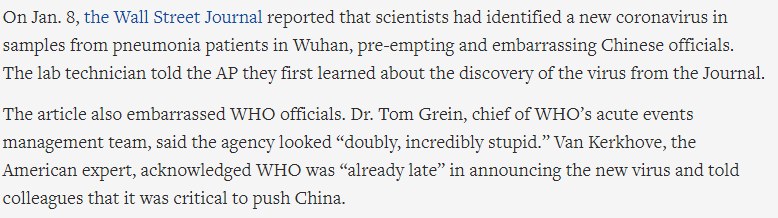
The article also embarrassed WHO officials. Dr. Tom Grein, chief of WHO’s acute events management team, said the agency looked “doubly, incredibly stupid.”
apnews.com/article/3c0617…
The article also embarrassed WHO officials. Dr. Tom Grein, chief of WHO’s acute events management team, said the agency looked “doubly, incredibly stupid.”
apnews.com/article/3c0617…
44/
"After the article, state media officially announced the discovery of the new coronavirus. But even then, Chinese health authorities did not release the genome, diagnostic tests, or detailed patient data that could hint at how infectious the disease was."
"After the article, state media officially announced the discovery of the new coronavirus. But even then, Chinese health authorities did not release the genome, diagnostic tests, or detailed patient data that could hint at how infectious the disease was."
45/
A: WHO was informed about the sequence, and I think the time between the article appearing and the official sharing of the sequence was maybe a few hours. I don’t think it’s more than a day.
来源:新华网 | 2020年01月09日 10:04
news.cctv.com/2020/01/09/ART…
A: WHO was informed about the sequence, and I think the time between the article appearing and the official sharing of the sequence was maybe a few hours. I don’t think it’s more than a day.
来源:新华网 | 2020年01月09日 10:04
news.cctv.com/2020/01/09/ART…
46/
Xu Jianguo: As of 21:00 on January 7, 2020, a new type of coronavirus has been detected in the laboratory, and the complete genome sequence of the virus has been obtained.
Xu Jianguo: As of 21:00 on January 7, 2020, a new type of coronavirus has been detected in the laboratory, and the complete genome sequence of the virus has been obtained.
47/
"By Jan. 7, another team at Wuhan University had sequenced the pathogen and found it matched Shi’s"
A major factor behind the gag order, some say, was that Chinese CDC researchers wanted to publish their papers first. “They wanted to take all the credit,” said Li
"By Jan. 7, another team at Wuhan University had sequenced the pathogen and found it matched Shi’s"
A major factor behind the gag order, some say, was that Chinese CDC researchers wanted to publish their papers first. “They wanted to take all the credit,” said Li
48/
Q: But a public database of viral sequences later showed that the first one was submitted by Chinese researchers on 5 January. So there were at least 3 days that you must have known that there was a new coronavirus.
Q: But a public database of viral sequences later showed that the first one was submitted by Chinese researchers on 5 January. So there were at least 3 days that you must have known that there was a new coronavirus.
49/
"By Dec. 27, one lab, Vision Medicals, had pieced together most of the genome of a new coronavirus with striking similarities to SARS."
"By Jan. 2, Shi had decoded the entire genome of the virus, according to a notice later posted on her institute’s website."
"By Dec. 27, one lab, Vision Medicals, had pieced together most of the genome of a new coronavirus with striking similarities to SARS."
"By Jan. 2, Shi had decoded the entire genome of the virus, according to a notice later posted on her institute’s website."
50/
A: I don’t think so. We shared the information with scientific colleagues promptly, but this involved public health and we had to wait for policymakers to announce it publicly. You don’t want the public to panic, right?
A: I don’t think so. We shared the information with scientific colleagues promptly, but this involved public health and we had to wait for policymakers to announce it publicly. You don’t want the public to panic, right?
51/
"On Jan. 3, the National Health Commission issued a confidential notice ordering labs with the virus to either destroy their samples or send them to designated institutes for safekeeping."
"On Jan. 3, the National Health Commission issued a confidential notice ordering labs with the virus to either destroy their samples or send them to designated institutes for safekeeping."
52/
"The notice, first reported by Caixin and seen by the AP, forbade labs from publishing about the virus without government authorization."
(GFG reports to NHC)
"The notice, first reported by Caixin and seen by the AP, forbade labs from publishing about the virus without government authorization."
(GFG reports to NHC)
53/
A: And no one in any country could have predicted that the virus would cause a pandemic. This is the first noninfluenza pandemic ever.
A: And no one in any country could have predicted that the virus would cause a pandemic. This is the first noninfluenza pandemic ever.

54/
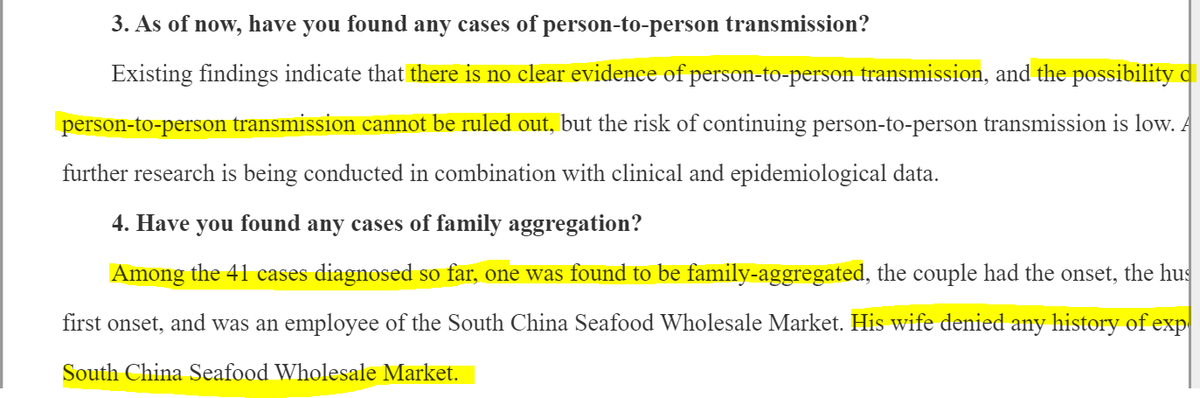
Q: It wasn’t until 20 January that Chinese scientists officially said there was clear evidence of human-to-human transmission. Why do you think epidemiologists in China had so much difficulty seeing that it was occurring?
A: Detailed epidemiological data were not available
Q: It wasn’t until 20 January that Chinese scientists officially said there was clear evidence of human-to-human transmission. Why do you think epidemiologists in China had so much difficulty seeing that it was occurring?
A: Detailed epidemiological data were not available
55/
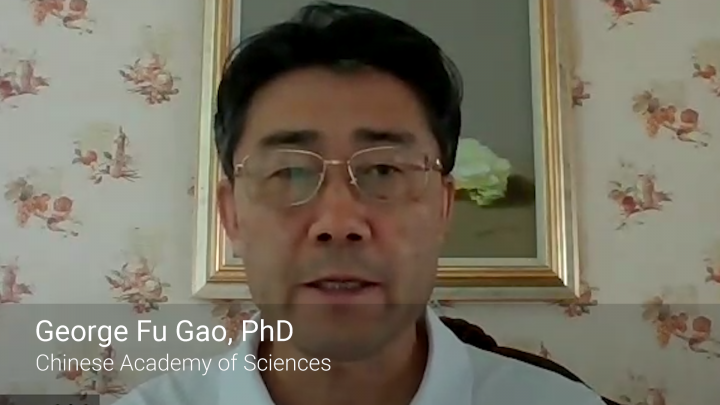
A: From the very beginning scientists, everybody thought: “Well, it’s just a virus.”
What the FUCK is his problem
A: From the very beginning scientists, everybody thought: “Well, it’s just a virus.”
What the FUCK is his problem
56/
*crrrrrick* *glug* aaaah, that first treble of the day
*crrrrrick* *glug* aaaah, that first treble of the day

57/
A: At the moment, we are using both monkeys and transgenic mice that have ACE2, the human receptor for the virus. The mouse model is widely used in China for drug and vaccine assessment, and I think there are at least a couple papers coming out about the monkey models soon.
A: At the moment, we are using both monkeys and transgenic mice that have ACE2, the human receptor for the virus. The mouse model is widely used in China for drug and vaccine assessment, and I think there are at least a couple papers coming out about the monkey models soon.
58/
A: It’s definitely not good to call it the Chinese virus. The virus belongs to the Earth. The virus is our common enemy—not the enemy of any person or country.
A: It’s definitely not good to call it the Chinese virus. The virus belongs to the Earth. The virus is our common enemy—not the enemy of any person or country.
60/
"Infectious diseases cannot be contained by national borders, still less between Asians who are closer in DNA," Gao says.
asia.nikkei.com/NAR/Articles/C…
"Infectious diseases cannot be contained by national borders, still less between Asians who are closer in DNA," Gao says.
asia.nikkei.com/NAR/Articles/C…
61/
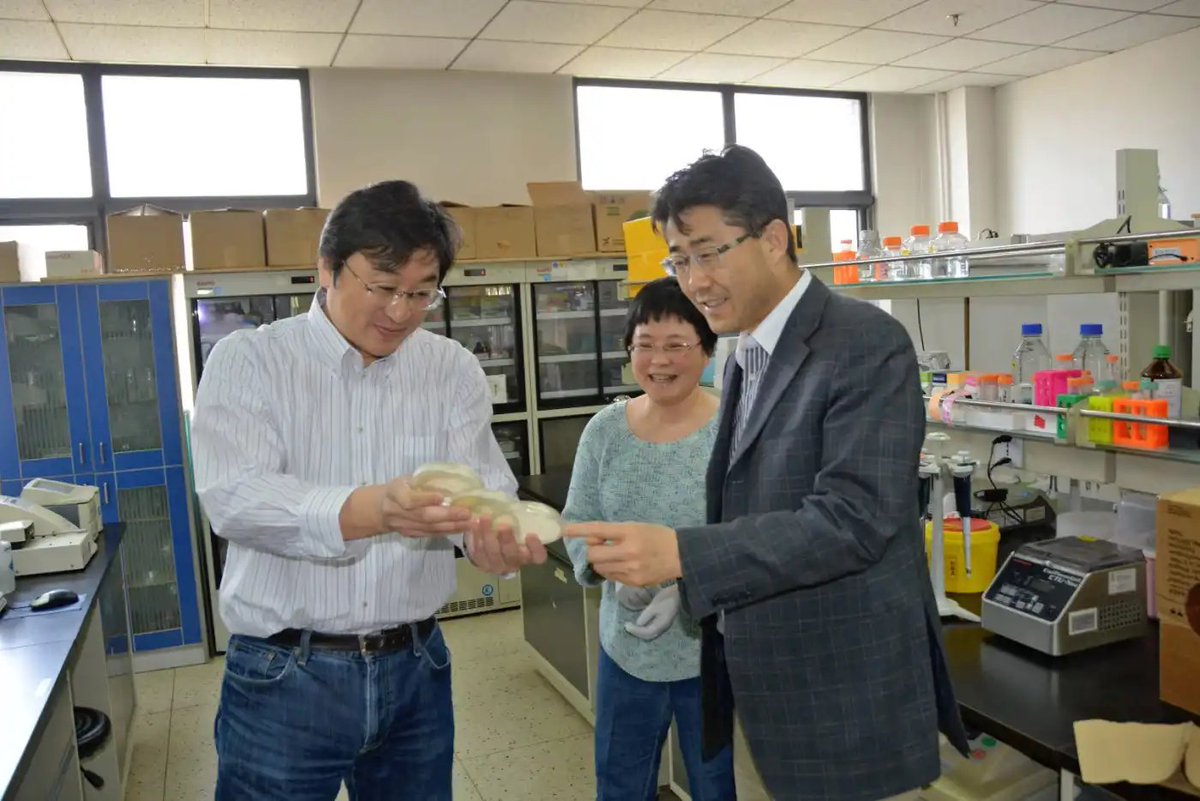
Hao Song
Chinese Academy of Sciences | CAS · Beijing Institutes of Life Science
phD
researchgate.net/profile/Hao-So…
Hao Song
Chinese Academy of Sciences | CAS · Beijing Institutes of Life Science
phD
researchgate.net/profile/Hao-So…
62/
Generation of antibodies against COVID-19 virus for development of diagnostic tools
Hao Song et al.
Posted February 27, 2020.
The COVID-19 China coronavirus started in Dec 2019 was challenged by the lack of accurate serological diagnostic tool
medrxiv.org/content/10.110…
Generation of antibodies against COVID-19 virus for development of diagnostic tools
Hao Song et al.
Posted February 27, 2020.
The COVID-19 China coronavirus started in Dec 2019 was challenged by the lack of accurate serological diagnostic tool
medrxiv.org/content/10.110…
63/
Since when???? Do they not have dates in China
"RT-PCR has been used since the first day to screen the suspected and now used for confirmation of diagnosis for COVID-19 infection due to the lack of immunologic diagnostic assays for the new virus"
Since when???? Do they not have dates in China
"RT-PCR has been used since the first day to screen the suspected and now used for confirmation of diagnosis for COVID-19 infection due to the lack of immunologic diagnostic assays for the new virus"
64/
Bill Was Right Again @WhereIsYanLing
"Balb/c mice and New Zealand White rabbits were immunized with KLH-conjugated synthetic peptides. Bleeds were tested for titers against unconjugated peptides and purified NP by ELISA."
Bill Was Right Again @WhereIsYanLing
"Balb/c mice and New Zealand White rabbits were immunized with KLH-conjugated synthetic peptides. Bleeds were tested for titers against unconjugated peptides and purified NP by ELISA."
65/
"This work is supported by Research Grants from Beijing Science and Technology Commission, and Bill & Melinda Gates Foundation to Le Sun."
FABULOUS!
"This work is supported by Research Grants from Beijing Science and Technology Commission, and Bill & Melinda Gates Foundation to Le Sun."
FABULOUS!

66/
Identification of novel bat coronaviruses sheds light on the evolutionary origins of SARS-CoV-2 and related viruses
March 2021
Hao Song, Eddie Holmes et al.
biorxiv.org/content/10.110…
Identification of novel bat coronaviruses sheds light on the evolutionary origins of SARS-CoV-2 and related viruses
March 2021
Hao Song, Eddie Holmes et al.
biorxiv.org/content/10.110…
67/
Our study highlights both the remarkable diversity of bat viruses at the local scale and that relatives of SARS-CoV-2 and SARS-CoV circulate in wildlife species in a broad geographic region of Southeast Asia and southern China. These data will help guide surveillance efforts
Our study highlights both the remarkable diversity of bat viruses at the local scale and that relatives of SARS-CoV-2 and SARS-CoV circulate in wildlife species in a broad geographic region of Southeast Asia and southern China. These data will help guide surveillance efforts
68/
Genomic characterisation and epidemiology of 2019 novel coronavirus: implications for virus origins and receptor binding
22 Feb 2020
Hao Song, Eddie Holmes, George Gao et al.
thelancet.com/journals/lance…
Genomic characterisation and epidemiology of 2019 novel coronavirus: implications for virus origins and receptor binding
22 Feb 2020
Hao Song, Eddie Holmes, George Gao et al.
thelancet.com/journals/lance…
69/
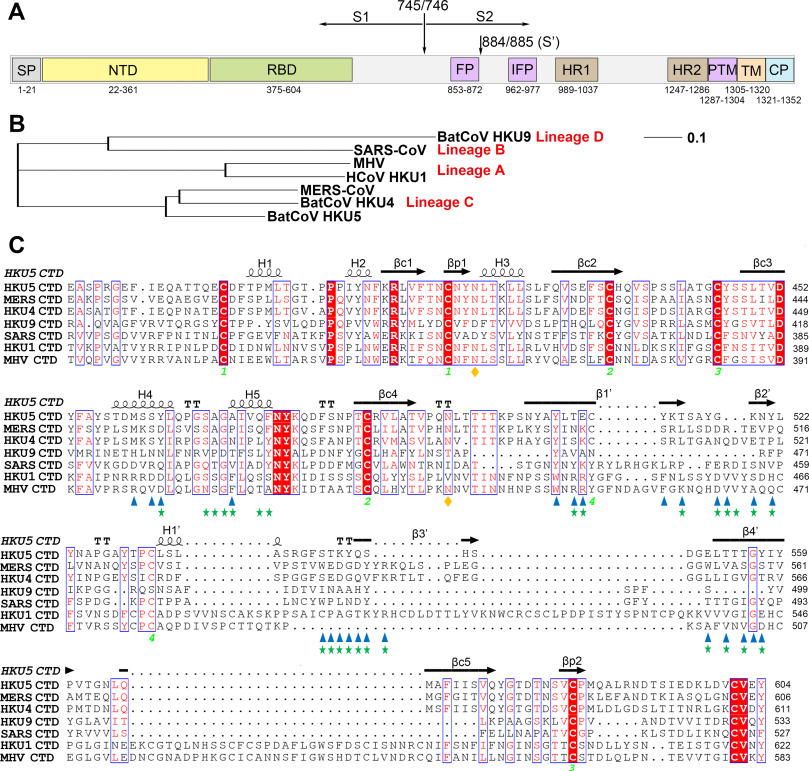
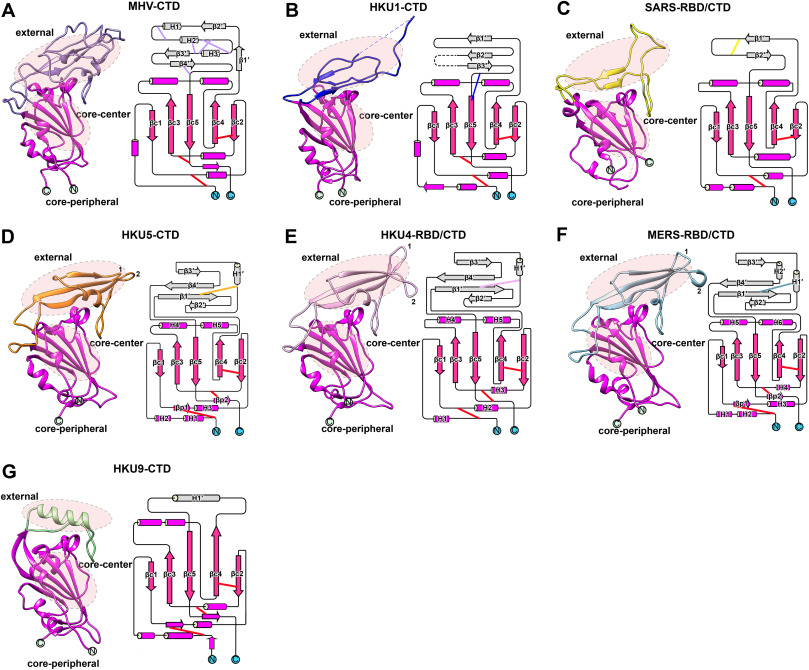
Structure of the S1 subunit C-terminal domain from bat-derived coronavirus HKU5 spike protein
Hao Song, George Gao et al.
Received 12 March 2017
sciencedirect.com/science/articl…
Structure of the S1 subunit C-terminal domain from bat-derived coronavirus HKU5 spike protein
Hao Song, George Gao et al.
Received 12 March 2017
sciencedirect.com/science/articl…
70/
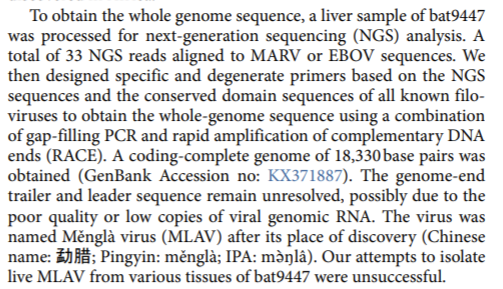
An infectious clone of BatCoV HKU5 containing the ectodomain from the SARS-CoV S protein was constructed through reverse genetics and synthetic-genome design, and the recombinant virus replicates efficiently in cell culture and in young and aged mice
An infectious clone of BatCoV HKU5 containing the ectodomain from the SARS-CoV S protein was constructed through reverse genetics and synthetic-genome design, and the recombinant virus replicates efficiently in cell culture and in young and aged mice
71/
Whether the virus has the potential to bypass the bat-human barrier needs to be evaluated.
Whether the virus has the potential to bypass the bat-human barrier needs to be evaluated.
72/
In addition, the key proteins for virus replication, such as the 3C-like protease, polymerase, and exonuclease of BatCoV HKU5 display high amino acid sequence similarity to those in MERS-CoV...
In addition, the key proteins for virus replication, such as the 3C-like protease, polymerase, and exonuclease of BatCoV HKU5 display high amino acid sequence similarity to those in MERS-CoV...
73/
... indicating that once the genome of BatCoV HKU5 is released into host cells, genome replication, virus particle assembly, and release can readily occur. Therefore, the receptor would be the last barrier for BatCoV HKU5 to infect humans.
... indicating that once the genome of BatCoV HKU5 is released into host cells, genome replication, virus particle assembly, and release can readily occur. Therefore, the receptor would be the last barrier for BatCoV HKU5 to infect humans.
74/
Our data show that BatCoV HKU5-CTD does not use hCD26 as a receptor, though it folds into a very similar structure as MERS-RBD/CTD and HKU4-RBD/CTD. In other words, the cellular receptor of BatCoV HKU5 is still a mystery that requires further study.
Our data show that BatCoV HKU5-CTD does not use hCD26 as a receptor, though it folds into a very similar structure as MERS-RBD/CTD and HKU4-RBD/CTD. In other words, the cellular receptor of BatCoV HKU5 is still a mystery that requires further study.
75/
George Fu Gao: the past and future of Ebola
Published: 22 February 2015
academic.oup.com/nsr/article/2/…
George Fu Gao: the past and future of Ebola
Published: 22 February 2015
academic.oup.com/nsr/article/2/…
76/
Newly returned from the frontline of the battle against Ebola in West Africa, Dr George Fu Gao talked to NSR on this largest Ebola epidemic in history.
Newly returned from the frontline of the battle against Ebola in West Africa, Dr George Fu Gao talked to NSR on this largest Ebola epidemic in history.
77/
Gao: The most important features in preventing acute infectious diseases are part of the ‘Four Early’ strategy: early discovery, early diagnosis, early quarantine, and early intervention. In this recent epidemic, there was failure in all four of these strategies.
Gao: The most important features in preventing acute infectious diseases are part of the ‘Four Early’ strategy: early discovery, early diagnosis, early quarantine, and early intervention. In this recent epidemic, there was failure in all four of these strategies.
78/
The fact is that the World Health Organization (WHO) did not openly announce the seriousness of the epidemic until August 2014. Even then, most countries only reacted at the level of discussion—for setting rules and operation procedures, without really reaching the frontline
The fact is that the World Health Organization (WHO) did not openly announce the seriousness of the epidemic until August 2014. Even then, most countries only reacted at the level of discussion—for setting rules and operation procedures, without really reaching the frontline
79/
NSR: Was the slow reaction to the Ebola epidemic related to the systems and policies of local governments?
Gao: Indeed. As a former British colony, Sierra Leone's policies on biomedical ethics followed closely those in western countries.
NSR: Was the slow reaction to the Ebola epidemic related to the systems and policies of local governments?
Gao: Indeed. As a former British colony, Sierra Leone's policies on biomedical ethics followed closely those in western countries.
80/
Gao: Yes. China now has a well-established system for responding to the spread of infectious diseases, unless the infected individuals go to hide in remote areas, an unlikely scenario.
Gao: Yes. China now has a well-established system for responding to the spread of infectious diseases, unless the infected individuals go to hide in remote areas, an unlikely scenario.

81/
"Gao: There are three vaccines currently in trials... the third one is being developed by Dr Wei Chen of the Chinese Academy of Military Medical Sciences, based on human AdV5 and the glycoprotein."
Will she be ok if she keeps injecting herself with experimental vaccines 😮
"Gao: There are three vaccines currently in trials... the third one is being developed by Dr Wei Chen of the Chinese Academy of Military Medical Sciences, based on human AdV5 and the glycoprotein."
Will she be ok if she keeps injecting herself with experimental vaccines 😮
82/
NSR: Given their clinical trial status, these vaccines cannot be used widely at present. Is that right?
Gao: I have frequently said, in the course of history, biological safety and ethics were ignored, but it seems to be overemphasized at present.
@BillyBostickson
NSR: Given their clinical trial status, these vaccines cannot be used widely at present. Is that right?
Gao: I have frequently said, in the course of history, biological safety and ethics were ignored, but it seems to be overemphasized at present.
@BillyBostickson
83/
NSR: Through viral sequencing, a Harvard team found in June 2014 that Ebola virus has mutated with a rate doubling that found over the past 40 years, why?
Gao: As the virus spreads in the human population, it continues to mutate and adapt to new human hosts.
@Daoyu15
NSR: Through viral sequencing, a Harvard team found in June 2014 that Ebola virus has mutated with a rate doubling that found over the past 40 years, why?
Gao: As the virus spreads in the human population, it continues to mutate and adapt to new human hosts.
@Daoyu15
84/
Gao: I think the AIDS vaccine research has reached a dead end. Just following the successful example of polio vaccine—using a vaccine to activate immune responses—may not be the best approach. We need a new conceptual scheme and new approaches.
@BidoliNicola
Gao: I think the AIDS vaccine research has reached a dead end. Just following the successful example of polio vaccine—using a vaccine to activate immune responses—may not be the best approach. We need a new conceptual scheme and new approaches.
@BidoliNicola
85/
Gao: Personally, I think it is not possible to develop a universal vaccine. We can now find universal neut. antibodies in human blood, but when the virus really invades humans, these antibodies seem to be in hibernation, showing no protective reaction.
@BillyBostickson
Gao: Personally, I think it is not possible to develop a universal vaccine. We can now find universal neut. antibodies in human blood, but when the virus really invades humans, these antibodies seem to be in hibernation, showing no protective reaction.
@BillyBostickson
87/
Ebola virus can infect multiple somatic cell types, it also may not require a specific cell surface receptor, but this remains to be determined. An unusual feature of Ebola virus is the prolonged incubation period—as long as 21 days.
Ebola virus can infect multiple somatic cell types, it also may not require a specific cell surface receptor, but this remains to be determined. An unusual feature of Ebola virus is the prolonged incubation period—as long as 21 days.
88/
This is rather rare among acute infectious diseases. Male Ebola patients can carry virus in their semen for three months during the recovery period. It is not clear why.
archive.is/tYpDp
This is rather rare among acute infectious diseases. Male Ebola patients can carry virus in their semen for three months during the recovery period. It is not clear why.
archive.is/tYpDp
89/
We have recently established a CAS Center for Influenza Research and Early-warning. One of our goals is to solve the problem of cross-species transmission through multidisciplinary approaches.
We have recently established a CAS Center for Influenza Research and Early-warning. One of our goals is to solve the problem of cross-species transmission through multidisciplinary approaches.
90/
China CDC, which has established a national network of infectious diseases monitoring networks throughout China since the SARS pandemic, can provide immediate information on disease incidence in various local regions.
China CDC, which has established a national network of infectious diseases monitoring networks throughout China since the SARS pandemic, can provide immediate information on disease incidence in various local regions.
91/
NSR: Some scientists propose to use ‘gain of function’ (GOF) to predict potential threats of viral mutation on human populations. What is your view on this approach?
Gao: Frankly, I am not in favor of the GOF approach, although there are pro and con arguments.
NSR: Some scientists propose to use ‘gain of function’ (GOF) to predict potential threats of viral mutation on human populations. What is your view on this approach?
Gao: Frankly, I am not in favor of the GOF approach, although there are pro and con arguments.

92/
Gao: My point is that the process of gene mutation and natural selection involves many more combinatorial scenarios than the human mind can imagine, and how could one select among all possibilities and provide comprehensive tests?
@angoffinet @BillyBostickson
Gao: My point is that the process of gene mutation and natural selection involves many more combinatorial scenarios than the human mind can imagine, and how could one select among all possibilities and provide comprehensive tests?
@angoffinet @BillyBostickson
unroll plox 😘@threadreaderapp
• • •
Missing some Tweet in this thread? You can try to
force a refresh