
Undergrads, if your post-school plan is 9-5 career, doing these 5 things in school may be helpful to you
1. Study hard to make good grade
Despite the trend of "attack" on grades, getting a good grade remains my #1 advice. Let me not rehash the points. See earlier tweet on it
1. Study hard to make good grade
Despite the trend of "attack" on grades, getting a good grade remains my #1 advice. Let me not rehash the points. See earlier tweet on it
https://twitter.com/Jarushub/status/1373251673142005765
2. Be versatile
Don't be a student that does no more than moving from hostel to class, and back, everyday throughout your school days. Attending higher institution goes beyond the direct learning from class, it is an environment to expand your horizon, maximize the opportunity
Don't be a student that does no more than moving from hostel to class, and back, everyday throughout your school days. Attending higher institution goes beyond the direct learning from class, it is an environment to expand your horizon, maximize the opportunity
All those interactions, those "debates" in newspaper stands in front of SUB, those debates in the room, are indirect learning. There are also some skills you can learn for free in the uni. You may have a roommate that is good in something, say graphic designing, you can learn
3. Cultivate a network of friends
Some of my most valuable contacts today, I met them in the uni. In fact, look at this webinar I organized few weeks ago, everyone on that session 2 panel, I met them while in school, except Tola that I met when I returned to my dept to talk
Some of my most valuable contacts today, I met them in the uni. In fact, look at this webinar I organized few weeks ago, everyone on that session 2 panel, I met them while in school, except Tola that I met when I returned to my dept to talk
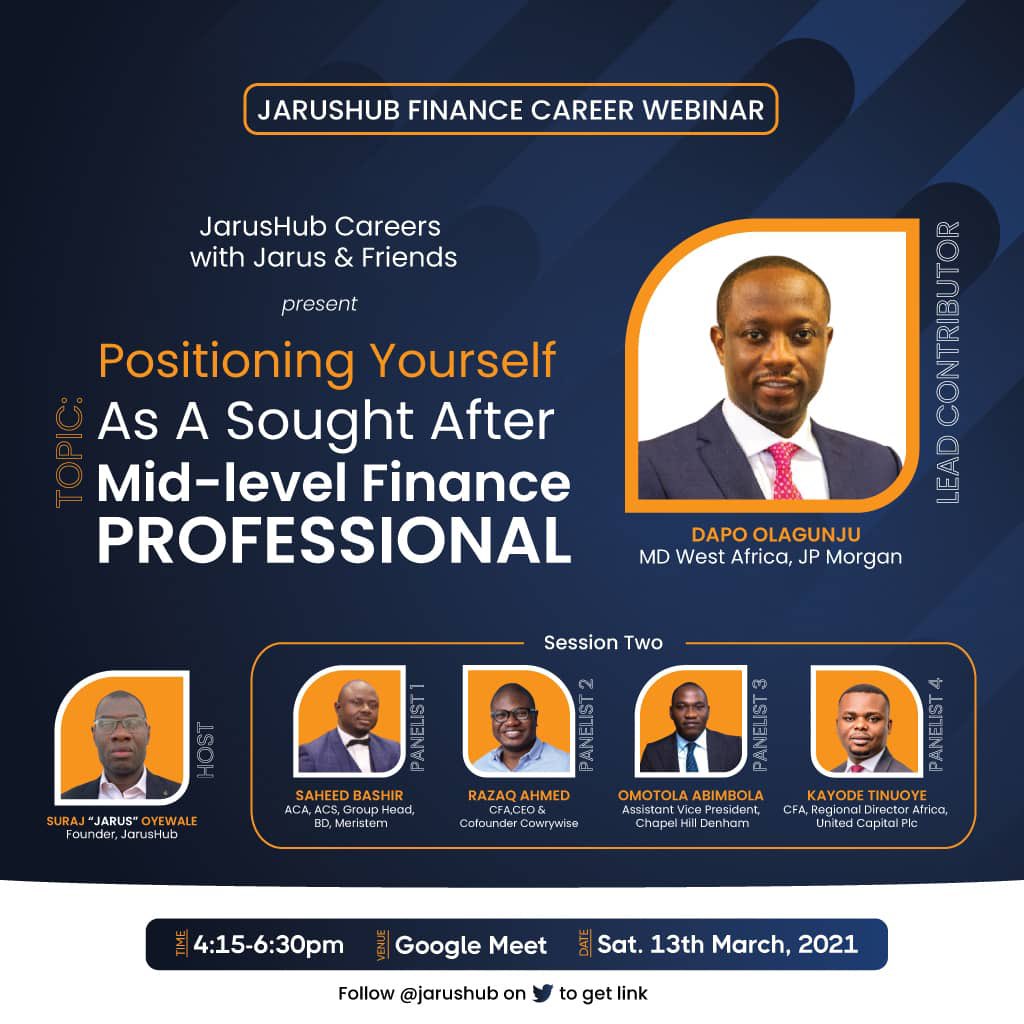
Other than Tola that we came in contact in 2013, others were either my senior (Saheed), my mate (Kayode) or my junior (Razaq) in our Ife years 2001-2006. Our relationship is still so good 15 yrs after school that a phone call 72 hours to this impromptu event and they all accepted
Build a strong network of friends while in school. Keep in touch with everyone post-school. Naturally, they tend to remember you whenever there is an opportunity. Don't be an Island when in school. You wont be a stranger when you need people that can help your career!
4. Participate in associations
One of the most useful contacts I have today is the immediate past CEO of the Nigerian office of a multinational consulting firm. Got to know him when I was the Coordinator of Faculty of Social Sciences Muslim Students Society, OAU chapter 2005/06
One of the most useful contacts I have today is the immediate past CEO of the Nigerian office of a multinational consulting firm. Got to know him when I was the Coordinator of Faculty of Social Sciences Muslim Students Society, OAU chapter 2005/06
I invited him for a programme I organized for final year Muslim students and that was how I struck network. Today, he is like a big brother to me, very helpful to me in many respects. I will recommend departmental associations too.
If you’re president of your departmental association, it is a good opportunity to network with your alumni. Just invite them for an event, get their contact details (email or phone number) and strike friendship with them after the event.
Just call/sms or send email once in a while to say . When you graduate send your CV to them. Religious associations are also helpful. All these are avenues to build network while in school which will be beneficial after school.
In fact someone on that panel, who got job before writing his final exam, got it because as the chairperson of the department's annual conference, he had the opportunity to interact with one of the guests, a CEO of one of the mid-size investment firms, who was impressed with him
...and invited him for a chat, and offered him his PA. Fiam, the rest is history!
5. Develop your communication skills
Once asked the CEO of a top firm one question about the employability of Nigerian graduates and he said it takes a period of grooming on communication and other basic skills before many Nigerian graduates catch up in the workplace.
Once asked the CEO of a top firm one question about the employability of Nigerian graduates and he said it takes a period of grooming on communication and other basic skills before many Nigerian graduates catch up in the workplace.
Please use the university as a platform to build your communication skills. I was also a consistent writer for my departmental press outfit and had a fair writing skill. But don’t make my own mistake. While I concentrated on writing, I did little to improve my oral comms skills.
When I began working in corporate Lagos, with the ‘tush’ environment where I got to work and relate with fonee speaking colleagues, I struggled to catch up, and it initially affected my confidence level. Would have used the uni to develop my oral communication skills if I knew
6. Start writing professional examinations
If your course or the profession you intend to pursue has some professional examinations that can be written by student, please enrol if you are able to. Ability here comes in two folds: money to finance the exams ..
If your course or the profession you intend to pursue has some professional examinations that can be written by student, please enrol if you are able to. Ability here comes in two folds: money to finance the exams ..
and ability to combine with your academics which should be the most important. But if you know you don’t have the capacity to combine professional exams with your academics, please put academics first. You can always write professional exams after school.
• • •
Missing some Tweet in this thread? You can try to
force a refresh