Right now, is probably the stupidest time for fintech firms like @zerodhaonline to be raising money. It is quite crazy the number of folks reaching out & the different deals. We might regret it in the future, but we are not raising & here are the counterintuitive reasons why. 1/7
We don’t need the money, so there’s no point in raising money just because someone is ready to give it to you. We are profitable, have zero debt. And we don’t spend on marketing and advertising which is probably the single biggest reason for folks raising money. 2/7
We don't want to grow just for sake of growth with random businesses. We want to build things around our core competency, do it well. We are partnering great founders for any adjacent opportunities through @Rainmatterin and fostering innovation in a highly regulated market. 3/7
Our business performance is directly linked to fortunes of the stock market. The hotness of our industry can disappear overnight with a 20% fall in the markets. As a founder, it is hard to take on the investor obligation to continuously keep growing in an industry like ours. 4/7
Building a business requires a moat. Be it a better product, deeper pockets (investors), or the ability to stay customer focussed at all times. In an industry like ours, what is right for the investors (VCs) is hardly ever right for the customer (more trades, loans, etc). 5/7
Our bet is that in a fight of deep pockets, the ability to do what is right for the customer will be our edge. For eg, the focus now is to help traders be profitable using Nudge. Each nudge reduces our trading volume and revenue but is the right product for the customer. 6/7
But yeah, all of these theses may be wrong. But the freedom of not being obligated to an investor is much more valuable than the biggest cheque. And having the option to say all of this is probably a moat in itself. 😬 7/7
• • •
Missing some Tweet in this thread? You can try to
force a refresh
The big news from last week was the blow-up of a leveraged hedge fund Archegos & how it caused $billions in losses to its bank/broker. A primer to what it means to be a brokerage for such trades, the risk to reward, and more. 1/9
Being a broker is almost like running an insurance business, you keep earning brokerage income (like premium) & are always one black swan or mega volatile day away from giving it all back and more if one large client or many small clients default at the same time. 2/9
For all those who don’t understand, when customers trade with leverage or trade by keeping a portion of the value of trade as margin, if the customer loses more money than the margin, that is on the broker. 3/9
This is a more systemic issue, not with one bank but across the board, banks to ed-tech to fintech. As long as you give revenue targets & push employees to get there, products that generate more revenue for the business over what is right for the customer will be mis-sold 1/4
Easier for employees of banks, brokerages, wealth management firms to mis-sell as relationships are already established & there is trust with the brand, which is why the customer has allowed them to be custodians of their assets. 2/4
A potential fix is to mandate every sale of a product to be digital, even if this is being done in person. Mis-selling a product digitally leaves a trail and makes the company also responsible unlike physically where there isn’t a trail & blame can be passed to the employee 3/4
A lot has been said about what we should have done on 24th Feb 2021 when NSE halted trading. Of course, with hindsight, it is easy now to suggest. But at 3 PM on the 24th Feb, the best option was to square off all NSE intraday positions on BSE.
Intraday (MIS/CO) trades are taken with margin, as low as 5% of value. Pre-Condition: positions will be force closed before close as they carry higher risk. Until 3.20 pm, we didn't know timings would be extended. So sticking to, normal square-off timing was right thing to do 2/n
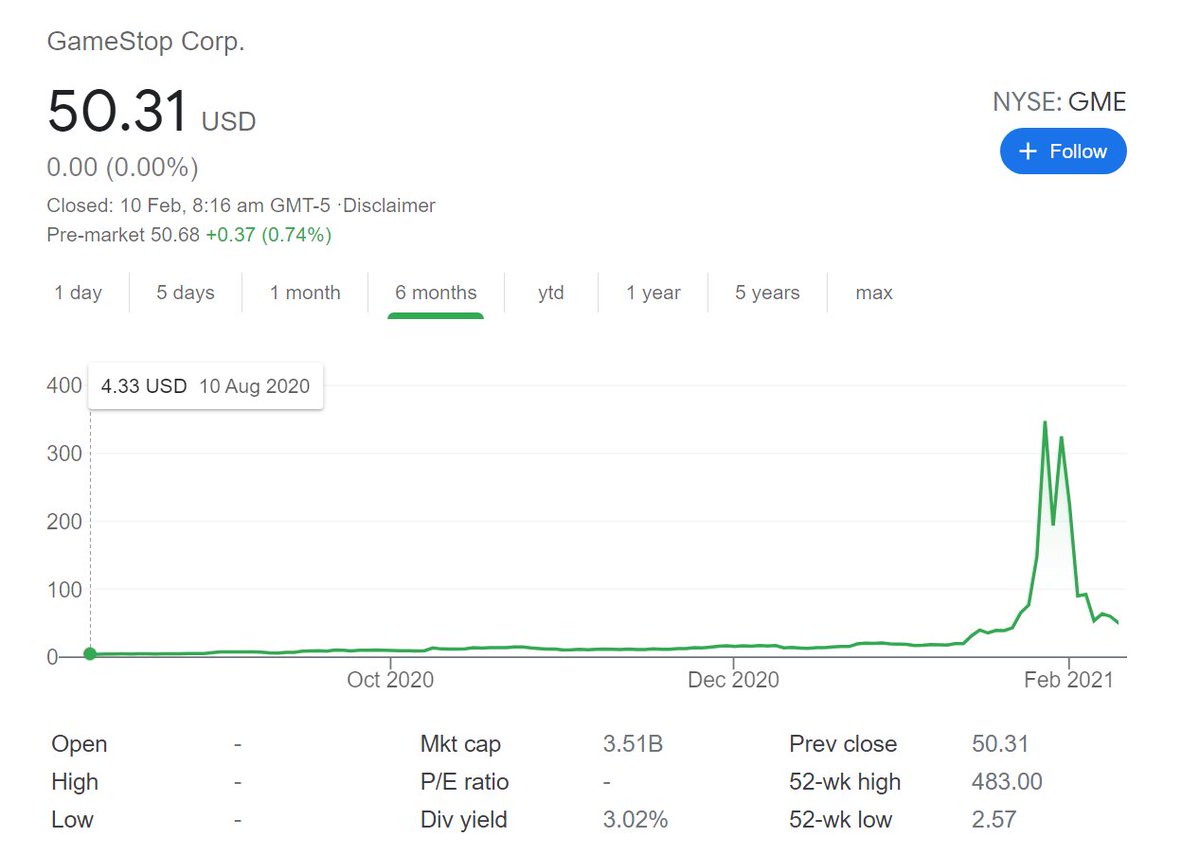
In the Gamestop saga, the media has loved telling the story of how Retail made a lot of money from Hedge funds. The reality is entirely different, almost everyone apart from retail has probably made money or benefited from this. 1/8
Firstly, yes, a couple of Hedge funds were sitting on large losses on Gamestop shorts. Now that stock is at $50, the losses also would be a fraction, if the shorts still held. What no one is talking about are other hedge funds who made billions in the retail frenzy. 2/8
Almost everyone and their parents seem to have wanted to participate in some form. Not only the brokerage firms who added a record number of accounts benefited, but News/TV/Social media itself must have gained a lot of views and hence earned handsomely. 3/8
Financial awareness about the importance of saving and investing in India is increasing at the fastest rate ever, especially among millennials. Of course, stock markets doing well and lower bank FD rates are helping. But there are also a few structural changes afoot here. 1/4
Historically financial products have been sold hard & mostly in person. Products mostly sold based on promises of high returns (sales pitches in person leave no audit trail). Chances of sale higher if customer is less aware of what is being sold, so no incentive to educate 2/4
New age online financial services firms can't sell greed to acquire customers because it leaves a trail (SMS, emails, notifications). So businesses are forced to turn financial products into a "pull-product" to acquire clients. Which means having to educate customers. 3/4
We have a habit of looking west and thinking what they do must be right. With all the craziness going on in the US capital markets, I thought it will be a good time to share some of the reasons why India is way better in terms of capital market regulations. 1/n
In US, hedge funds can leverage unlimited & run positions worth hundreds of $billions bringing in systemic risk. In India, no one can hold overnight positions more than ~5 times leverage (SPAN+Exposure for F&O, VAR+ELM for stocks). Even intraday leverages are now capped 2/n
In US your stock holdings are held by the brokers (held in book or street name, also the reason for the large stock lending market). If a broker goes down, your securities is at risk as well. In India, they sit in your Demat with NSDL/CDSL, ring-fenced from any broker risk 3/n