Kolofon dari naskah Wawacan Nabi Medal (fotokopi) koleksi Departemen Pendidikan Bahasa Daerah, UPI Bandung. Huruf yang digunakan yaitu Pégon, modifikasi huruf Arab untuk menuliskan bahasa Sunda.
Terlihat penggunaan huruf <c> ( ڄ) pada kata "maca" (مَڄَا), yaitu huruf ha dengan titik dua vertikal di bawah; <ng> (ڠ ) dalam "ngadangding" (ڠَادَڠْدِڠْ) yaitu huruf 'ain dengan titik tiga di atas, dan <g> (ࢴ) dalam "margi" (مَرْࢴِي) yaitu huruf ka dengan satu titik di bawah.
Selain itu ada juga penanda vokalisasi pepet yang dilambangkan dengan fathah 'meliuk' (curly fathah), mislnya dalam kata "ieu" (اِيࣤ) dan "lereskeun" (لࣤرࣤسْكࣤنْ). Tampak tidak ada perbedaan cara menulis untuk <e> (pepet) maupun <eu> (paneuleung)
Huruf Pegon di Sunda (mungkin juga di Jawa), memang ada beberapa varian, terutama mengenai jumlah titik dalam huruf <p>, <g>, <ny>, <c>. Ada yang menggunakan satu titik, dua titik, atau tiga titik.
• • •
Missing some Tweet in this thread? You can try to
force a refresh

Here are two small fragments of the first folio of an old Sundanese manuscript in the National Library of Indonesia (@perpusnas1 ). Written on gebang (talipot palm leave) with the western old Javanese script. They are kept together with old Javanese fragments.
I curious about this fragment due it uses old Sundanese language. I'm quite sure that it is a prose rather than a poem. The beginning should be the left fragment, because it has a distinctive symbol.
More over the first line said "ndah nihan tapa lekas", where the phrase "ndah nihan" is never used as the beginning of the old Sundanese poem but more common used in the prose texts.
Now I'm transliterating and translating an old Sundanese poem written on lontar entitled "Kawih Mahanyana". The text tells about philosophical values and the path to the moksha. The title mentioned in the first line:
"ini kawih mahanyana,
pikawiheun bwat mangkuk."
This manuscript is in the possession of the National Library of Indonesia number 15 L 615. The text written in old Sundanese language and old Sundanese script on 5 folios of palm leave.
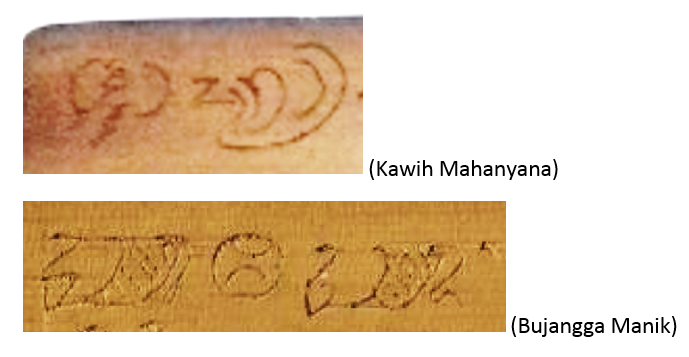
The symbol for the beginning of the text is quite different compared to Bujangga Manik mss. It is, somehow, look like stylisation of aksara "nga" with "long tail", rather than two independent vowel "a" with circle in between that used in Bujangga Manik.
The copper writing support called "paripih", as mentioned in Sanghyang Sasana Maha Guru. There are several interesting old Sundanese copper plate inscriptions dated from ca. 15th century AD known as Prasasti Kabantenan.
But, I'm not sure if these copper inscriptions are the 'paripih.' mentioned in SSMG. I found interesting word comparison in Balinese language > peripih, (meripih) wear an amulet, wear a magic belt <
It possibly has linguistic relation, of course, but the context of its function in the old Sundanese language is not quite clear.
Saya terutama berkontribusi di Wikipedia Bahasa Sunda (@suwikipedia). Sebuah kehormatan bagi saya bisa ikut berkolaborasi dengan para Wikipediawan dari seluruh dunia untuk berbagi pengetahuan dan manfaat Wikipedia.
Tahun 2019 lalu, saya didaulat oleh @wikimediaid untuk mengikuti Konferensi Wikimania di Stockholm, Swedia. Membagikan pengalaman berkontribusi di Wikipedia.
Tidak ada satu pun momen yang bernuansa tendensius di tengah keragaman bangsa, suku, bahasa, ras, agama, dan golongan. Yang ada hanya rasa kebersamaan dan kekeluargaan.
Di Wikipedia saya belajar memilih sumber yang terpercaya, memilah sumber yang relevan dan berimbang.
An old Sundanese text, Sanghyang Sasana Maha Guru,, mentioned ten types of writing support based on its material. They called as "Dasawredi"
The first five are metals, as mentioned:
"Sastra munggu dina omas,
sastra munggu ring salaka,
sastra munggu ring tambaga,
sastra munggu ring cundiga,
sastra munggu ring beusi,"
"The writing on gold,
writing on solver,
writing on copper,
writing on steel,
writing on iron,"
There is another building mentioned in Sewaka Darma: The palace of Batara Wisnu (Vishnu), which known as "Kahyangan Miru Hireng" or 'The Black Top of Heaven' at the north.
Its poles made of engraved iron, the roof of China iron, the floor of 'maléla' (alloy?) iron, the wall of yellow iron (brass?), and the roof top of 'panamar' (prestige?) iron.
Again, the same building also mentioned by Sri Ajnyana when he was in the heaven.