/1 Technical analysis is the lowest alpha generating framework of the different viable approaches to markets.
It is only incredibly popular because of how accessible it is for retail participants. It is only viable because some participants use it. It is circular.
/2 It is useful as a part of a trading framework (that sources its signals through other means) to choose entry and exit levels.
/3 Arguments for TA are caught in a double-bind: either it is alpha-generating, in which case it is equilibriumed out given its ease of use, or it is not, absent the mirroring effects.
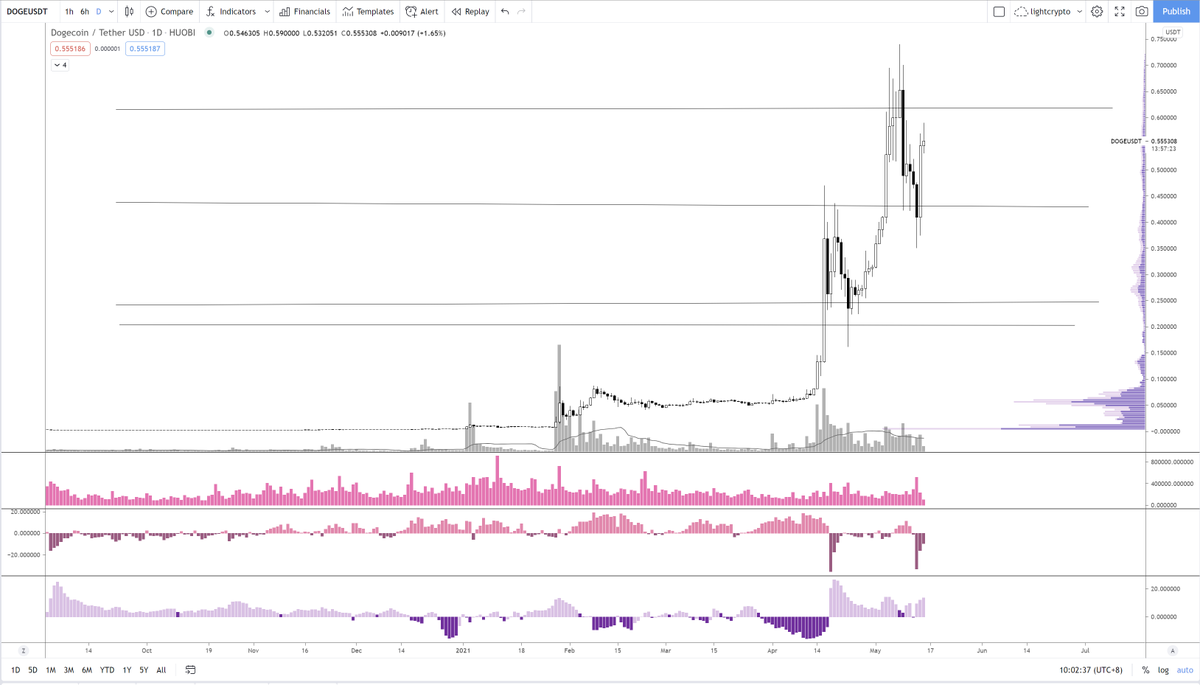
/4 Affection for TA among traders also stems from apophenia. To see this, simply hide the candles of the asset you are charting, draw some arbitrary lines, and then unhide the candles.
/5 Below I drew 4 random horizontals, and then turned back on the candles for DOGEUSDT.
Your mind will immediately be drawn to arbitrary interactions of the lines and the candles (see The Art and Science of Technical Analysis by Grimes).
/6 A caveat - technical analysis shines with assets that we have trouble valuing, during periods of market stress, and broadly, during moments of uncertainty where we congregate on simple shared beliefs.
/7 I'll end by saying that this isn't some sort of calling out of technical traders. I trade technically, in part. But obsessing over TA and not exploring other trading frameworks handicaps your development and profitability.
• • •
Missing some Tweet in this thread? You can try to
force a refresh

/2 If you let yourself, these are the days when you learn the most about markets, trading, and your own weaknesses.
A lot was lacking in my approach to this trade. I had not considered the different scenarios that could play out, and thus had no plan to meet them.
/3 I traded from reflex, not thought. And I did so from the short side, which compounded these errors.
Maybe I won't end up being the ultimate fish when the dust settles. I expect my short will end up profitable in the next week. Retail will, as usual, get stuck with the bag.
/1 I think it time for me to acknowledge that I was grossly off in a lot of my criticism of NFTs.
I owe thanks to those forward-thinking individuals whose exploration of this new creative medium changed my mind.
/2 However, a caveat - I continue in thinking that buying almost any NFT tradeable today will result in a net loss in 1 years' time and further.
/3 I have purchased a few NFTs myself and had a great time in doing so. I think part of my myopia stemmed from framing NFTs solely from the perspective of a trader. There are many other lens through which NFTs become much more persuasive.
/1 on the advantages of replacing high leverage margin swap/futures positions with options
/2 have heard anecdotes of participants losing large parts of their crypto holdings by chasing the bull market with mistimed leveraged longs and see thousands of nameless participants in the billions in notional that are liquidated on any material move in the markets.
/3 there are two enormous costs to engaging in this behavior:
1) poor traders tend to chase, margin longing after significant price moves up have already happened. combined with high leverage, this means they manage to lose money by being liquidated (force sold) on pullbacks.
An alt has the veneer of scarcity within its own system. But that mirage evaporates when it is viewed outside its border.
If an alt then lacks scarcity outside of its own confines, its only value stems from two sources: its use case as a speculative vehicle and the minimum amount necessary to be held at any one time to achieve its demanded utilization.
Remember this chart if anyone dares tell you there is scarcity in alts; ~7,500 alts are listed on CMC alone (more than 2x the count from 1 year ago), with 2x+ that number unlisted and floating in the ether.
One alt threatens the scarcity of BTC. Many alts only ossify it.