Thread: Excerpt from "Srpski mitološki rečnik" (Serbian mythological dictionary) dlscrib.com/download/srpsk…
"Holy oak - In the recent past, Kuči (Tribe from Montenegro) did not have a single whole church. The people had no place to gather or perform religious rites..."
"Holy oak - In the recent past, Kuči (Tribe from Montenegro) did not have a single whole church. The people had no place to gather or perform religious rites..."

"...Feeling the need for a consecrated place they turned to oaks, a practice common among other Serbs and which, in all likelihood, has its origins in a very ancient, pre-Christian veneration of oaks, and trees in general, among the Slavs..."
"...Any large oak growing in a conspicuous place in or near the village became the village temple. The priest performed church rites under it. People gathered around it for village assemblies and celebrations... "
"...The ground around these holy oaks was considered consecrated too, so people buried their dead around some of these holy oaks too..."
Cemetery from Gornja Morača region in Montenegro inhabited by Serbs, with an ancient oak growing in its centre
oldeuropeanculture.blogspot.com/2018/09/mounta…
Cemetery from Gornja Morača region in Montenegro inhabited by Serbs, with an ancient oak growing in its centre
oldeuropeanculture.blogspot.com/2018/09/mounta…

"...Even now, very old oaks can be seen growing in many old Kuči cemeteries. And in Kuči villages that do not have their own churches, in the middle of the village there is a consecrated oak, around which stone slabs are arranged for sitting..."
These holy trees were once indeed found in every Serbian village. A large cross, often made of stone, may be erected beside the holy tree, and the surrounding area may be fenced...
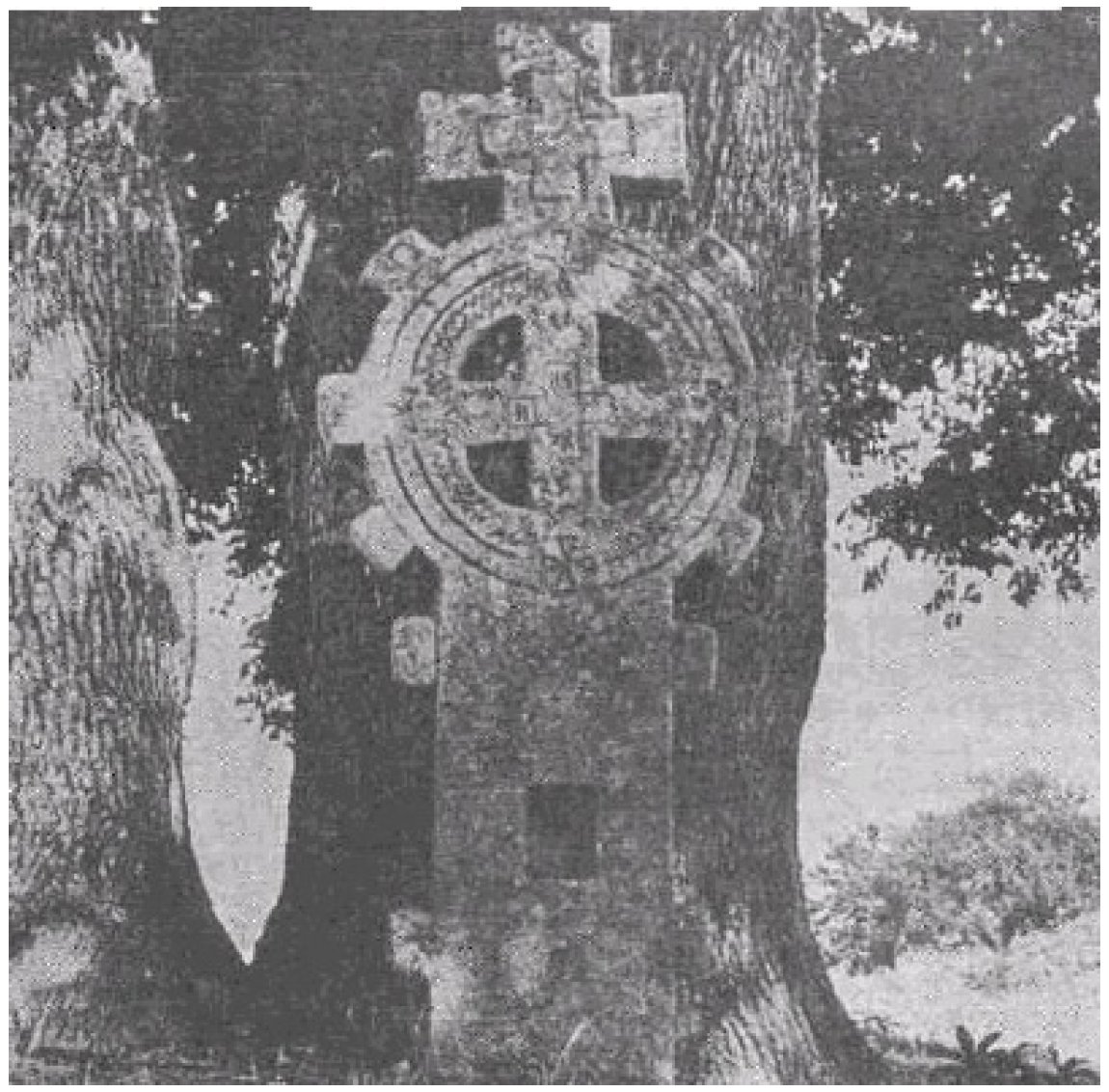
The most common name people use for these holy trees, is "zapis" literally "inscription", the name most likely derived from the fact that all these sacred trees were at some stage Christianised by a cross "inscribed", cut into, the tree trunk...
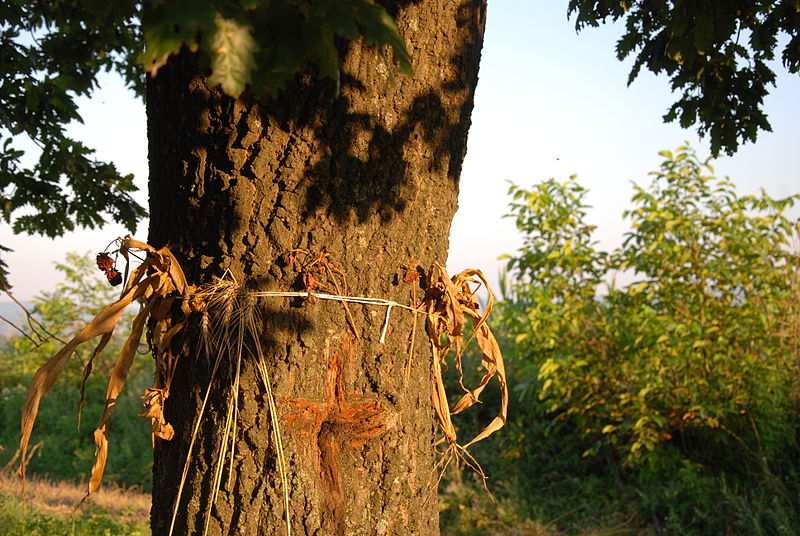
People believed that these trees protected the village on whose land they grew. In settlements without a church, ceremonies such as weddings and baptisms were once conducted under the tree...
Even in villages which had churches, the village church ceremonies, like celebrations of the village Saint, the protector of the village, were held under these holy trees...

Particularly prayers to God for protection against destructive weather conditions were always held under the village holy tree. Interestingly, most of these trees were large oaks, the holy trees of the Slavic Thunder God Perun...
https://twitter.com/serbiaireland/status/1212680631269896192
People firmly believed that a great misfortune will befall anyone that dares fell a zapis (sacred tree). Climbing it, sleeping under it, and picking its fruits and twigs, were also forbidden. Even the branches and fruits that fell from the tree were never collected...
A village may have had more than one zapis: the main one in the settlement or near it, and several others in the village's fields, usually chosen so that they mark the village boundaries...
This was done both to insure magical protection of the village land, but also to protect the village land boundaries from being changed, as there was a taboo about cutting these trees...Hence they preserved borders between villages and peace...
In that way holy trees played the role similar to ancient boundary stakes, which eventually became standing stones and totems. I talked about them here oldeuropeanculture.blogspot.com/2020/04/stake.…
oldeuropeanculture.blogspot.com/2020/04/coloss…
oldeuropeanculture.blogspot.com/2020/04/coloss…
According to Serbian scholar Veselin Čajkanović, the veneration of the "zapis" holy trees is inherited from the pre-Christian religion of the Serbs, in which it had been used as a temple...
The proof for that can be found in reports left by Christian missionaries in all Slavic land. One of the main accusations against Slavs found in all of them was that "Slavs venerated trees, stones and wells (springs), to which they prayed and sacrificed"...
How the Pagan Slavs saw and respected trees, particularly oak, can be seen from Serbian Yule log rituals, during which an oak tree is addressed as god, prayed to and sacrificed to
https://twitter.com/serbiaireland/status/1337096668748066816
You can find these church reports accusing Slavs of tree worship listed in this article (Serbo-Croatian):
A lot of other interesting Slavic plant related folklore too...
https://twitter.com/serbiaireland/status/1409461094423400450
A lot of other interesting Slavic plant related folklore too...
These church reports also state the measures undertaken to "Christianise" Slavic peasant population, which involved cutting holy trees and groves, with the intention to eradicate the vile tree worship...
This was obviously only partially successful, as you can see from the above thread... 🙂
Anyway, you might find this thread interesting too. It is discussing how old this tree worship could be. Somewhere in there is a link to a very interesting article about Hazel tree worship
https://twitter.com/serbiaireland/status/1255609710176280577
And this thread about willow folklore could be of interest too...
https://twitter.com/serbiaireland/status/1376212056148488192
• • •
Missing some Tweet in this thread? You can try to
force a refresh