Sharing our updated pre-print on Delta Variant and emergence, replication and immune evasion properties. We previously reported partial evasion of neutralising antibody responses following vaccination and breakthrough in vaccinated health care workers. biorxiv.org/content/10.110…
We now further define Delta immune evasion using a panel of 38 monoclonal antibodies, showing significant loss of potency of NTD and RBD targeting antibodies. Imdevimab, part of the REGN2 dual monoclonal antibody cocktail is compromised by Delta.
We also show loss of activity for casivirimab, part of the Lily dual therapy cocktail. These dual therapies could be less effective against Delta particularly in the setting of immune compromise could lead to escape variants emerging/ transmitting.
Taking replication we originally showed increased growth of Delta virus in vitro using airway organoids compared to Alpha. Now we show increased virus production in two other systems: Calu-3 epithelial lung cell lines (shown here) and airway epithelial cells (@wendybarclay11)
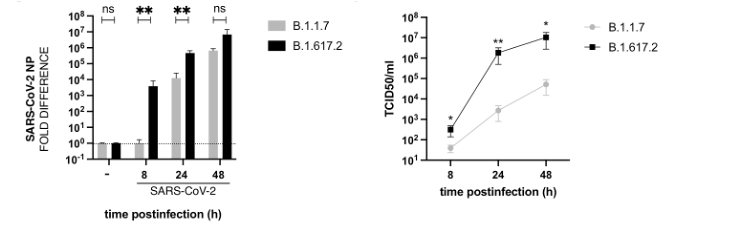
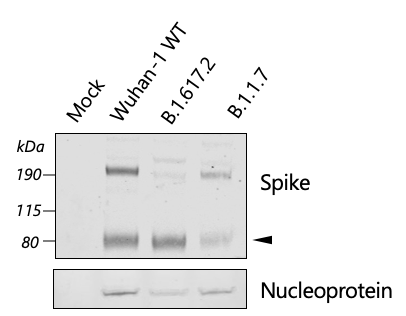
We also found that the Delta virus appears to be in a predominantly cleaved form as compared to Alpha. This may suggest that each virus particle is more infectious in addition to more virus particles being produced
These properties likely explain vaccine breakthrough. We provide data on 132 Delta infections in partially/fully vaccinated hospital staff (25% non-Delta and 75% Delta). We found ChAdOx-1 efficacy to be lower against Delta compared to non-Delta in those who received two doses.
• • •
Missing some Tweet in this thread? You can try to
force a refresh

Is Delta 25% more transmissible😑? 50%😳? 100%😱? Read on for the answer...But first: we argue that transmission is only half the story! Breakthrough infections and our lab studies point towards significant immune evasion, something seen with Beta and Gamma (but not Alpha).
In India’s second wave, mathematical modelling suggests that Delta reinfected many who had been infected in the first wave. How do we know? @creswapi, @MellanTom, @charliewhittak fit a 2-category Bayesian disease transmission model to genomic surveillance, serology, and deaths.
Following the prelim data presented last week, here is our pre-print on B.1.617. Key points: 1. B.1.617 appears to have modestly reduced in vitro susceptibility to neutralising antibodies generated after vaccination. biorxiv.org/content/10.110…
2. We show that vaccinated individuals can be infected with B.1.617, but without severe disease. The data go some way to explaining the dominance of this variant in a partially immune population, but highlight that vaccination is still protective for the majority of people.
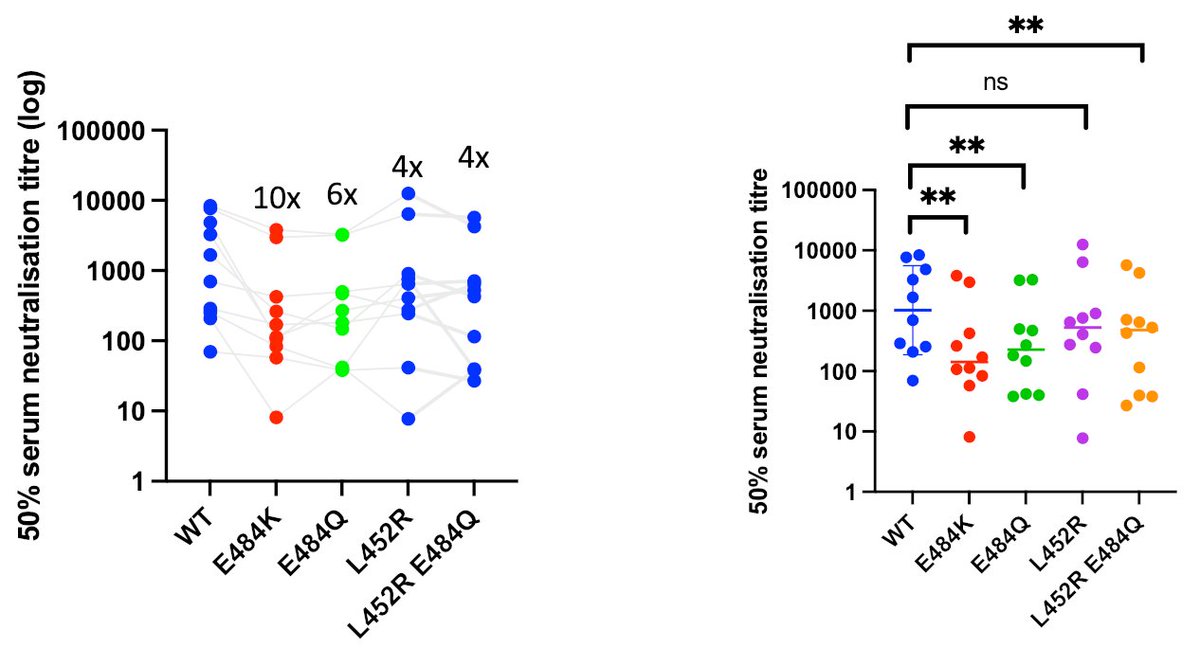
Given the dire situation in India and questions regarding the new variant B.1.617, the so called ‘Double Mutant’ we are sharing some prelim analyses on viruses with either or both of the mutations E484Q and L452R in the critical receptor binding domain that our antibodies target
One key question is whether these mutations together are able to overcome immunity from vaccines and natural immunity from past infections. We tested serum from 9 young individuals (<50 years old) who had one dose of the Pfizer vaccine 4-12 weeks prior to the blood sample.
E484K seen in B.1.351 and P.1 (ex SA and Brazil), gives around a ten fold loss of neutralisation. B.1.617 has E484Q which has not been studied. E484Q has a smaller, 6 fold loss. The second mutation, L452 has a 4 fold effect(not statistically different to Wuhan-1 D614G here).
Antibody levels were much higher after the second dose as expected. Following the first dose, three times more serum was needed to block B.1.1.7 and following second dose around two fold more. This small change is only likely to be relevant in those with low antibody levels.
We also noted that B.1.1.7 viruses with E484K were transmitting in the UK. We tested vaccine and convalescent sera against B.1.1.7 Spike bearing pseudoviruses +/-E484K. There was a larger drop in neutralisation against B.1.1.7 E484K (vaccine sera 6x; convalescent sera 11x).
Following on from the first dose Pfizer data below where 7/15 participants above the age of 80 did not achieve neutralisation of virus, we report that all 15 have achieved neutralisation 3 weeks after second dose.
It could be that >80 yo are slower in mounting responses but this is unlikely and also leaves people vulnerable despite vaccine. Remember >80 y o are not featuring in trials so they might still get severe disease. Pre print to come but significant delays.
We should add that the second dose was given at 3 weeks after the first. Likely we should stick to this schedule in those above 80 years. Huge effort from @damicollier@rpdatir@CambridgeBRC
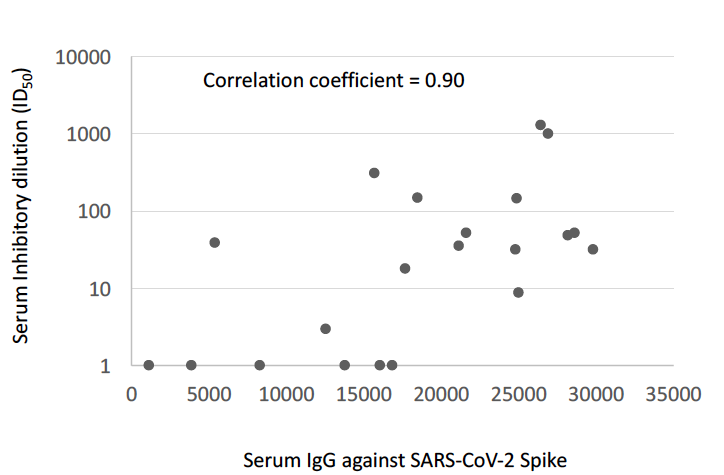
Sharing some real world data on antibody responses to the Pfizer mRNA vaccine. We tested serum from 23 participants (median age 82) vaccinated with the first dose 3 weeks previously.
Serum IgG antibodies against Spike were measured with a luminex assay. Virus neutralisation by participant serum was measured with a virus pseudotyping system where virus particles are made that express the SARS-CoV-2 Spike protein. The figure shows that the two were correlated.
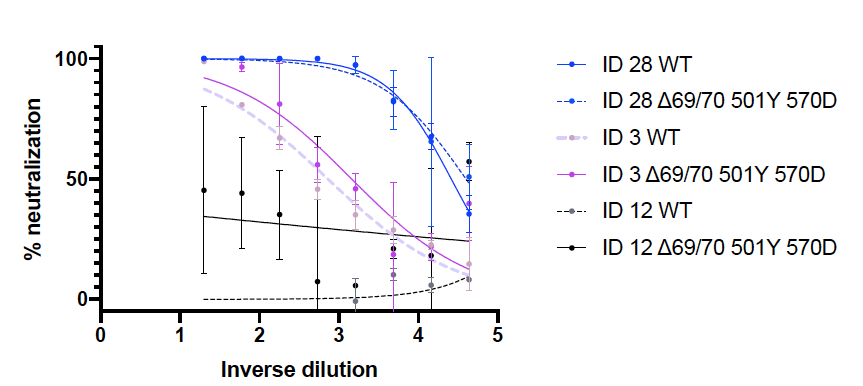
All participants under 80 (n=8) demonstrated reasonable neutralisation titres against wild type virus (D614G). However, 7/15 of those above 80 failed to neutralise virus to 50%. In blue and purple are participants who neutralised virus. In grey is a participant that did not.