I've seen a number of people claiming our education system is just fine when it comes to history because we teach kids about "slavery" and "racism."

Well, my history education was not fine: A 🧵
I grew up in the northeast. I went to a public high school. I have a college degree, a masters-level seminary degree (with an emphasis in church history), and a law degree (from a top 25 law school). Here are *some* of the things I never learned about:
1. Nobody ever told me about lynching, much less its purpose (intimidate blacks out of voting), its frequency (at the peak, in 1892, averaging 4+ a week), the horror (burning alive, cutting off fingers and toes as souvenirs, pregnant women), or the spectacle (1000s of observers).
2. Nobody told me that lynchings were announced (date, time, and place) in advance in newspapers, pictures were taken of the participants, post cards of the event were produced and sold, and then newspapers would report that the lynching was "at the hands of persons unknown."
3. Nobody told me about the collapse of Reconstruction after our nation lost the political will to see it through.

4. Nobody told me that the federal govt paid reparations to slaveowners while they bankrupted freed slaves through the derelict management of the Freedman's Bank.
5. Nobody told me about the Wilmington coup of 1898, in which white supremacists overthrew the duly elected, integrated government of the city by force while the NC Governor and US President stood idly by.
6. Nobody told me that, in 1901, Alabama held a constitutional convention to adopt amendments to the state constitution to (in the words of the president of the convention) "establish white supremacy in this state."
7. Nobody told me about the Tulsa Massacre of 1921, in which hundreds of blacks were killed and 35 blocks of their neighborhoods destroyed by an angry white mob. Nor did anyone tell me that no one was held accountable for any of this.
8. Nobody told me about Bloody Sunday in Selma in March of 1965.

9. Nobody had me read any of the major speeches or writings by Martin Luther King, Jr.
10. Nobody told me that, prior to the Voting Rights Act of 1965, essentially no blacks were able to vote in the South.
11. Nobody told me that, after the assassination of MLK in April 1968, a major party presidential candidate ran--and won in Nov 1968--on a platform challenging the civil rights movement.
12. Nobody told me that, until 1977, the Mississippi State Sovereignty Commission was a state-funded agency that existed to investigate people associated with the civil rights movement and to protect the state from "encroachment" by the federal government.
13. Nobody, at the SBC seminary where I took Baptist history, told me that the SBC was founded on a theology of white supremacy. Looking back at my class notes, there is only passing reference to the slavery issue involved in the founding.
14. Nobody in my church history classes in seminary exposed me to any of the thought of black theologians or the ministers who led the civil rights movement.
I suppose it's possible that I just got a singularly awful history education that is not reflective of what others received.

OR, maybe the passing references we teach about "slavery" and "racism" are sanitized to make us all feel less bad.

• • •

Missing some Tweet in this thread? You can try to force a refresh

 

Keep Current with Matthew Martens

Matthew Martens Profile picture

Stay in touch and get notified when new unrolls are available from this author!

Read all threads

This Thread may be Removed Anytime!

PDF

Twitter may remove this content at anytime! Save it as PDF for later use!

Try unrolling a thread yourself!

how to unroll video
  1. Follow @ThreadReaderApp to mention us!

  2. From a Twitter thread mention us with a keyword "unroll"
@threadreaderapp unroll

Practice here first or read more on our help page!

More from @martensmatt1

17 Jul
Wild story about the 1898 white supremacist coup in Wilmington, NC: a 🧵

In 1885, a small group of members from First Baptist Church of Wilmington started a Sunday school class in a vacant store owned by the Police Chief John Melton.
/1
That small Sunday school class grew quickly and, in 1886, was organized as Brooklyn Baptist Church of Wilmington. The first worship service of this new church was held on Apr 4. In Nov 1893, the church called as its pastor the Rev. John W. Kramer.

/2
In Nov 1898, white supremacists in Wilmington rigged the election of county officials and then violently overthrew the existing city government. Rev. Kramer was a significant participant in the riot and overthrow of the city government.

/3
Read 8 tweets
3 Jul
If your grandparents robbed a bank and bequeathed the stolen money to your parents who then bequeathed it to you, would you (if you are a Christian) believe that you had a moral obligation to repay the inherited money to the bank? Even though you didn’t rob the bank?
In 1898, 73% of revenue of state of Alabama was derived from convict leasing. It was stolen money. Which means that whatever assets the state government of Alabama holds *today* were obtained in part with stolen money. Is there a moral obligation to give the money back?
I don’t need the story of Zacchaeus to understand that. I can get that from the Eighth Commandment.

#reparations

@dukekwondc
Read 4 tweets
2 Jul
I listened to a podcast this week hosted by a conservative at a prominent DC think tank with a large following. He claimed that MLK didn’t believe the US was systemically racist. His evidence for this claim was King’s 1963 “I Have a Dream” speech.

Actually . . .
“White Americans must recognize that justice for black people cannot be achieved without radical changes in the structure of our society.” — #MLK (Where Do We Go from Here? 1968)
“The problems of racial injustice and economic injustice cannot be solved without a radical redistribution of political and economic power.” — #MLK (speech to the SCLC board, Mar. 30, 1967)
Read 4 tweets
2 Jul
A 🧵 about today’s SCt opinion concerning the Voting Rights Act:

For nearly a century after the Civil War, numerous southern states passed laws denying Blacks the educational and economic opportunities available to whites./1
Those states passed laws using those denials of educational/economic opportunities as a reason to deny the right to vote. States passed poll taxes and literacy tests — statues that were racially colorbkind but effectively put voting beyond the reach of black Americans./2
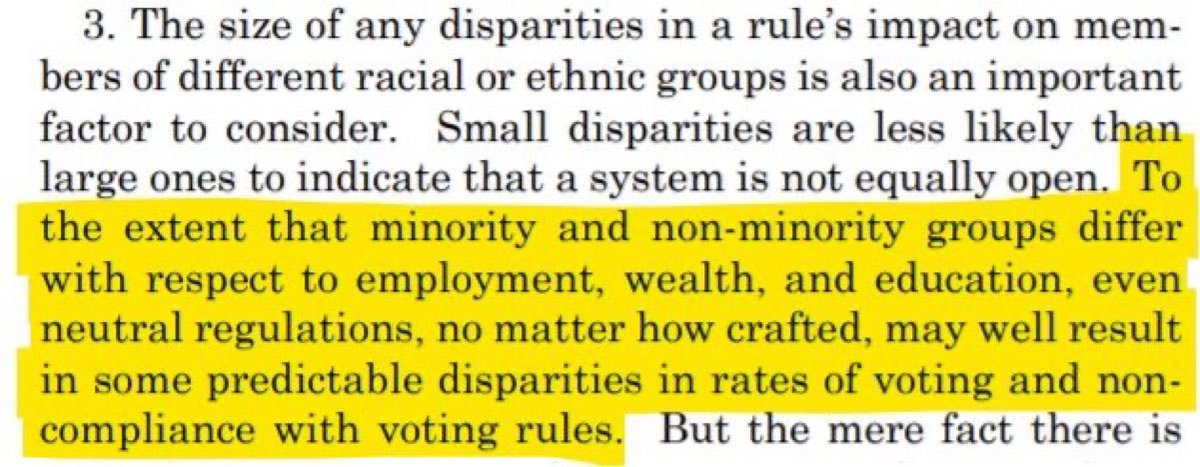
Despite that history, the SCt ruled today that the Voting Rights Act does not prohibit states from enacting laws that disparately impact black voters in their right to vote because of those still present educational and economic disparities./3 Image
Read 4 tweets
29 Jun
My other primary disappointment with both “Confronting Injustice” (by @ThaddeusWill) and “Fault Lines” (by @VoddieBaucham) was the failure to really grapple with the argument being made by some about the relevance of racial disparities in outcome. /1
Let me say first that Professor Williams is certainly correct that racial disparities do not *necessarily* point to a racist cause. /2
But since race has no biological relationship to morality/ability, we wouldn’t expect race to correlate with unfavorable outcomes in wealth, achievement, or education any more than we would expect something like shoe size to correlate with unfavorable outcomes in those areas. /3
Read 9 tweets

Did Thread Reader help you today?

Support us! We are indie developers!


This site is made by just two indie developers on a laptop doing marketing, support and development! Read more about the story.

Become a Premium Member ($3/month or $30/year) and get exclusive features!

Become Premium

Too expensive? Make a small donation by buying us coffee ($5) or help with server cost ($10)

Donate via Paypal Become our Patreon

Thank you for your support!

Follow Us on Twitter!

:(