Firms in a post-Keynesian model be like:
(Pulling from "Introduction to Post-Keynesian Economics by Marc Lavoie")
Firms here are not assumed to be profit-maximizing, but rather want to ensure their own survival. So, they want to gather economic power, to keep out new firms and control markets.
That means they need to grow. Firms that don't keep up with the growth of the market will be overtaken and fail. Growth, of course, requires capital expenditures and R&D. Yet how can firms get the funds required for that spending? It's simple: with profits.
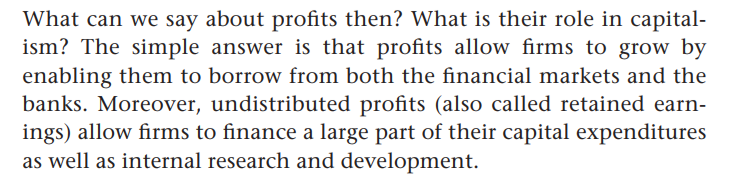
Lenders and firms both want to limit their risks here (firms don't want to default because it threatens their survival). So, more profits means more money can be borrowed for investments, which means more growth.
In naive neoclassical models, the assumption of decreasing returns to scale (AKA increasing marginal costs) limits the size of firms. But empirically, this doesn't seem to hold in most industries.
Instead, what limits firms here is that while they want growth, they need enough profits to finance that growth, and don't want to take on too much risk.

• • •

Missing some Tweet in this thread? You can try to force a refresh

 

Keep Current with Keegs 🏳️‍🌈

Keegs 🏳️‍🌈 Profile picture

Stay in touch and get notified when new unrolls are available from this author!

Read all threads

This Thread may be Removed Anytime!

PDF

Twitter may remove this content at anytime! Save it as PDF for later use!

Try unrolling a thread yourself!

how to unroll video
  1. Follow @ThreadReaderApp to mention us!

  2. From a Twitter thread mention us with a keyword "unroll"
@threadreaderapp unroll

Practice here first or read more on our help page!

More from @LittleKeegs0

9 Sep
Here's an interesting question: what do you think is wrong about this meme? I can think of quite a few things.
What comes to mind to me:
1. This article, basically. We should use more clear terms.
mattbruenig.com/2021/05/12/the…
2. Housing in general ought to be socialized, and folks should still pay rent for equity reasons.
peoplespolicyproject.org/2018/01/26/how…
3. By making the "surplus value" pile bigger than the "fruits of your labor" pile, I think they mean to say there's more surplus value than wages. This seems clearly wrong.
apps.bea.gov/iTable/iTable.…
Read 5 tweets
26 Aug
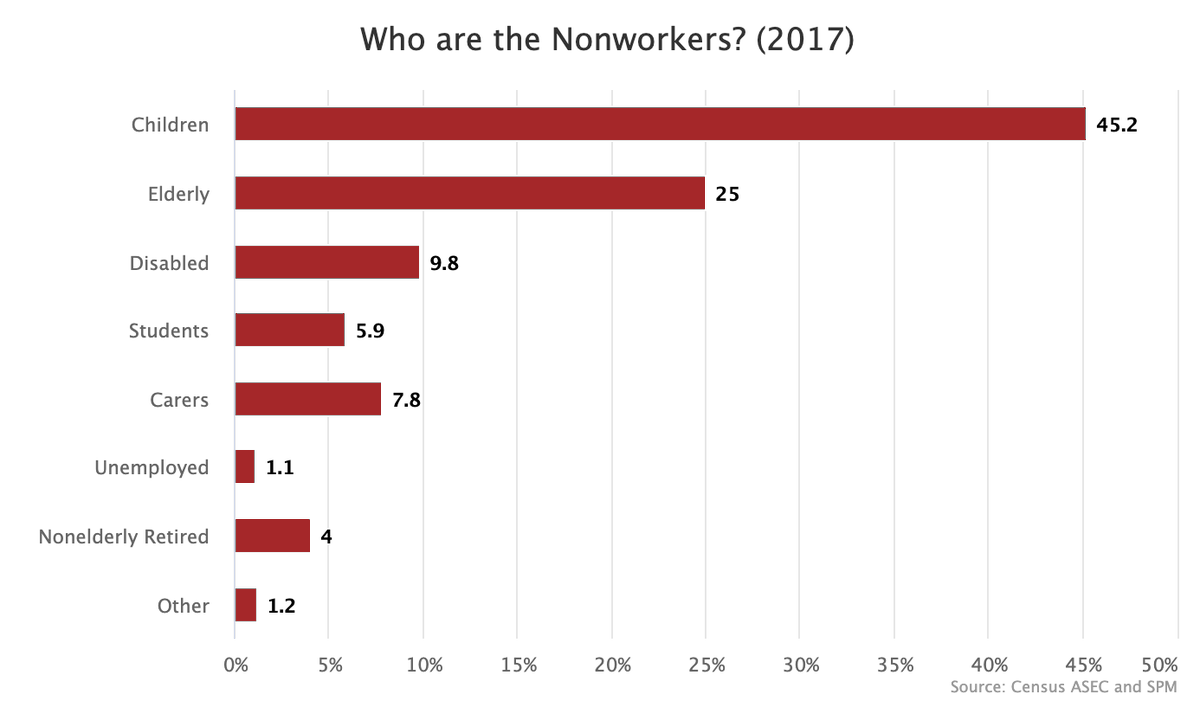
How I think about guaranteed income is that workers and all of these groups need to get income. The simplest way to do this is with UBI, of course, with its high headline cost. Some proposals reduce that cost by excluding children and/or the elderly.
After all, we can ensure their coverage with a child allowance and minimum benefit at the poverty line. But why not go farther? With full-time workers, a $15 minimum wage should get families without non-workers out of poverty.
Give disabled folks a minimum benefit too, give students free room and board (or a cash alternative), and add a caregiver allowance. Add that up, and basically everyone (outside of able-bodied people aged 19-64 who don't work, attend college, or caregive) would be out of poverty.
Read 8 tweets
27 Jul
When they say the panel has "some of the most distinguished thinkers on the topic of social democracy" but I don't see any Twitter mutuals
(Commenting as I listen)
I really like the idea that the neoliberal turn involved a shift from thinking the economy is something we manage, to thinking we must adapt to global markets that are outside our control. This still shows up in lots of left party rhetoric outside the US.
It's hard to describe exactly, but something I've picked up from reading social democratic writings and and about the '70s and '80s was this looming sense of dread, that it was all about to fall apart.
Read 10 tweets
11 Jul
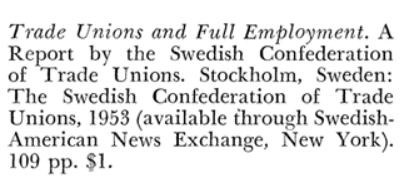
It looks like Meidner presented a paper called "Trade Unions and Full Employment", which explained the Rehn-Meidner model, to the LO Congress in 1951. Does anyone know where I can get the translated text of that paper?

cc: @jdcmedlock @ColinJMcAuliffe
If you can only find it in Swedish, that's a great start! I would pay to have it translated honestly.
Looks like it is available in English somewhere!
journals.sagepub.com/doi/abs/10.117…
Read 4 tweets
5 Jun
I'm very curious to hear from folks why they've changed to different ideologies over time. Did your ethics change? Did you get new evidence, new theory, or did you just abandon an ideology after you learned more about it? How long did the changes take?
I've been a committed utilitarian since maybe 10th grade, before I even knew the word "utilitarian". Sans a period when I was specifically a positive utilitarian in like the first year of college, that hasn't changed.
I've always been left-wing, grew up in a fairly liberal household. But in a vague sense, ofc didn't know much policy when I was very young. Reading "Conscience of a Liberal" in 2014 or so started giving me some solid positions.
Read 17 tweets
4 Apr
From "The Three Worlds of Welfare Capitalism, on Sweden":
Labor force participation for women with kids 0-2 went from 43% in 1970 to 82.4% in 1985. But, on any given day, 47.5% of those women were absent from work, but still being paid.
Lots of paid leave policy was implemented on that period. In 1980, EXCLUDING vacation and holidays, workers on average spent 11.2% of their hours absent but paid.

This represents a move towards decommodification of labor time:
"The welfare state has taken upon itself to permit employees to pursue non-work related activities within the work contract".
Read 4 tweets

Did Thread Reader help you today?

Support us! We are indie developers!


This site is made by just two indie developers on a laptop doing marketing, support and development! Read more about the story.

Become a Premium Member ($3/month or $30/year) and get exclusive features!

Become Premium

Too expensive? Make a small donation by buying us coffee ($5) or help with server cost ($10)

Donate via Paypal Become our Patreon

Thank you for your support!

Follow Us on Twitter!

:(