It looks like Meidner presented a paper called "Trade Unions and Full Employment", which explained the Rehn-Meidner model, to the LO Congress in 1951. Does anyone know where I can get the translated text of that paper?

cc: @jdcmedlock @ColinJMcAuliffe
If you can only find it in Swedish, that's a great start! I would pay to have it translated honestly.
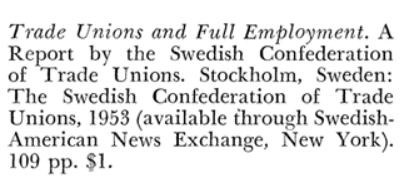
Looks like it is available in English somewhere!
journals.sagepub.com/doi/abs/10.117…
Another one, where did these people get this?
academic.oup.com/cje/article-ab…

• • •

Missing some Tweet in this thread? You can try to force a refresh

 

Keep Current with Keegs 🏳️‍🌈

Keegs 🏳️‍🌈 Profile picture

Stay in touch and get notified when new unrolls are available from this author!

Read all threads

This Thread may be Removed Anytime!

PDF

Twitter may remove this content at anytime! Save it as PDF for later use!

Try unrolling a thread yourself!

how to unroll video
  1. Follow @ThreadReaderApp to mention us!

  2. From a Twitter thread mention us with a keyword "unroll"
@threadreaderapp unroll

Practice here first or read more on our help page!

More from @LittleKeegs0

5 Jun
I'm very curious to hear from folks why they've changed to different ideologies over time. Did your ethics change? Did you get new evidence, new theory, or did you just abandon an ideology after you learned more about it? How long did the changes take?
I've been a committed utilitarian since maybe 10th grade, before I even knew the word "utilitarian". Sans a period when I was specifically a positive utilitarian in like the first year of college, that hasn't changed.
I've always been left-wing, grew up in a fairly liberal household. But in a vague sense, ofc didn't know much policy when I was very young. Reading "Conscience of a Liberal" in 2014 or so started giving me some solid positions.
Read 17 tweets
4 Apr
From "The Three Worlds of Welfare Capitalism, on Sweden":
Labor force participation for women with kids 0-2 went from 43% in 1970 to 82.4% in 1985. But, on any given day, 47.5% of those women were absent from work, but still being paid.
Lots of paid leave policy was implemented on that period. In 1980, EXCLUDING vacation and holidays, workers on average spent 11.2% of their hours absent but paid.

This represents a move towards decommodification of labor time:
"The welfare state has taken upon itself to permit employees to pursue non-work related activities within the work contract".
Read 4 tweets
3 Apr
Did not think "The Three Worlds of Welfare Capitalism" would build up to such a incisive and devastating critique of capitalism. This book slaps
The critique is basically that capitalism can't handle the wage demands of full employment while maintaining decent growth and low, steady inflation.
High wage demands lead to lowered profitability, therefore less investment and less growth. It also leads to wage-push inflation.
Lowered competitiveness too! You can attempt to divert these wage demands into welfare state expansion ("only raise wages by 5% and gov. will increase pensions by 5%"). This requires tight solidarity between workers and non-workers. But even then, consumption remains high.
Read 11 tweets
2 Apr
A farmer-labor alliance backing socdem parties was key to the success of post-war Scandinavian countries. What's interesting is how they differed: in Denmark, farmers held more power and numbers, leading to more of a focus on price stability and agricultural subsidies for a time.
In Norway, the Labor party alone held a majority of seats in parliament from 1945-1961. They used this dominance to command a large amount of investment.

In Sweden, labor was particularly strong, thus leading to the labor-focused Rehn-Meidner model.
A wage policy, vs. Norway's credit policy. This model requires high investment & employer confidence, which started to fall in the mid 1970's. Of course, if governments controlled more investment and employed more people in the first place, this would be much less of an issue!
Read 7 tweets
30 Mar
It made sense for early liberals to oppose ​the state, as it was usually an oppressive, aristocratic institution vs. the potential freedom of the market.

It made sense for early socialists to oppose the state, as it was controlled by capitalists, with voting highly limited.
But these views are now both outdated. The market is the main aristocratic and oppressive force. States are complex, and voting rights are often under attack, but the same restrictions no longer exist. The state now can be, and is, regularly used as a tool for good by the people.
I think a lot of people get brainworms because they read some older texts that haven't grappled with the fact the state is fundamentally different nowadays. And they couldn't have grappled with it, the changes hadn't happened yet!
Read 6 tweets
9 Jan
Might as well respond to this article that's been going around:
currentaffairs.org/2021/01/the-on…
Hey, I'm right here!
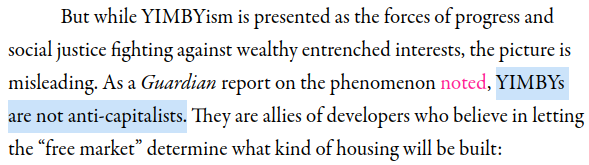
Anyways, I've seen this confusion around many things. A simple rephrasing of econ 101 in terms of class conflict should clear things up: we want the capitalist class to have internal conflict through competition, as this will leave normal folks better off. Image
At the extreme end, it's easy to see why anti-capitalists would prefer a perfectly competitive market to a perfect monopoly.
Now of course, certain things are natural monopolies that we want the public to take over. But housing is certainly not one of those.
Read 14 tweets

Did Thread Reader help you today?

Support us! We are indie developers!


This site is made by just two indie developers on a laptop doing marketing, support and development! Read more about the story.

Become a Premium Member ($3/month or $30/year) and get exclusive features!

Become Premium

Too expensive? Make a small donation by buying us coffee ($5) or help with server cost ($10)

Donate via Paypal Become our Patreon

Thank you for your support!

Follow Us on Twitter!

:(