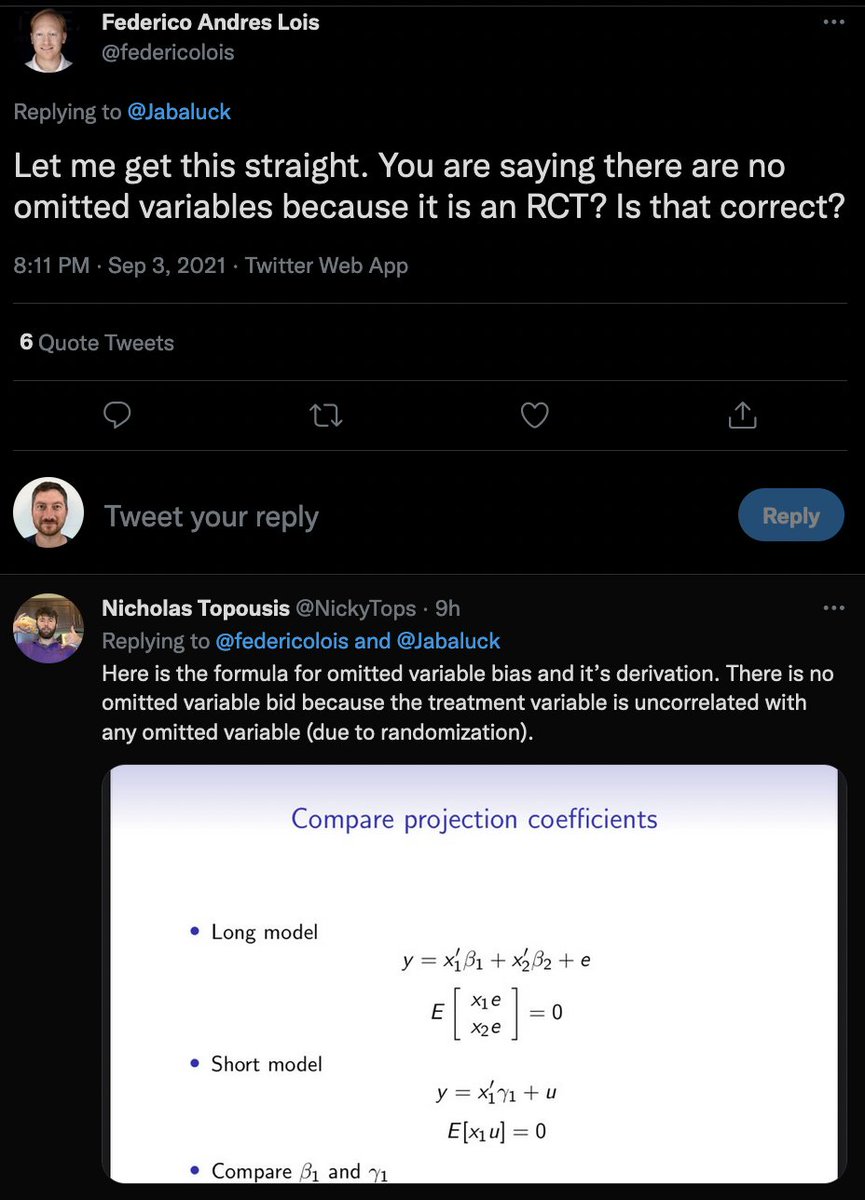
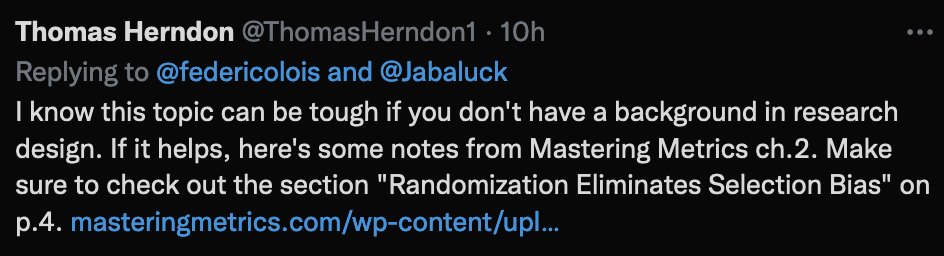
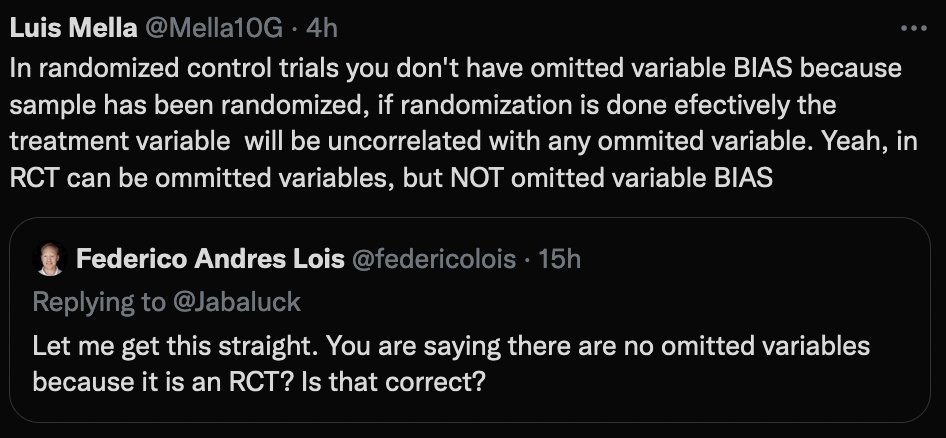
I'm sad and annoyed that my community is humiliating and ridiculing someone who has a deficient understanding of econometrics and was not modest about it. This is not the #EconTwitter I know and love.
A rope: 1/n
I can understand that it's frustrating for @Jabaluck and colleagues to pull of an amazing study and then have to deal with confident but wrong takes. I also understand getting impatient with them and clapping back a little at some point. But: 2/n
1. Losing our patience is not something to be proud of. *We are teachers.* We shouldn't kick down to people who don't get it. Even if they're obstinate about it: Others are watching. Humiliating people is distasteful, ineffective, and a partial mission failure. 3/n
2. Crucially, while even the best of us can have such moments, the rest of us should not celebrate this and add to the humiliation. We came across here as arrogant, gate-keeping tribalists with sneering disdain for the unenlightened. *This is why people dislike economists!* 4/n

3. What angers me is that this damages the larger mission. People: If we behave like this, others don't want to work with us! We cannot complain that policy isn't evidence-based, and at the same time display such rudeness and cruelty. 5/n
4. In the concrete case, with some empathy and willingness to understand the intended meaning, productive corrections without condescension were possible. Here are some nice examples. 6/n
I'll conclude by saying that the mask RCT by @Jabaluck, @mushfiq_econ, and others is one of the most impressive and inspiring pieces of research I've ever seen. Thanks to them, both for the huge public health contribution, and for modeling what amazing science can look like. 7/7
• • •
Missing some Tweet in this thread? You can try to
force a refresh

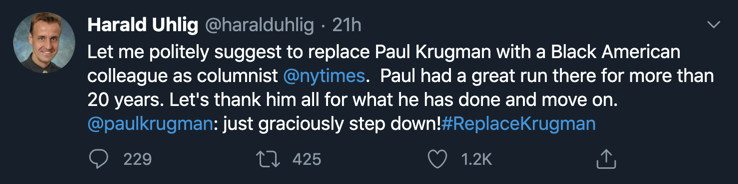
Today @haralduhlig, lead editor of the @JPolEcon, a prominent journal in economics, called for @paulkrugman to step down as @nytimes columnist to make room for a POC. I think this is an important moment for the economics profession because of the context of this tweet. Thread:
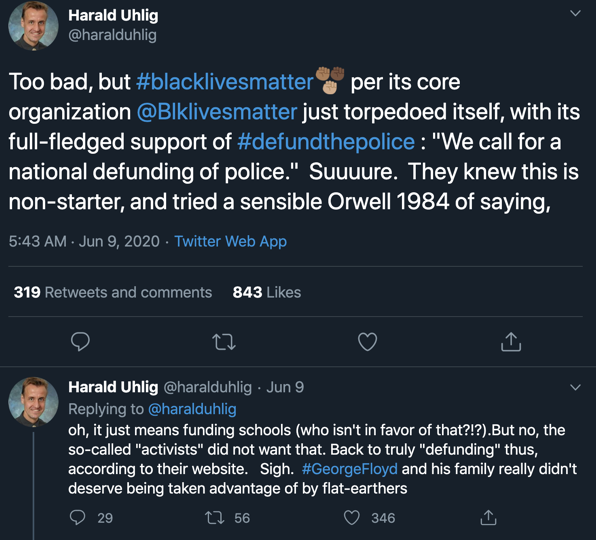
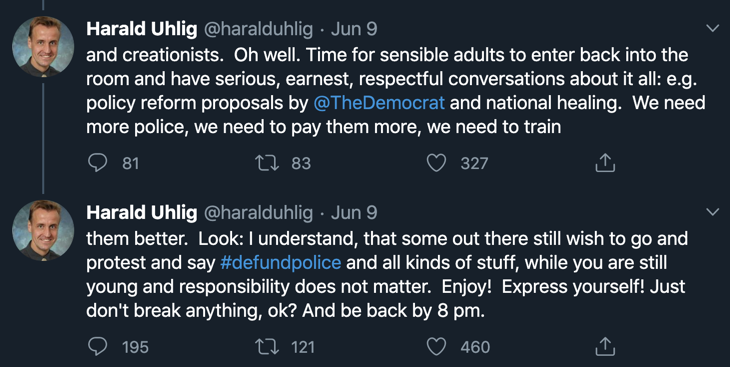
In June, Uhlig called BLM members who advocated defunding the police "flat-earthers and creatonists": "some... wish to go and protest... while you are still young and responsibility does not matter. Enjoy! Express yourself! Just don't break anything, ok? And be back by 8pm."
In response to the ensuing criticism of these statements, he posted an apology thread that was a spectacular exercise in not apologizing; some details here:
This is a non-apology apology @haralduhlig. You first apologize for having irritated people. Not for the substance of what you said, but for their reaction. Not a good start. [thread]
Then you apologize for having chosen the wrong words and comparisons. Not the substance of your wholesale dismissal of particular goals of BLM, but how you put it. To be fair, your tone was a significant part of the problem. But then you double down:
1. "There are many thoughtful and sensible voices on what needs to be done". You again make yourself the arbiter of what is thoughtful. You have squandered the privilege of being taken seriously on what's thoughtful after the display of the last few days, at least for a while.
I often run into randomized experiments (and am guilty myself) where treatment is much more expensive than control, but sample sizes in the two groups are equal. Has been said before but bears repeating: when c(T) > c(~T), the optimal sample size ratio T/~T is sqrt((c(~T)/c(T)).
Implications: 1. With fixed budget B and sigma1=sigma0, the power-maximizing group sizes are n(~T)*=B/ (sqrt(c(~T)*c(T))+c(~T)) and n(T)*=B/(sqrt(c(~T)*c(T))+c(T)).
2. With desired effect size delta & power beta: n(~T)*=t_MDE^2/delta^2 *(1+sqrt(c(T)/c(~T))); n(T)*=t_MDE^2/delta^2 *(1+sqrt(c(~T) /c(T))), where t_MDE=t_{alpha/2}+t_beta