wait until media companies learn that they can use NFTs to create a secondary market around membership, content & community.
what does this look like?
today, you pay $ in exchange for access to content. that relationship breaks as soon as the content becomes non-essential & you decide cancel your subscription. there is no penalty in leaving and usually it's cheaper to come back.
so why NFTs?
NFTs introduce a premium "ownership" tier to the subscription relationship. it means you:
1) hold a LE membership that includes benefits outside of content 2) own an asset that builds value as benefits & rarity accrue 3) can hold or sell based on interest of participation
the value moves from content to the individual. with premium "ownership" the subscription becomes a vehicle of value ($), status, identity and relationships (community). & it's not necessarily something someone wants to sell, in fact, it's influence/benefits can outweigh price.
• • •
Missing some Tweet in this thread? You can try to
force a refresh

we are entering the age of living online. As with the ‘real world,’ the things we own enable important connections to other people. /2
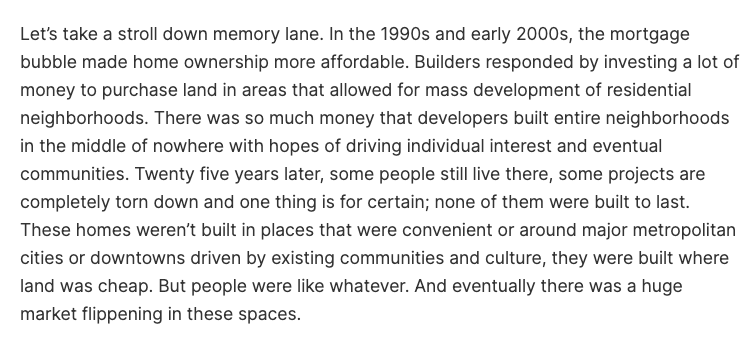
Instead of just finding land, developing homes and hoping community fosters through a shared space, developers need to invest in making sure individual buyers get value out of their experience. /3
The Renaissance Creator - the hybridization of the individual as both a creator & an entrepreneur. It's those who have built a career in media or journalism & now decide to become entrepreneurs, & those who have built a career in biz or tech and now decide to become creators.
/2
By going independent, the creator is aspiring to not only create, but willingly assume the management and business of their entire self. This acceptance of responsibility as a formula for success will dictate a creator’s desire to go independent and develop a micro-label.
New Post: The media companies of tomorrow will look a lot like record labels of today.
The best platforms/publishers will prioritize talent to build a business that puts creator reputation + brand reputation + operations at its core. How? Why?
In the record industry, talent is the driving force behind the business. In media, traditionally, the economics place value and attribution on brand driven products that put an emphasis on audience (advertising) and “all you can eat” consumption behaviors (subscriptions) /2
Media companies have always been talent companies but their business models don’t reflect that. That’s because while talent was a driving force behind their business, the financial focus was tied closer to content ownership and distribution (owned processes) /3
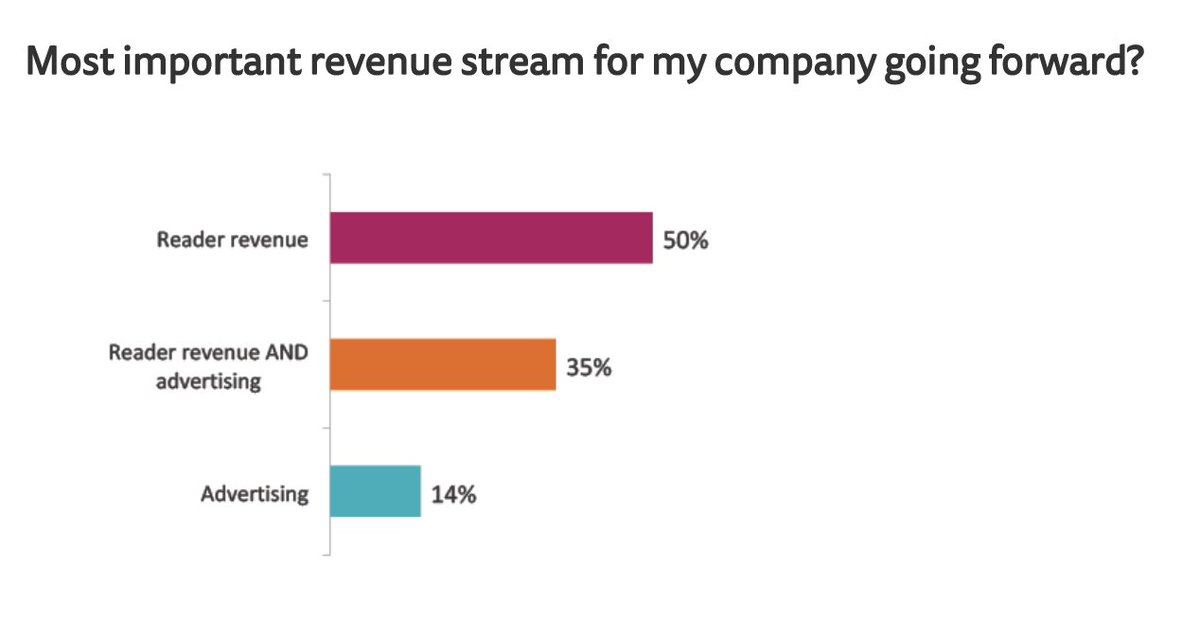
1) No new revenue. "A blend of/outside ads/subs" 2) No acknowledgment of The Passion Economy (@ljin18)
/2
@risj_oxford@ljin18 Media leaders need to go beyond advertising & subscriptions. Branching beyond a singular business model is critical. Pivoting from one (ads) to another (subs) is the definition of insanity. This requires both operational (how things work) & inspirational (value) reinvention.
/3
Media companies, while fighting against social platforms, are exposing what their value in the ecosystem actually is; being an agency & platform for creators. The role of a media company will mimic that of record labels; real value as operators, not as a voice. What do I mean? /1
People say media cos are going away, or that we just have too many media cos (I'm one of them!). The volume is the exact reason why there isn't enough ad $ and soon won't be enough sub $ to go around. It's not that these models don't work, there just are too many platforms. /2
The problem is, it's hard to create new revenue streams. Isolating your value to a brand or consumer is limiting, & making it interoperable means forfeiting exclusivity & ownership. Also, many don't have the opportunity to take these risks. But a model as operator works. Why? /3