1/ As autotuning firmware providers and operators of @slush_pool, we work with miners using every major energy source out there.
Braiins OS+ boosts ASIC efficiency for all miners, but it’s particularly useful for those with unstable energy supplies.
A #MiningInsights thread👇
Braiins OS+ boosts ASIC efficiency for all miners, but it’s particularly useful for those with unstable energy supplies.
A #MiningInsights thread👇
2/ First, who are these miners with variable energy sources?
Mainly:
+Solar & wind
+Some natgas
+Peak/off-peak PPA’s (Power Purchase Agreements)
+Grid-tied demand response (e.g. ERCOT in Texas)
The question is: how to maximize BTC mined despite rapid changes in available power?
Mainly:
+Solar & wind
+Some natgas
+Peak/off-peak PPA’s (Power Purchase Agreements)
+Grid-tied demand response (e.g. ERCOT in Texas)
The question is: how to maximize BTC mined despite rapid changes in available power?

3/ We can break down how they do it into 3 points:
1) Minimize downtime (time not hashing)
2) Maximize ASIC efficiency (W/TH -> BTC mined per Watt consumed)
3) Maintain hardware lifespan long-term
1) Minimize downtime (time not hashing)
2) Maximize ASIC efficiency (W/TH -> BTC mined per Watt consumed)
3) Maintain hardware lifespan long-term
4/ Minimizing downtime = hashing as close to 24/7 as possible.
E.g. miners on solar/wind can supplement with grid power or batteries to keep their ASICs online while the primary energy source is unavailable.
This is especially critical right after purchasing ASICs because…
E.g. miners on solar/wind can supplement with grid power or batteries to keep their ASICs online while the primary energy source is unavailable.
This is especially critical right after purchasing ASICs because…
5/ Difficulty trends up over time (5-10%/month usually), decreasing the amount of BTC an ASIC can produce. Downtime in the early days is more costly in BTC terms than downtime 2 years into an ASIC’s lifetime.

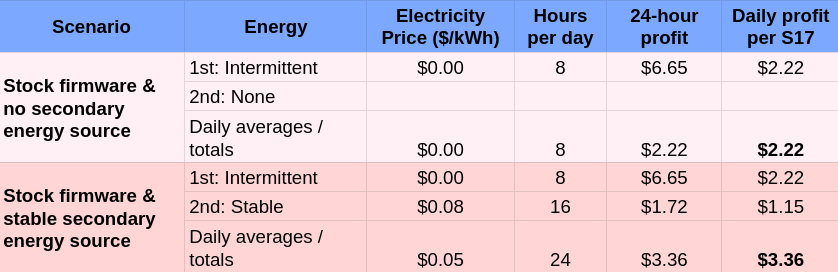
6/ Supplementing with a secondary energy source can boost mining profitability significantly, even if said energy source is more expensive than the primary.
E.g. 8hrs/day of “free” solar, 16hrs/day of grid power at 8¢/kWh outperforms mining with solar alone by >50%
E.g. 8hrs/day of “free” solar, 16hrs/day of grid power at 8¢/kWh outperforms mining with solar alone by >50%
7/ But this part is rather obvious to miners.
More interesting is the ability to granularly optimize based on variable energy prices and amounts. Enter Braiins OS+...
More interesting is the ability to granularly optimize based on variable energy prices and amounts. Enter Braiins OS+...
8/ With autotuning, miners can increase hashrate while using the same amount of power, making the 8hrs/day of free solar more profitable.
Even better, they can optimize for efficiency while on more expensive grid power.
Even better, they can optimize for efficiency while on more expensive grid power.
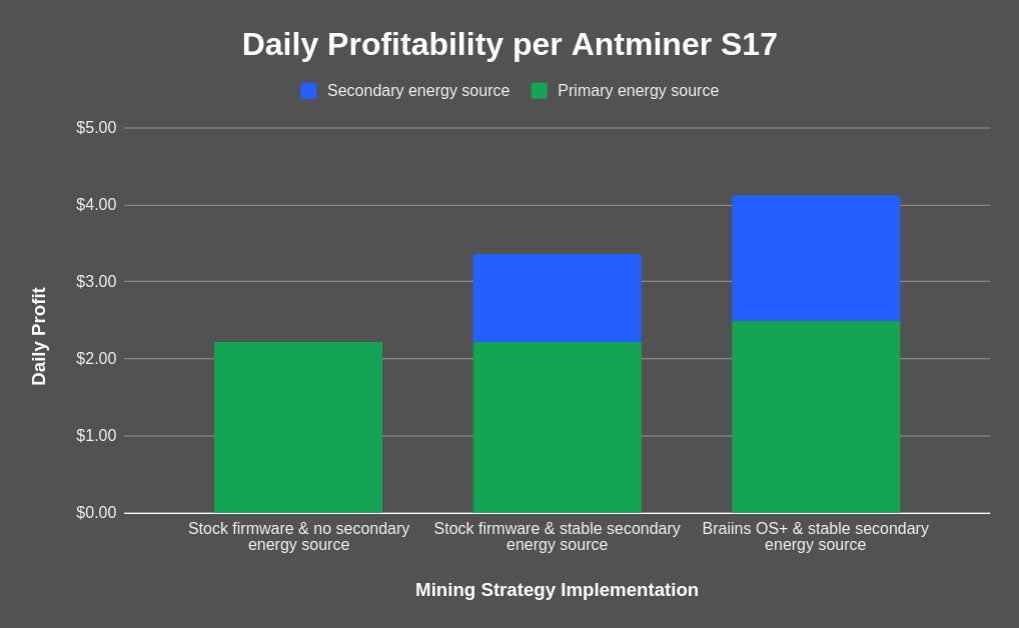
9/ By reducing the power consumption of their ASICs when energy is more expensive or less available, miners actually make their rigs more efficient. That means they get more BTC per Watt of energy they consume.
The results of strategic autotuning (right column) are clear.
The results of strategic autotuning (right column) are clear.
10/ Our article by @dfrumps explains more about these optimizations miners can make and how they can also think long-term to maintain hardware lifespan by reducing thermal cycling.
For those who who want to dive deeper🐇🕳️
braiins.com/blog/optimizat…
For those who who want to dive deeper🐇🕳️
braiins.com/blog/optimizat…
End/ Mine smarter not harder.
• • •
Missing some Tweet in this thread? You can try to
force a refresh