This afternoon's system-design ramble is brought to you by LEGO Part Number 41530: "Propeller 8-Blade, 5 Diameter."
I've talked before about the ways the LEGO building system demos important qualities of consistent, flexible, growing systems. One of the most important ways it "keeps its promises to itself" is ensuring pieces use recurring magic numbers for their measurements and proportions.
Those magic numbers become critical when pieces connect to each other; rods fit, heights of stacked bricks match, etc. Even if pieces weren't explicitly designed to work with each other, their interactions with the *system* of measurements and connections does the heavy lifting.
Good ol' Part #41530 is a great example. In the late 90s and early aughts LEGO got a reputation for introducing lots of special-purpose parts for their increasingly toy-like sets. There was some truth to that, but the "system" was still very present.
The part was introduced as part of LEGO Set 4789-1, the "Alpha Team Aquatic Mech." It was kind of a saw blade, kind of a propeller, but mostly useful as a cool bit on the end of a big ol' robot's arm.
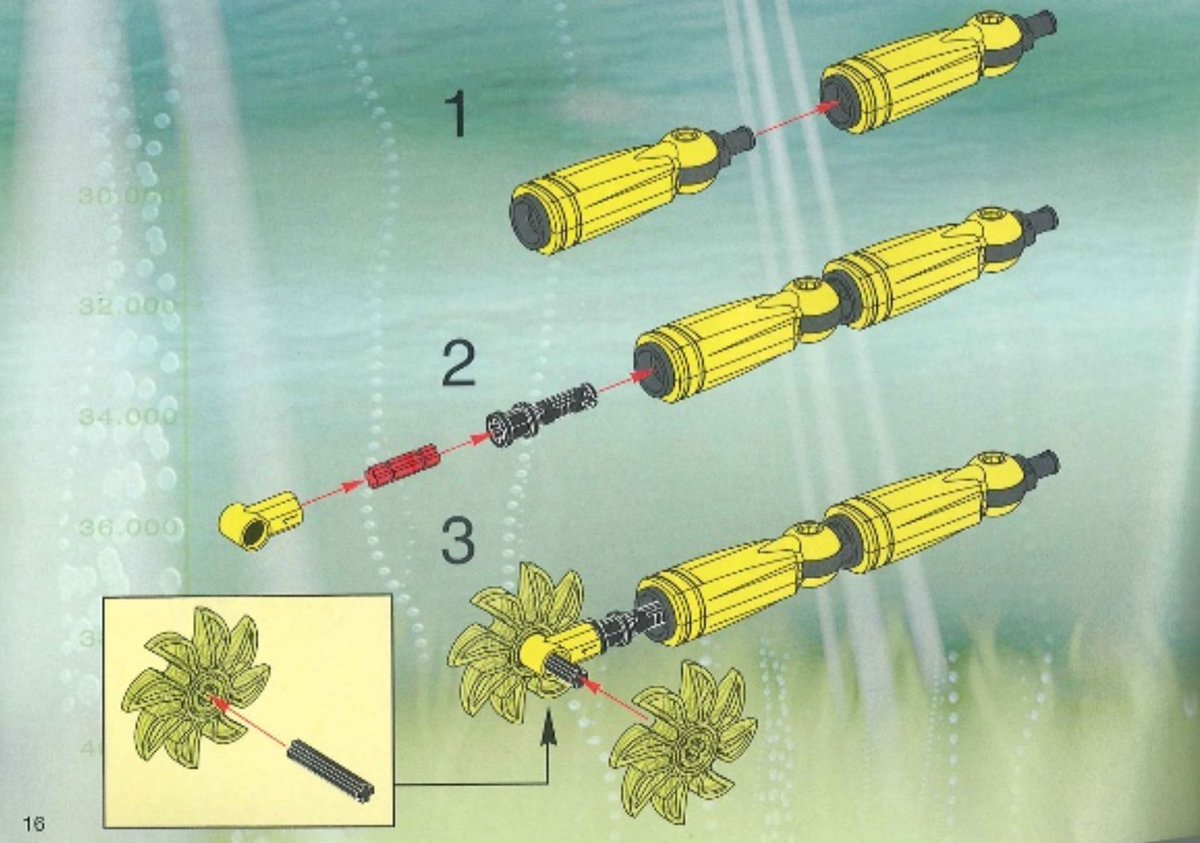
It started showing up in other sets over the next several years, as a decorative hubcap (possibly a Mad Max style wheel-weapon?) and the turbine in a jet's engine.
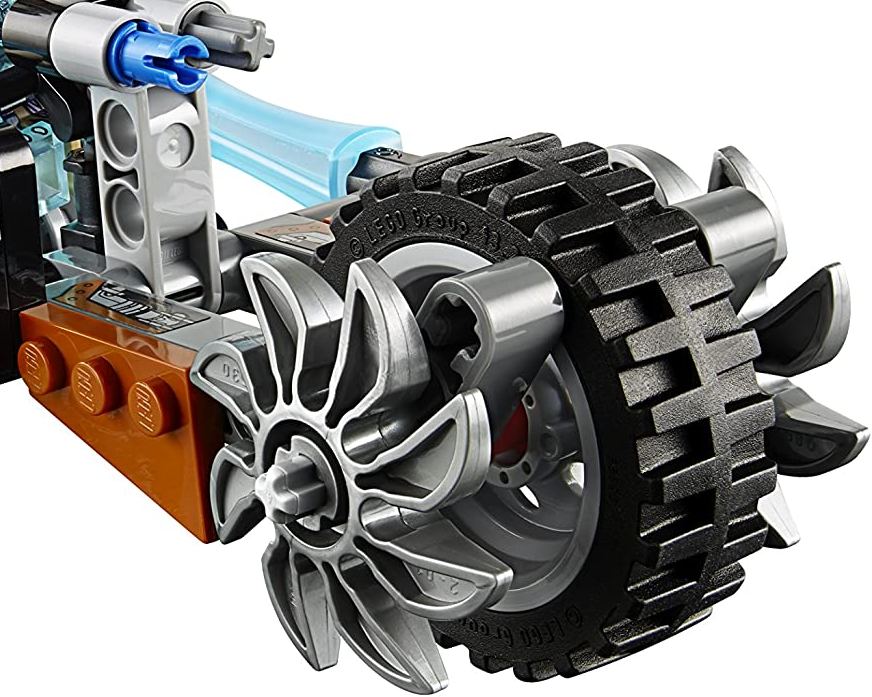
Bit it was particularly impressive as a critical but invisible part in the "holy crap, it actually works" LEGO Typewriter. (Set 21327, retail cost of $199… For more details, see the in-depth review by @BrothersBrickbrothers-brick.com/2021/06/15/leg…)
Inside the case, that decorative propeller became a functional cog in the typewriter's mechanism. It wasn't *designed to function in a machine*, but its consistency and compatibility with the overall system of proportions, connections, etc. meant it could be used in novel ways.
Especially with pattern-oriented design and component content systems, it's easy to get sucked into a slowly-expanding fractal of cross-component interactions. Adding components to meet new needs adds new interactions, which requires revisiting old ones, and, well… Ugh.
A while back, @HiMaya wrote a FANTASTIC piece about the importance of consistent "connection points" in modern systems (uxdesign.cc/measuring-the-…) — as she points out, the value of LEGO isn't the number of pieces, but that every piece keeps working with the others.
That only scales if you're willing to hammer out the rules and boundaries for those connections, the ways that parts will interact with each other, and stick with them. Individual components may come or go, but the ways they interact are forever.
• • •
Missing some Tweet in this thread? You can try to
force a refresh

IIRC it was Dell that really popularized the JIT manufacturing philosophy, back in the days when computers were purchased like cars — you hoped someone had the configuration you wanted in stock.
This was also the era when the best way to get a deal on a Mac was waiting for Apple to announce a new model… then waiting 6 months for them to auction off a huge pile of the old model at cut rates.
Quite a bit of the complexity we end up helping *our* clients navigate, regardless of vendor, boils down to "making sense of a complex multi-product integration…"
The divides between products, even from one vendor, are about underlying mental and architectural models, assumed workflows, etc, not just consistent branding and "they all have the same SSO now," so acquisitions take a lot of time and work to really integrate.
Friends know that I've long subscribed to "bottom of the barrel" conservative email-lists. GOP PATRIOT NEWS and other fly-by-night popup "news services" litter the conservative landscape, firehosing ad-encrusted email blasts on the hour.
The reason they exist is well-documented: the conservative base responds to fearmongering and lib-mocking. And when they respond, their clicks and shares can be monetized. The system doesn't require diabolical propagandists, just profit-seekers leeching off the echo chamber.
Take this morning's email from "TPN News" — aka "Three Percent Nation," a reference to a far-right group that advocates active resistance to the corrupt, liberal federal government. (en.wikipedia.org/wiki/Three_Per…). Mind you, TPN News
One of the interesting things about the @CRightcast podcast has been realizing just how interconnected many right-wing fundamentalist groups are with white supremacist and even white nationalist groups.
In most cases (IMO) it isn't a dark conspiracy: rather a natural consequence of the psychological building blocks that both movements share: authoritarian power structures, fixation on rigid gender roles, terror at outside corruption, and yearning for an ideal (imagined) past.
Modern American fundamentalism was a backlash against developments like "studying the Bible as literature" and "the theory of evolution" and "ecumenical movements in mainline Protestant churches." Over the course of a century, it's merged with reactionary-right politics.
For language and meaning nerds, the actual ~things~ that live outside the vocabulary and syntax of a sentence but carry important meaning — like emphasis or rhythm — are called "suprasegmentals". In linguistics, "Prosody" is the study of suprasegmentals, and it rocks.
This matters a lot in digital content, because the push to make content more flexible and less brittle often means "removing decoration so it can be handled somewhere else." When done naively, though, that can strip away the "suprasegmentals" and discard real meaning.
It's like copying a bunch of formatted text and pasting it into "plain text" — a lot of what vanishes might be purely aesthetic decoration, but things like italicization for emphasis get lost as well, and that conveys actual meaning.
So, as @danieleharper mentioned, @kristinrawls and I Kool-Aid-Man'd into an episode of @idsgpod to chat about the overlap between Christian fundamentalism and the alt-right…
There are numerous fascinating (and deeply troubling) connections — we focused on the direct and explicit ones embodied by Doug Wilson's "paleoconfederate" flavor of Christian Reconstructionism, the stuff @kristinrawls has been diving into for @CRightcast.
But we also touched on the less explicit thematic and conceptual building blocks that the alt-right movement shares with broader fundamentalism in the Christian Right. The idealization of a "pure and unsullied" past; rigid gender roles and masculine authority/female submission…