There’s one week left to register for the first-ever in-person #OST2 all-you-can-learn buffet class on x86-64 assembly, OS internals, and firmware: hardwear.io/netherlands-20…
There’s a lot of open questions around this experiment, most notably “will students be interested in coming to an in-person training to get direct support instead of just taking the free online version?” And so far the answer seems to be yes
The fact that I have multiple attendees, even while we’re in the midst of the pandemic, and everyone’s still a bit skittish about in-person conferences and trainings makes me very optimistic about the format for the future
My hope is that if I can show other instructors that they can still teach paid in-person training if they want to, that they’ll be more interested in putting their material up on OST2
(My personal hypothesis is that the set of folks who have the money for paid training, vs. have the time for free at-your-own-pace online training, is actually disjoint. But I won’t be able to fully test that until I replicate my circa 2015 training circumstances
I.e. I have to be in the public eye a bit more having given multiple conference talks. Then I’ll be able to compare attendance from back then to attendance in an OST2-B (ost2.fyi/Thoughts-on-OS…) class.)
I think it will also be interesting to eventually start teaching hybrid OST2-B classes with other instructors. E.g. a class that starts with me on x86-64 assembly but ends with someone else on reverse engineering or exploits
If I can show the interest in OST2-B classes it will also enable other OST2 instructors who perhaps are not in the public eye as much (perhaps because they work at companies that won’t let them do public talks) to team up and put together multi-instructor classes on more topics
• • •
Missing some Tweet in this thread? You can try to
force a refresh

I have another thought on OST2 all-you-can-learn buffet classes that I wanted to share separate from that other thread, since this will probably be a future blog post: Another eventual goal is to use them to hand over the reins for my material to a new instructor
Basically you can imagine having someone else who knows x86-64 assembly very well acting as a “TA” in some larger OST2-B (ost2.fyi/Thoughts-on-OS…) classes, helping to answer questions. Because the key thing is that an instructor should know the material well enough to explain it
Regardless of what curveball questions students ask. Or alternatively if they don’t know, they should be able to go look it up or determine the answer experimentally while the student goes back to watching videos, before getting back to them with an answer
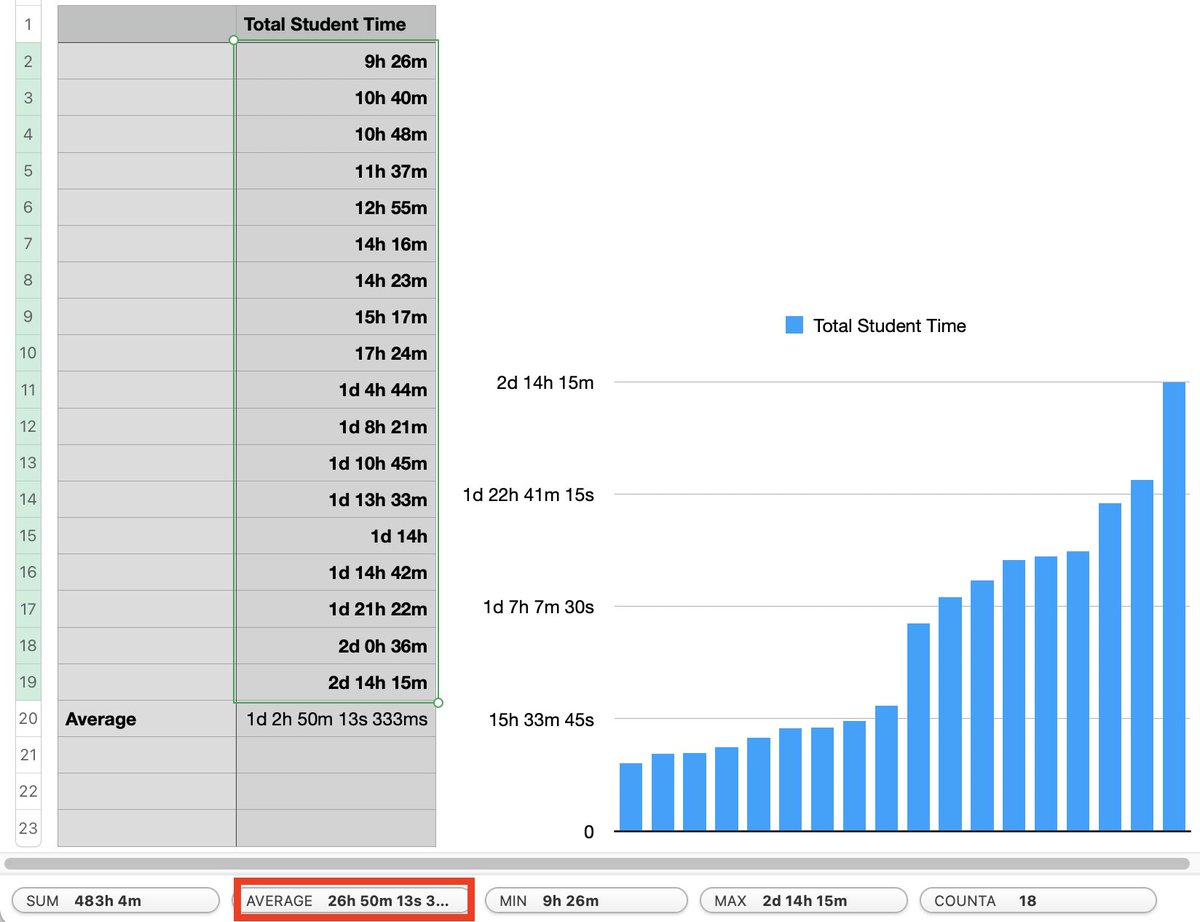
I just extracted the self-reported completion times data from the Architecture 2001: x86-64 OS Internals #OST2 beta class students who filled out all 10 entries, and it looks like the following. Some thoughts below…
1) This was originally created targeting about 2 days (~14 hours after subtracting lunch ;)) of in-person delivery. You can see a *few* students could do it in that time, but most needed more time. This is why I really like that I can now let students learn at their own pace
I don’t really think anyone’s well-served by the 1-size-fits-all approach of dragging students through a class in less time than they need to understand the material. If someone needs 62 hours to finish a class, I say give it to them!
Thread: This would perhaps be a good time to point out that while it’s absolutely true that Windows’ UEFI SecureBoot is intentionally not designed to defend against physical presence, that’s actually an improvement I shot for with Mac SecureBoot, first on T2 and then M1
I termed the security goal “P != X” meaning mere physical possession *in and of itself* should not equal code execution. Rather, possession must be combined with knowledge of an administrator password before you could disable that critical security feature.
I was able to shoot for this because Macs have a couple things going for them: 1) the first user which is set up is an administrator user by default 2) all Macs have a “recovery OS” (originally an HFS partition, and then an APFS volume), which has always been digitally signed
Check it out for more about the first-in-the-world work @coreykal & Rafal Wojtczuk have done for UEFI DMA protection and UEFI sandboxing of PCIe Option ROMs
Thread: A while back I was asked to add SGX attack papers to the timeline. That seemed reasonable to me, so I started collecting them...and then got distracted before I had worked through cross-references and such...
In general I'm not super interested in capturing the SGX/SideChannel category of papers, because they're mostly academic papers, which already do a good job of citation. So you can always just look at the end of the latest few papers to find most of the previous papers...
Whereas, the stuff I normally capture is conference talks / blog posts, and the non-academic security community does a *terrible* job of citing related work, hence why it needs collection