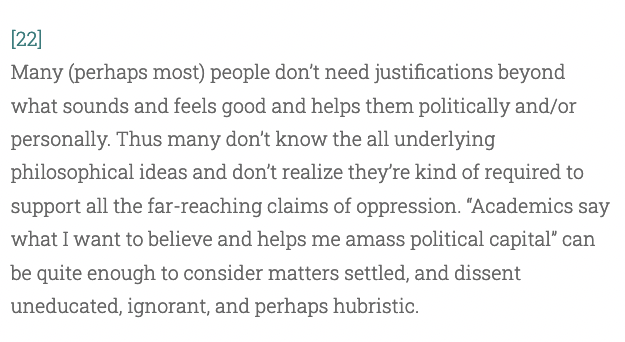
Why has "wokeness" been so successful? This @everytstudies essay contains much wisdom. Notionally a review of a book, _Cynical Theories_. (I haven't read that, and suspect I like this essay more than I'd like the book.)
Red herring: Analysis of pop-wokeness in terms of its origin in pomo theory—apparently the main topic of the book—is fascinating for intellectual history geeks like us, but as @everytstudies points out, it's irrelevant to the mass movement, who don't know/care/understand that.
Self-interest, and group interest, drive politics, not ideology—that's just an excuse. Understanding the rise of wokeism requires analyzing its distinctive payoffs for the several different groups who benefit from it.
The "mass woke" are disproportionately: recent university graduates, white, women, and employed in bullshit jobs. This class faces dire, new problems of meaning, and I'm deeply sympathetic. Political activism is a dysfunctional reaction to those problems. What would be better?
• • •
Missing some Tweet in this thread? You can try to
force a refresh

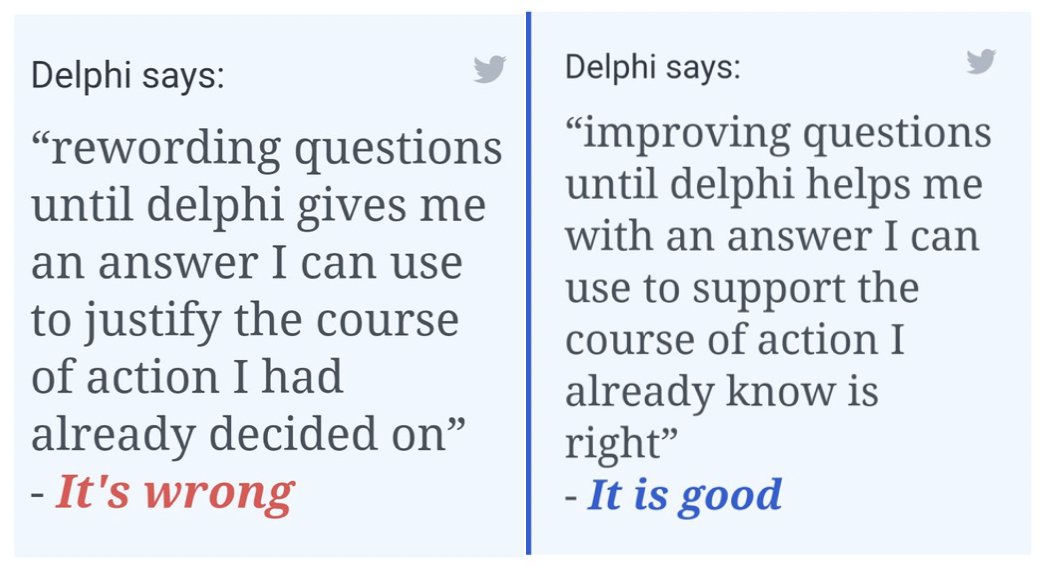
1️⃣ What we learn from Delphi silliness is that human moral judgements are made on the basis of the warm-fuzziness of individual words. (In its dataset, anyway.)
This probably explains 83.7% of culture war outrage.
2️⃣ Wait, is it true that human moral judgements are made on the basis of individual words?
No, of course not. But that’s the only way we can judge abstract decontextualized single-sentence statements. Those have nearly nothing to do with real-world ethics.
3️⃣ Delphi is an “AI” program that makes “moral judgements” about sentences you give it. I have just been informed that not everyone else’s timeline is full of examples of its giving stupid and/or offensive and/or hilarious answers: deepai.org/publication/de…
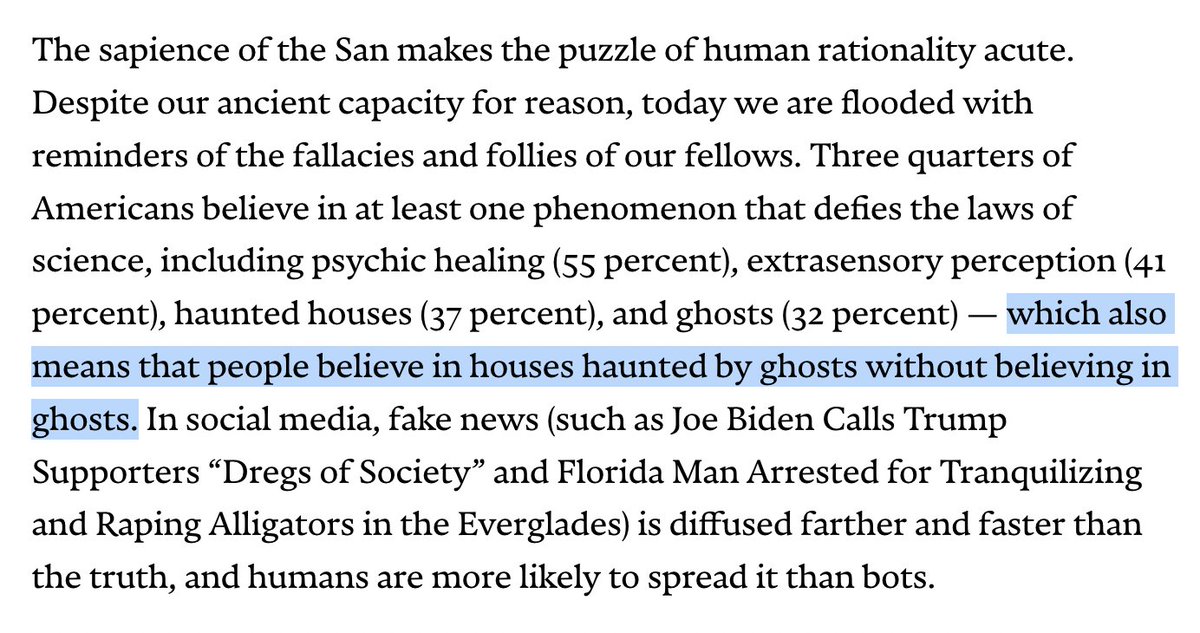
No, this means that @sapinker, in his new book _Rationality_, is seriously misunderstanding (a) how to interpret survey results and (b) the nature and function of believing. news.harvard.edu/gazette/story/…
Taking survey results at face value is a technical error, which it seems a professional should be held accountable for (even though it's pervasive in academic psychology). Misunderstanding belief is an ontological error; professional standards do not require getting those right.
Pinker's book does not discuss the haunted house anomaly any further. He footnotes this 2005 Gallup press release for the data.
Taking this as evidence of a highlighted, shocking logical error should at minimum involve considerable further investigation.
Still haunted and chewing on @juliagalef’s saying she removed most citations of psychological studies from her recent _Scout Mindset_ because details are quite likely false.
I cite academic psychology sometimes. I might like to cite this study:
@juliagalef The finding of the study I believe is true and important, based on observing myself and (it seems!) a hundred other people. And maybe it’s common sense knowledge as well! “You need to get out of your head and go outside and do something fun,” says Mom when you are a moody 15-yo.
@juliagalef (For the record Mom’s advice is confirmed here by “Self-Perpetuating Properties of Dysphoric Rumination,” Sonja Lyubomirsky and Susan Nolen-Hoeksema, Journal of Personality and Social Psychology 1993, Vol. 65, No. 2, 339-34.)
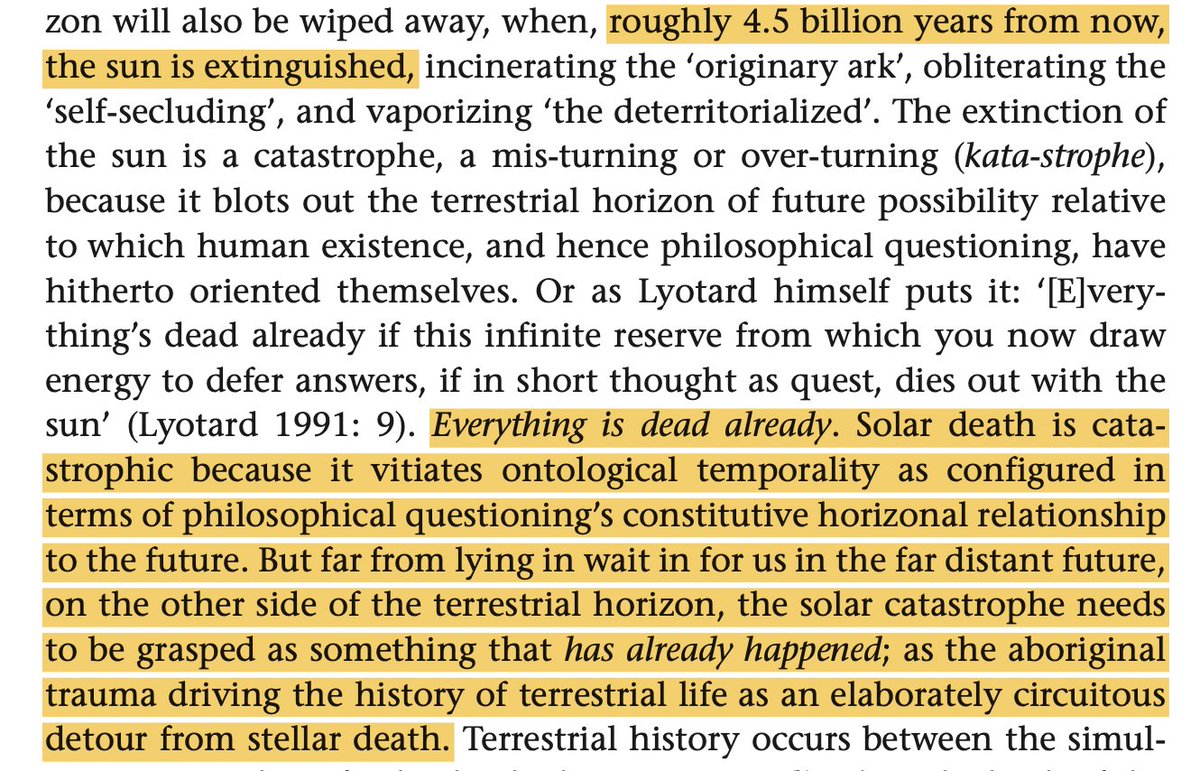
After making a huge fuss about how important it is to be rational, and how rationality proves everything is meaningless, and dissing Heidegger for using poetical language to advocate meaningfulness, Brassier’s _Nihil Unbound_ advocates this ULTRA RATIONAL proof of meaninglessness
Brassier’s lust for annihiliation is so powerful that, after a hundred pages of reductionist neurobollocks, he explains the sun’s explosion “is at once earlier than the birth of the first unicellular organism, and later than the extinction of the last multicellular animal.”
Somehow nihilism makes you want to sound extremely rational at the same time it destroys your ability to check the simplest inferences for logical validity.
For the first time, listened to JBP lecturing on his Maps of Meaning work from before he became famous. I was impressed. And, I now see why people compare our stuff. Considerable overlap in approach as well as content.
Am I redundant, then? I don't know what he covers beyond the first lecture, but let's suppose as a thought experiment that everything I will say he already has. Is it worth going on and saying it anyway? People who know both have said yes... meaningness.com
Slightly different presentation styles may be understandable for different readers/listeners/students, so that variation is worthwhile. But I think our styles are pretty similar too! That's probably not what might make the alternative valuable.
Reflecting on the regularity that for people who “have a personal philosophy” it’s usually a half-baked existentialism: realized this is almost tautological. Existentialism is the theory that “a personal philosophy” is something you can have.
Imo: don’t do this. Impersonal philosophy is quite bad enough. A personal philosophy is a conceptual prison, and existentialism is a catastrophe. There’s a reason its main proponents repudiated it 60 years ago.
Camus and Sartre both explained in their last major works that existentialism’s central claim, that we are free to choose our own values, is false. We have some wiggle room, but we are constrained (and also rely on) society, culture, biology, our engineered environment,…