Why does Amazon bother sending order confirmation / shipped emails anymore? There's no actionable information left in them.
All I know is "something shipped". I don't know *what* shipped, when it's arriving, the tracking number, etc.
So all I do is delete them because it tells me nothing.
Also, I really wish there was a privacy setting to say "I don't use a mail provider that data-mines my inbox, please include full order details in the emails"
Or, equivalently, "I use gmail but also adblock, so IDGAF if Google can see my purchase history because I won't be seeing the ads anyway".
I generally don't care much about silent background web tracking because it doesn't harm me in any noticeable way. Ads are in-your-face.
You can waste all the time you want data-mining whatever you can learn about my purchase habits and feeding it into some big neural network.
As long as it doesn't change my experience on or off line for the worse, I don't care.
• • •
Missing some Tweet in this thread? You can try to
force a refresh

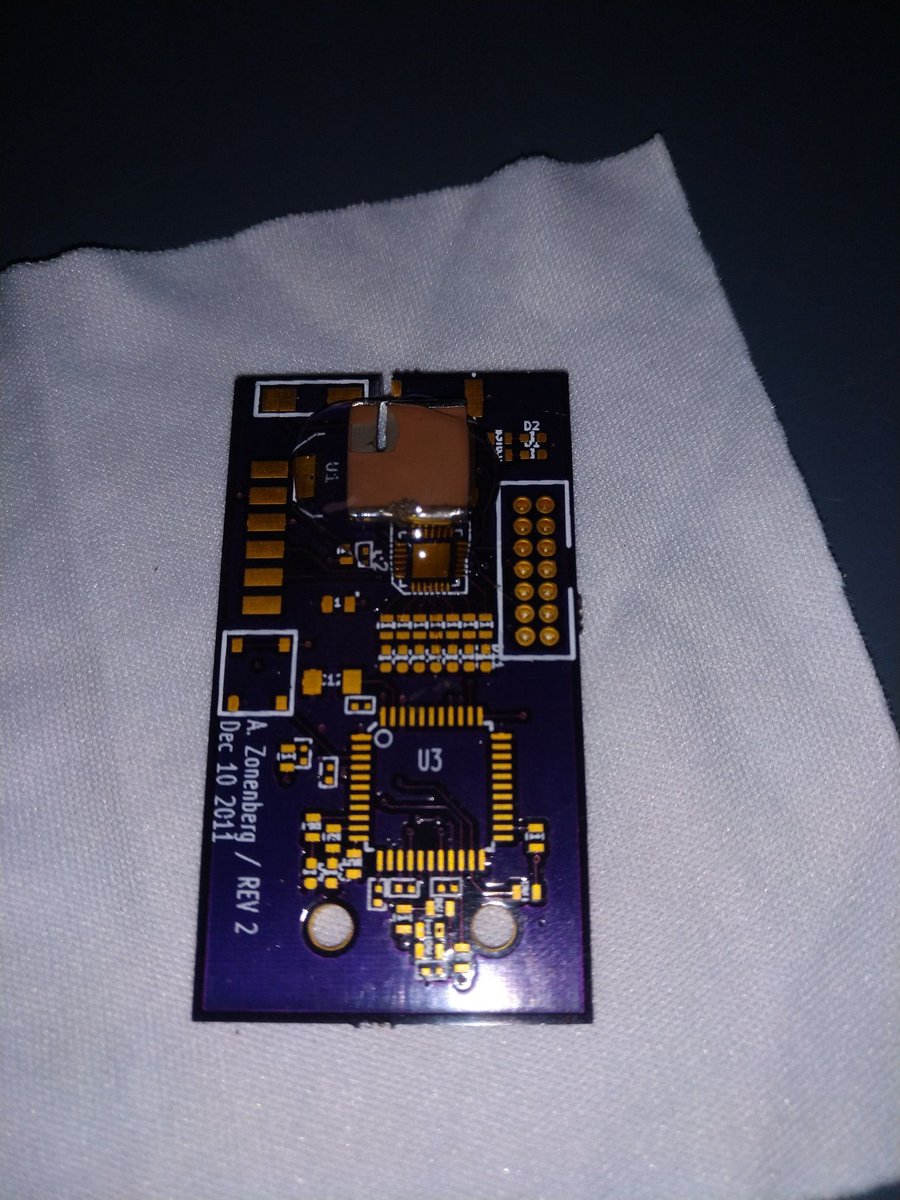
A week or so ago, @femtoduino asked me to help out with troubleshooting and reworking a prototype of the BOMU, a tiny USB-connected microcontroller dev board. It's a super dense six-layer board with multiple levels of blind vias.
Here's a bare board after removal of back mask.
So far, there's two known problems with it.
1) A blind via from layer 2 to 6 collides with a trace on layer 3. This is a design bug that slipped through DRC somehow, and results in SWCLK being shorted to a power rail.
Correction, from layer 3 to 6 collides with a trace on 4.
The good news is that there's no polygons on layer 2 in this area at all. While the USB connector footprint does cover it on layer 1, repairing a solid copper plane after an inner layer edit is straightforward.
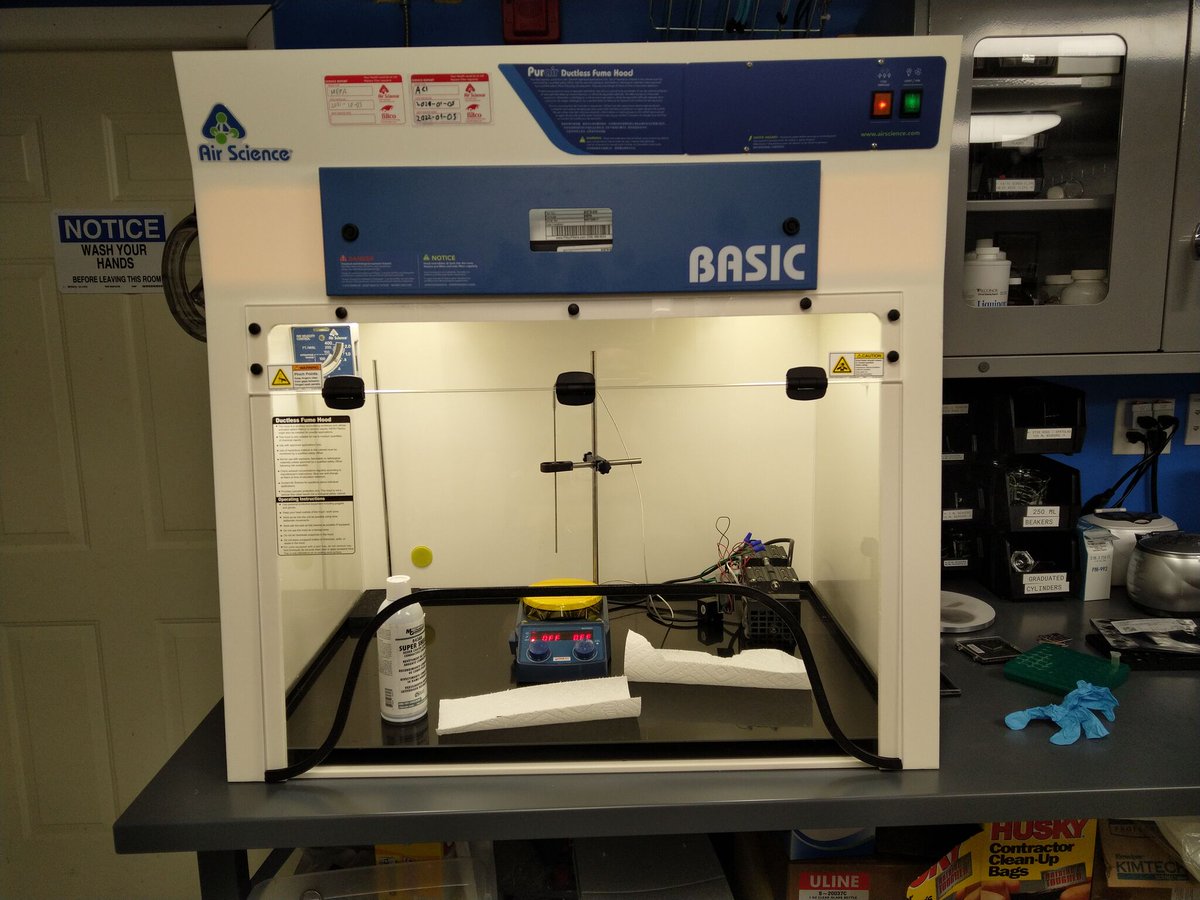
Preparing to apply shielding paint to the new rev AKL-AD3 enclosure. This time I'm trying electrical tape instead of Kapton tape as a masking material, we'll see if it helps with less bleed-through / overspray.
It's a little hard to see in this view but the new design has 45 degree angled interior walls to provide a smooth transition between horizontal and vertical. This should provide better paint coverage and conductivity.
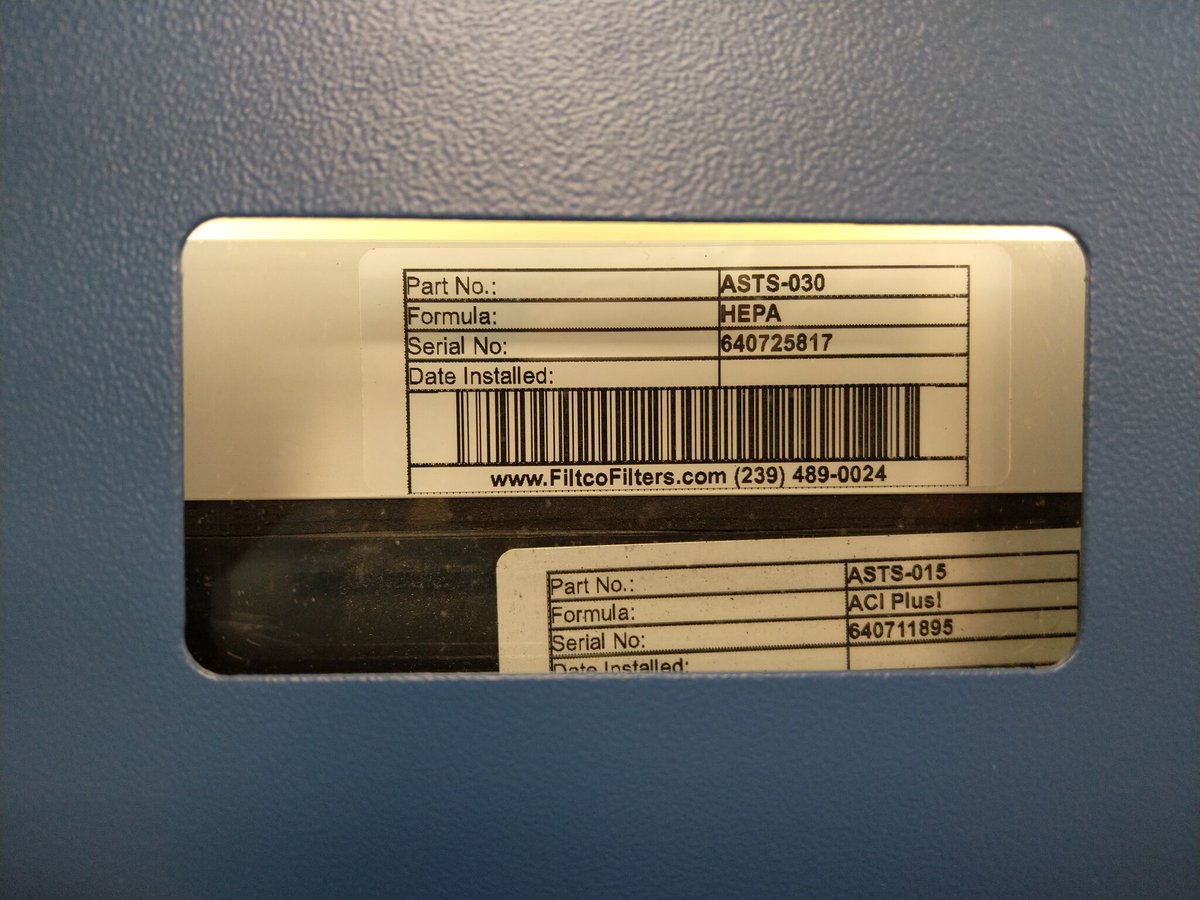
I painted the last rev in the fume hood to keep the lab from smelling like solvents, but noticed a huge spike on the particle counter after.
Seems like the solids in the shield paint were getting airborne and making it through the carbon filter in the hood. So I fixed that.
Continuing to play with the SSG5060X-V demo, testing the LFO. This is normally used as the source for analog modulation, but you can also output it directly via a front panel port which is handy.
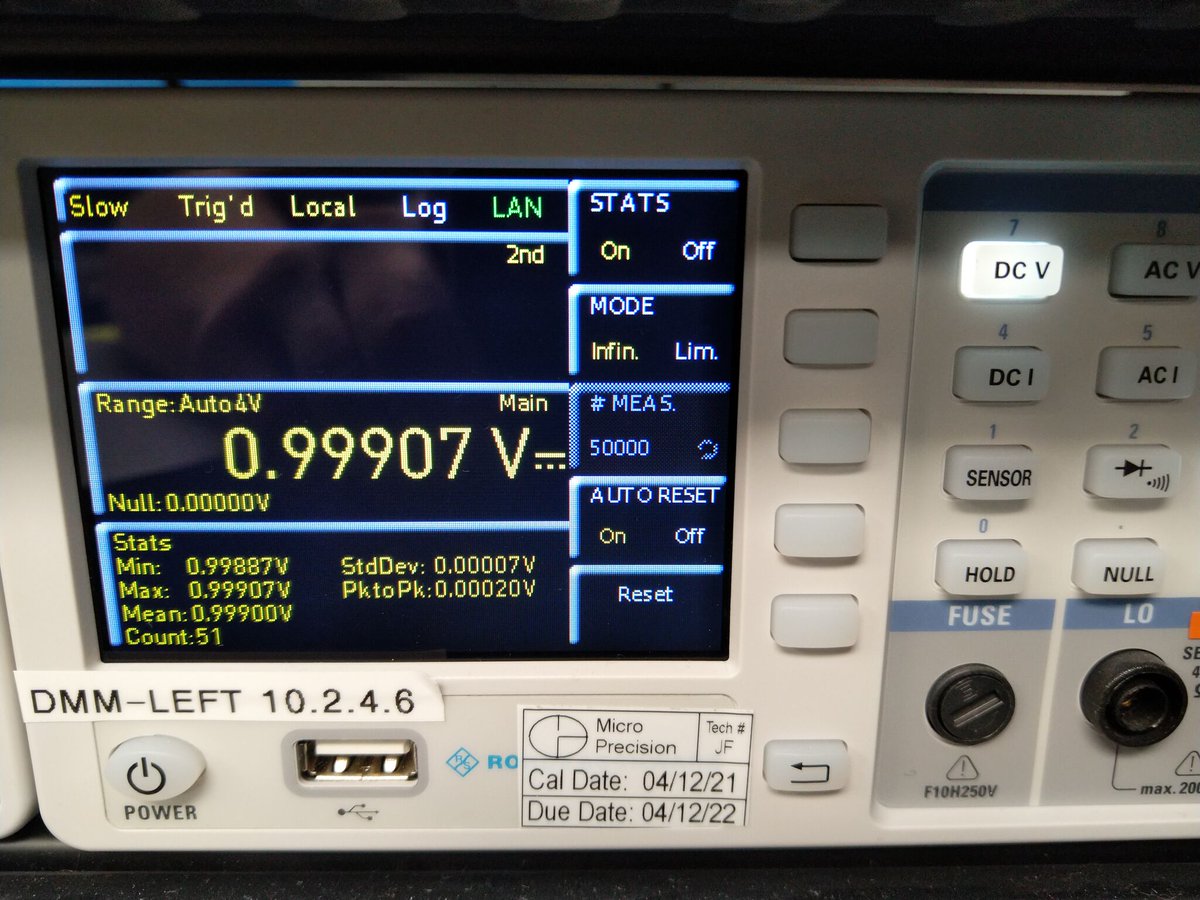
Note that the SSG output level is in Vpp and the DMM only reads in Vrms.
The LFO can also be used to produce DC signals, so you get a free DC reference/bias voltage generator.
The levels seem dead on, this test is 500 μV low. And some of that might be tolerance of the 50Ω terminator I have across the DMM.
At 1.0V DC output, still looking very good. <1 mV off nominal.
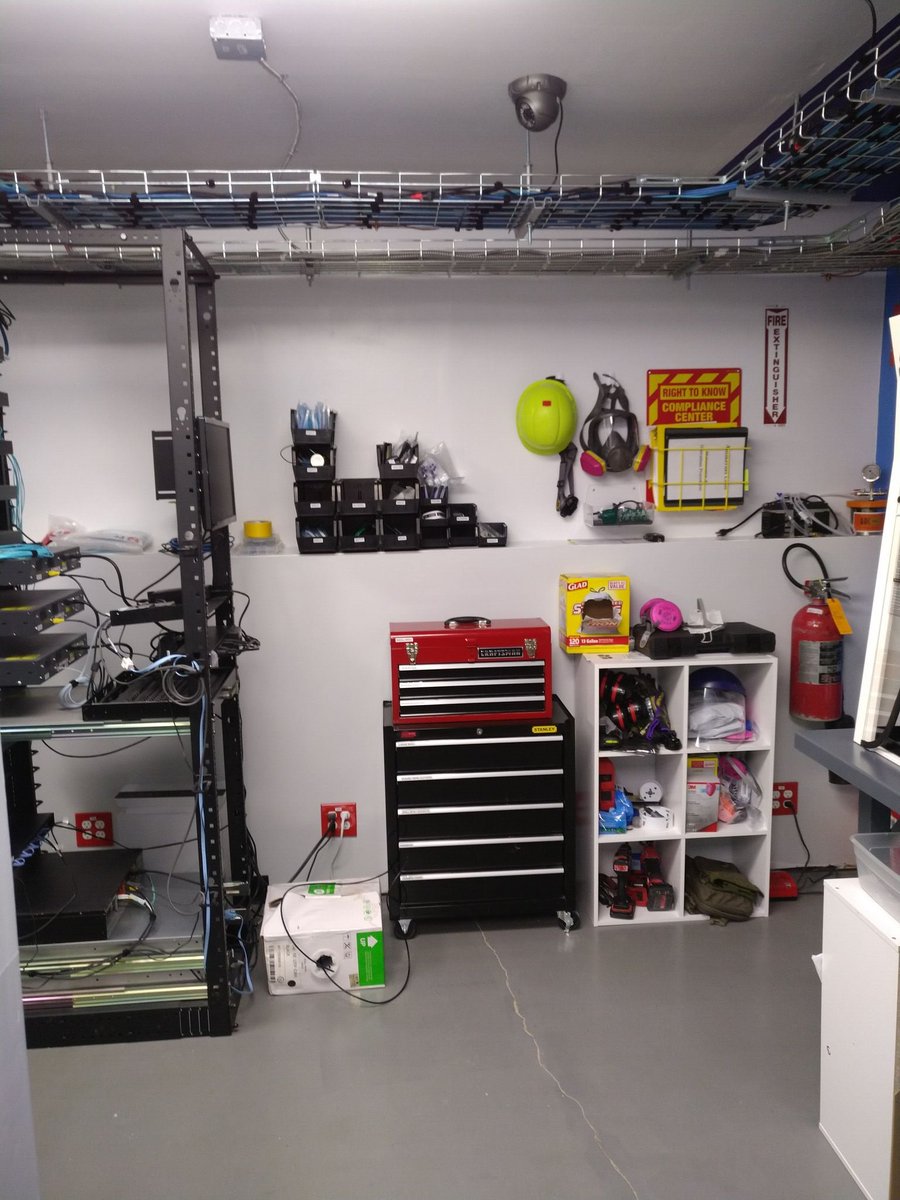
So @lukego was asking about component storage and lab organization in another thread. Thought I'd show you guys how I did it. Suggestions on how to improve are welcome!
All of this stuff lives inside a single large cabinet with bins mounted on internal rails.
I also use the same bins inside other cabinets and on shelves/workbenches for organization. Each in-progress project has one or more bins for dedicated supplies.
These bins currently sit on a shelf built into the wall, but I eventually plan on adding a wall-mounted rail to hang them on so I don't have to move the ones on top to get to the bottom of the stack.
Just got the capacitor samples from @Applied_Ion. First problem: they're HUGE. Like almost half an inch across.
Doing a sagittal section of this in my normal embedding molds is going to be impossible, and there's no way it will fit on the microscope stage either.
@Applied_Ion First attempt at gluing the undamaged cap to a random scrap PCB with Crystalbond 509 failed with a cracked top. Can't let that happen to the real specimen!
@Applied_Ion Crystalbond all over the top didn't help either. The heat of sawing just turned it into a goopy mess of capacitor dust and adhesive.
Having a really strange bug bringing up Ethernet on STARSHIPRAIDER. When I force the link speed on my switch to 10M, it links up and appears to be OK (although my MAC doesn't run in 10/100 mode yet so I can't actually test with TCP/IP traffic)
100M and 1G modes flap constantly and won't stay linked up. Suspecting signal integrity or power problem.
Tried swapping cables and switch ports already, no luck there.
Scope captures of the various 1000base-T test patterns look fine, as do eyes on 100baseTX transmit (I can't do CDR on 1000base-T yet). All power rails appear to be the correct voltages. Visually inspected all solder joints and touched up any questionable ones.