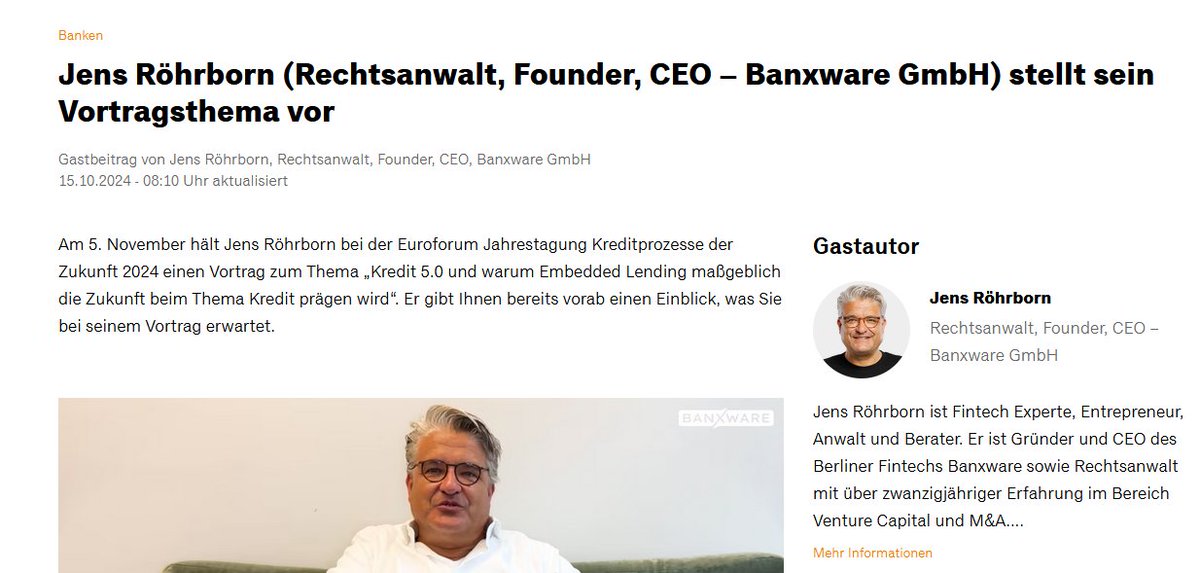
#wirecard#wirecardalt#funfacts Ein Fundstück ;) 2004 schrieb ich eine Menge über Wirecard, was denen gar nicht passte. Sie schickten spannenderweise nicht die Görres oder Röhrborn (die Namen wären bekannt gewesen), sondern Peter Katko. Die Texte wurden zunächst entfernt. 1/x
#wirecard#wirecardalt#funfacts Ich bekam eine recht schroffe Nachricht, ich möge doch bitte meine Aussagen belegen, denn ich könnte das ganze Forum in Gefahr bringen (wie es @bergermann1904 bei wiwo in etwas größerem Ausmaß passiert ist). Das tat ich. 2/x
#wirecard#wirecardalt#funfacts Die Diskussion blieb gelöscht. Aber was ich nicht wusste und erst Jahre später erfuhr: Es gab eine Diskussion von echt guten Leuten damals. Daraus mal ein paar Zitate... Das ist teilweise sensationell. 2004!!! lest mal ;) 3/x #prozessbetrug
#wirecard#wirecardalt#funfacts Damals wurde Bilanzbetrug als Mittel gesehen, um die wegen Computerbetrug dranzukriegen. Und man wunderte sich, warum die StA München nicht ermittelte. Sensationelle Passagen, wie gesagt: aus 2004! 4/x
#wirecard#wirecardalt#funfacts Der StA München wurden 2002 oder 2003 BEWEISE vorgelegt, aber nichts passierte. Ein Journalist blitzte auch ab. Darüber wunderten sich die Experten damals - Leute, in 2004! 5/x
Ich wurde damals despektierlich "das Trüffelschwein" genannt und meine Recherchen zur Geschichte wurden zitiert, die 14 Jahre später (!) von @bergermann1904 zum DAX-Eintritt aufgetischt wurden ;) #wirecard#wirecardalt#funfacts 6/x
#wirecard#funfacts#wirecardalt Anfang 2005 riet dann der Anwalt des Forums, nicht weiter gegen die Löschungsforderung vorzugehen, obwohl man im Recht war, wegen des unkalkulierbaren Risikos. "Das ist irgendwie schon frustrierend" 7/x
Die Entscheidung, der Einschüchterung nachzugeben, wurde heftig diskutiert: "Man muß die Publizität schaffen, die sie verhindern wollen". Aber: Das Risiko hätten die Forenbetreiber tragen müssen... Deshalb blieb es bei der Löschung... #wirecard#wirecardalt#funfacts 8/x
#wirecard#wirecardalt#funfacts Es gab ziemlichen Stress mit mir, weil gelöscht wurde. Ich habe es nicht verstanden. Von diesen Diskussionen erfuhr ich erst Jahre später und dann war ich natürlich versöhnt :) 9/x
#wirecard#wirecardalt#funfacts Ich werde nicht sagen, wer es war. Es sind für mich Helden. Ich verneige mich! Der Peter Katko und der Jens Röhrborn, die Andrea Görres und Braun, die wissen es. Schämt Euch! Mit Geld kann man alles kaufen? Hoffentlich keine milden Richter #shame
I know that article. I am talking about the time years before!
Leon David Black was the "right hand" of Michael Milken, the "junk bond king".
Michael Milken
By the mid-1980s, Milken's network of high-yield bond buyers (notably Fred Carr's Executive Life Insurance Company and Tom Spiegel's Columbia Savings & Loan) had reached a size that enabled him to raise large amounts of money quickly.
This money-raising ability also facilitated the activities of leveraged buyout (LBO) firms such as Kohlberg Kravis Roberts (KKR, sic!!!) and of the so-called "greenmailers". Most of them were armed with a "highly confident letter" from Drexel, a tool Drexel's corporate finance wing crafted that promised to raise the necessary debt in time to fulfill the buyer's obligations.
It carried no legal status, but by that time Milken had a reputation for being able to make markets for any bonds that he underwrote. For this reason, "highly confident letters" were considered to reliably demonstrate capacity to pay.[21][22] Supporters, like George Gilder in his book Telecosm (2000), state that Milken was "a key source of the organizational changes that have impelled economic growth over the last twenty years. Most striking was the productivity surge in capital, as Milken ... and others took the vast sums trapped in old-line businesses and put them back into the markets."[23]
Despite his influence in the financial world during the 1980s, (at least one source called him the most powerful American financier since J. P. Morgan),[24] Milken is an intensely private man who shuns publicity; he reportedly owned almost all photographs taken of him.[6][16]
---
Black started out as an accountant at Peat Marwick (which later became KPMG) and with the publisher Boardroom Reports. He also interviewed at Lehman Brothers but was told he did not have the brains or personality to succeed on Wall Street.[3] From 1977 to 1990, Black was employed by investment bank Drexel Burnham Lambert, where he rose to managing director and head of the Mergers & Acquisitions Group, and co-head of the Corporate Finance Department.[14] At Drexel, Black was regarded as "junk bond king" Michael Milken's right-hand man.[15]
---
[Benjamin Black
One of their children, Benjamin, runs an investment fund and was nominated by President Donald Trump to run the U.S. International Development Finance Corporation.[22][23]]
---
In 1997, he made Epstein one of the original trustees of what is today the Debra and Leon Black Foundation.[43] In his 2020 letter to Apollo investors, Black said that Epstein provided him with "estate planning, tax and philanthropic advice" to his "family partnership and other related family entities".
---
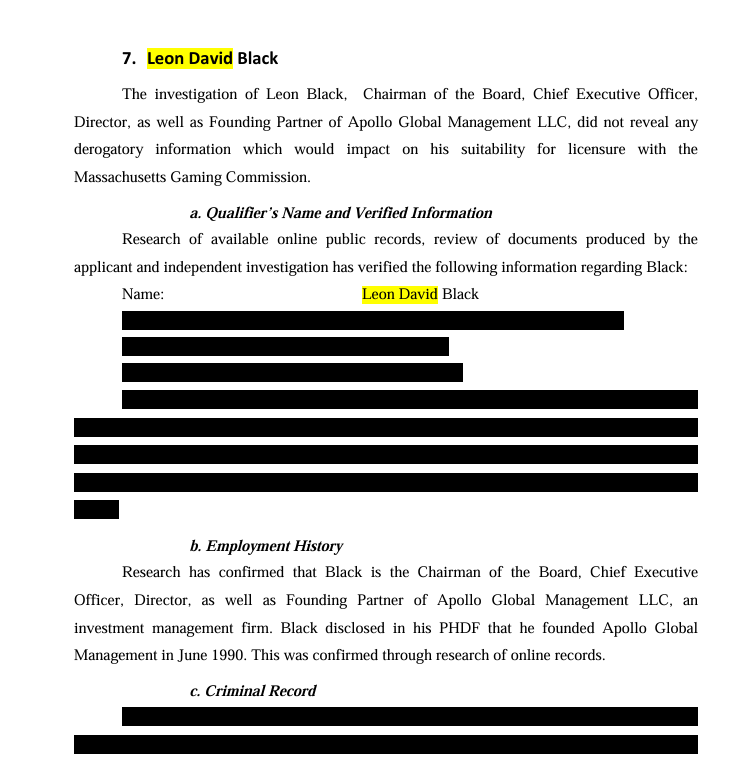
INVESTIGATIVE REPORT FOR THE MASSACHUSETTS GAMING COMMISSION APPLICANT: Sterling Suffolk Racecourse, LLC PRINCIPALS: Joseph O’Donnell Richard Fields October 18, 2013
There is a lot missing here...
---
Black disclosed that he has applied for qualification in various gaming jurisdictions, which could include US, tribal and/or international jurisdictions. The Investigators requested verification of certain US non-tribal licenses from the appropriate regulatory agencies as noted in the Scope and Methodology section of this report. The results of those inquiries, which verified the applicant’s disclosure, have been received and no negative or derogatory information is noted.
---
This companies were mentioned as related to Black
Valcour Associates • Valcour II Associates • Rayburn Associates • Cardiff Associates • M-Clift Partners LP • Associated Investors • North Sea LP • Power Investors • Remainderman Investors LLC • Residual Investment Corp. II • Residual Investment Corp. • Residual Investment Corp. III • Residual Investment Corp. IV • BPH Holdings LP • Apollo Co. Investors III LLC • Apollo Co. Investors IV LLC • Apollo Co. Investors V LLC • Apollo Co. Investors VI LLC • Apollo Dif. Co. Investors LLC • Apollo Soma Co. Investors LLC • Apollo Credit Opportunity Fund I • Pillowman NY LLC • Blue Sunshine LLC • Gift Horse Partners LLC • M-Related LLC • North Sea Investment • PAM Centre LP • Pent Holdings Corp.
"n. Media Coverage Research of available online and print media sources did not reveal any derogatory or adverse items relative to Black. He is mentioned numerous times on the Internet, however no adverse information was found regarding this individual. o. Conclusion Based on the investigation there were no known facts that would disqualify Black based on any of the criteria listed in the gaming laws or regulations in Massachusetts."
Black is the Chairman of the Board, Chief Executive Officer and a Director of Apollo Global Management LLC and a Managing Partner of Apollo Management LP. Black founded Apollo Global Management in 1990 to manage investment capital on behalf of a group of institutional investors, focusing on corporate restructuring, leveraged buyouts, and taking minority positions in growth-oriented companies. From 1977 to 1990, Black worked at Drexel Burnham Lambert Inc., where he served as Managing Director. Harris is a Senior Managing Director of Apollo Global Management and Managing Partner of Apollo Management LP which he co-founded in 1990. Prior to 1990, Harris was a member of the Mergers & Acquisitions Group of Drexel Burnham Lambert Inc. Rowan is a Senior Managing Director and Director of Apollo Global Management and Managing Partner of Apollo Management LP, which he co-founded in 1990. Prior to that time, Rowan was a member of the Mergers & Acquisitions Group of Drexel Burnham Lambert Inc., with responsibilities in high yield financing, transaction idea generation and merger structure negotiation. During the course of this investigation, the Investigators interviewed Caesars Board Member David Sambur and inquired whether he had any involvement in Caesars decision to participate in the Sterling Suffolk Racecourse casino project. He explained that he had been involved in the negotiation process, acting both as a Caesars Board member and as Apollo’s representative on the Board.
Rowan disclosed in his PHDF that he currently holds two active securities licenses, which were issued by the Financial Industry Regulatory Authority (“FINRA”). Consultation with FINRA revealed that Rowan is currently registered with a FINRA member firm, Apollo Global Securities LLC, under CRD No. 1410799, and is issued Series 24, Series 7 and Series 79 licenses. Rowan was previously registered by two firms, Credit Lyonnais Securities (USA) Inc. and Drexel Burnham Lambert Incorporated. Rowan is approved as a general securities principal and an investment banking representative. There are no regulatory actions, customer complaints or arbitrations filed against Rowan. Rowan disclosed that he has applied for qualification in various gaming jurisdictions, which could include US, tribal and/or international jurisdictions. The Investigators requested verification of certain US non-tribal licenses from the appropriate regulatory agencies as noted in the Scope and Methodology section of this report. The results of those inquiries, which verified the applicant’s disclosure, have been received and no negative or derogatory information is noted.
---
As of June 1, 2013, the Board of Directors consists of: • Leon Black • Joshua Harris • Marc Rowan • Martin Kelly • Paul Fribourg • Alvin Bernard (commonly “A.B.”) Krongard • Pauline Richards • Michael E. Ducey • Mark Spiker
---
The first significant issue involves a licensing agreement which Caesars entered into, through a subsidiary, Corner Investment Company LLC, with Las Vegas Gansevoort LLC, a subsidiary of Gansevoort Hotel Group (“Gansevoort”). One of the principals of Gansevoort, Arik Kislin, has been the subject of considerable media and law enforcement scrutiny over the past several years for alleged ties to Russian organized crime. Despite these serious allegations, as revealed during Caesars’ due diligence review of the proposed transaction and Kislin’s suitability, Caesars’ Compliance Committee approved the transaction and Caesars ultimately determined to proceed with the license agreement. This issue is addressed in detail in this investigative report. The second significant issue pertains to the hiring of Garber to be the head of Caesars Interactive Entertainment, Caesars’ subsidiary involved in the expanding world of Internet gambling (or “online gaming”). Garber previously headed two companies, PartyGaming LLC and Optimal Payments LLC, each of which entered into a non-prosecution agreement with the United States Attorney’s Office for the Southern District of New York. The non-prosecution agreements called for the forfeiture of substantial sums by each company. In turn, the USAO agreed not to prosecute the companies for any crimes related to their internet gambling businesses with U.S. customers. The third significant issue involves Caesars’ conduct with respect to Terrance Watanabe, a high roller patron at Caesars Las Vegas properties who accrued millions of dollars in unpaid markers in 2006-2007. Watanabe was charged criminally for the unpaid debt, and he sued Caesars civilly, claiming Caesars encouraged him to gamble while intoxicated. The civil suit ultimately settled, and the criminal case was dismissed. The episode touches on numerous concerns, including the lengths to which casino operators will go to cater to high rollers and problem gaming. The episode caused Caesars to review and revise its Compliance Program, as described below. The fourth significant issue relates to Caesars’ financial stability. As the Company acknowledges, it is an extremely highly leveraged entity, with a current debt burden of $23.7 billion. The interest payments on that debt consume virtually of the Company’s current cash flow. Caesars is currently meeting its debt covenant requirements. However, should the economy fail to recover sufficiently or if another downturn occurs, it could become difficult for Caesars to meet its debt service and covenant requirements. Caesars has stated that if cash flows and capital resources are insufficient to service their indebtedness, it may reduce or delay capital expenditures, sell assets, seek additional capital, restructure, or refinance its indebtedness. In an effort to address its financial situation, Caesars announced plans to transfer certain assets to a new publicly traded company known as Caesars Growth Venture Partners. Financial analysts have expressed concerns about this component of Caesars’ future operations.
#apol #caesars #leondavidblack
Caesars Probe Revealed More Than Mob Ties: Gaming Agency
Law360, New York (October 23, 2013, 6:57 PM ET) -- The Massachusetts Gaming Commission revealed Wednesday that an investigation into Caesars Entertainment Corp. raised red flags over alleged Russian mafia ties to a Las Vegas deal, as well as Caesars' $23.7 billion debt, the hiring of its Internet gaming head and a high roller's lawsuit.
MGC's suitability report was publicly released for the first time late Wednesday, though Caesars had ended its involvement in a $1 billion joint venture seeking one of the state's gaming license earlier in the week after being tipped off about the commission's concerns. Sources had told Law360 on Monday that these included alleged mafia ties related to a Las Vegas deal with the Gansevoort Hotel Group.
On top of that concern, however, the MGC's Investigations and Enforcement Bureau said in Wednesday's report that it was also worried about Caesar's hiring of Mitchell Garber to head the company's online gaming unit despite Garber having headed two companies that struck nonprosecution agreements with the U.S. Attorney's Office in New York. The MGC further pointed out a lawsuit where a high roller claimed Caesars encouraged him to gamble while drunk and noted the company's high burden of debt, though it ultimately concluded the company was financially able to handle the Massachusetts deal.
"Garber was the CEO of two companies that came under scrutiny by the [U.S. Department of Justice] for illegal Internet gaming operations while he was their CEO. Both companies entered into nonprosecution agreements which included statements that the companies' activities violated prohibitions against Internet gambling in the United States," the suitability report said, noting that Garber's companies paid out a total of $124 million in the settlements.
MGC's investigative arm noted a red flag in a suit from high roller Terrance Watanabe, who sued Caesars after he had to face criminal charges for unpaid debts, claiming he was encouraged to gamble while intoxicated. While Caesars countersued and Watanabe ultimately paid an undisclosed sum to the casino giant, the suit underscored a major issue for the MGC, according to commission documents.
"The Terrance Watanabe incident is a classic example of how casino operators cater to their high rollers and are sometimes tempted to overlook unacceptable behavior by high rollers so that they can maintain their patronage and high level of play," the report said.
Last, the commission made an extensive investigation into Caesar's financial stability, including recent refinancing efforts and plans to spin off some of its assets. "For some time, Caesars has been exploring different options for dealing with its highly leveraged financial status, as it sits perilously close to violating debt covenants," the MGC bureau said, though it ultimately concluded that it believes Caesars has the financial stability to be licensed in the state.
The alleged mob ties, however, were the first concern raised in the report about Caesars. They stem from a branding deal the company struck earlier this year — and ultimately broke off this week — with Gansevoort, who has an investor, Arik Kislin, that has been repeatedly linked to Eurasian organized crime. The MGC arm said it had received information from the Federal Bureau of Investigation confirming those concerns.
"The FBI indicated that historical law enforcement information indicates that Kislin handles large-scale investments within the United States for wealthy members of EOC and that Kislin's activities focus on laundering EOC profits from overseas," the report said.
Both Caesars and Gansevoort, however, have publicly railed against the MGC for allegedly passing judgment based on media speculation about Kislin and for allegedly setting unreasonable and arbitrary suitability standards that conflict with those in other gaming jurisdictions.
“We strongly disagree with the staff recommendation and were prepared to thoroughly address each of the concerns raised by the report. We withdrew our application at the request of and in deference to our partners in the project," Gary Thompson, a spokesman for Caesars, told Law360 Wednesday.
With Caesars bowing out of the gaming license bid, the remaining members of the Sterling Suffolk Racecourse LLC joint venture that it was a part of are units affiliated with the Suffolk Downs racetrack and the O'Donnell Group Inc., as well as a unit of Vornado Realty Trust.
Earlier this week a source close to the matter told Law360 that the Suffolks Downs racetrack owner and remaining joint venture partner in the casino-resort bid are working to secure a new gaming management partner to continue on with its bid.
The issues with Caesars, however, were not the commission's only concerns about the joint venture, and the report also raised concerns that one of the principals related to the racetrack owner may not be financially stable. "The issue relates to the fact that his net worth valuation is contingent upon the successful awarding of a license to [Sterling Suffolk]," the report noted.
The MGC's scathing suitability report is just the latest bombardment of bad news to hit Caesars in recent days. On Monday, the embattled Caesars also revealed in a regulatory filing that its Las Vegas-based Desert Palace Inc. unit is being investigated by a federal grand jury and the U.S. Department of the Treasury's financial crimes unit over alleged violations of the Bank Secrecy Act. Maryland's gaming authority is also now looking into the allegations raised by the MGC and federal agencies.
--Additional reporting by Emily Atkin. Editing by Katherine Rautenberg.By Natalie Rodriguez
Systematisches Blah-Blah in der FAZ über wirecard und cum-ex, präsentiert ausgerechnet von Jans Schwester und dem geheimnisvollen Wirtschaftsprüferprüfer, der auch noch 'Wirecard-Aufklärer" genannt wird - und das ausgerechnet in der FAZ.
Wir haben so viele angebliche Wirecard-Aufklärer, von Singapur über London bis nach Dubai und New York- nur haben wir kurioserweise immer noch keine Wirecard-Aufklärung.
Nur eine der Absurditäten dieses Falles...
Dazu erfährt man in diesem Gespräch eigentlich gar nichts - aber es ist halt Anne Kaffeekanne.
wollen wir ein bisschen gegen die Regierung stänkern?
Ein vergesslicher Olaf Scholz, der abgelöst wurde durch einen Blackrock-Anwalt?
Und was hat das mit cum-ex und wirecard zu tun?
nun ja,...
Gesicherte Schuld, unbelegte Schuld – und ein politisches Schutzinteresse
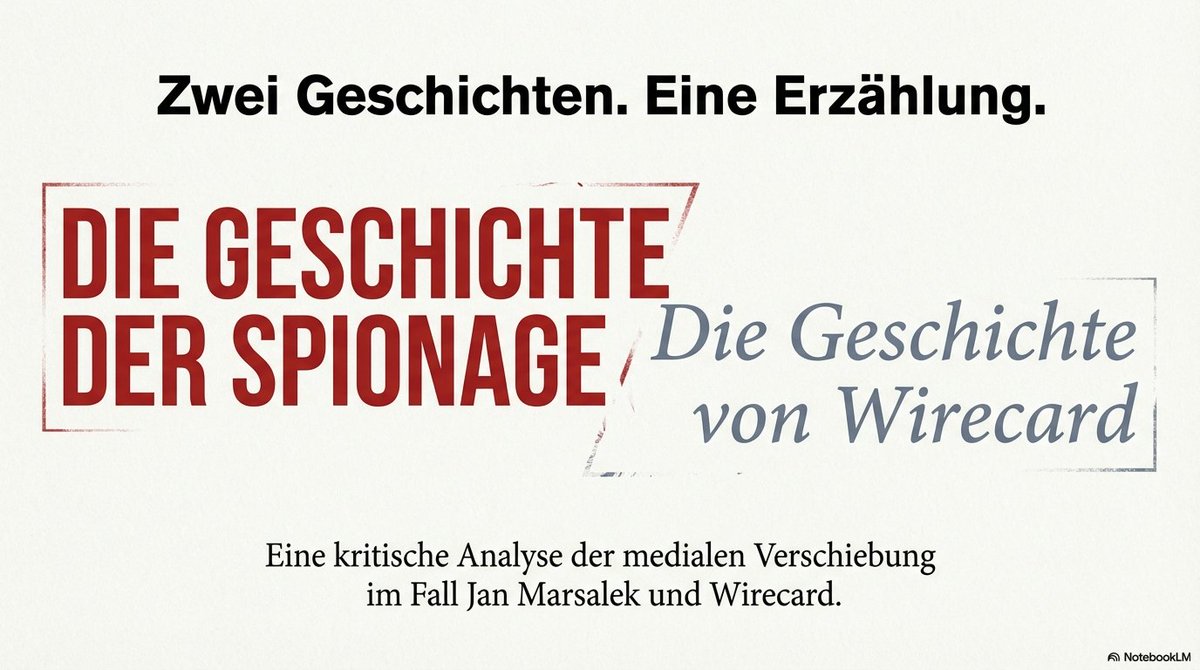
Im Fall der Wirecard AG werden bis heute zwei grundverschiedene Sachverhalte miteinander vermengt: nachgewiesenes Prüfversagen und strafrechtlich nicht bewiesene Täterschaft. Diese Vermengung ist kein Zufall – sie hat eine klare Funktion. Sie schützt Wirtschaftsprüfer, deren Schuld feststeht, und verschiebt Verantwortung auf eine Person, deren Schuld rechtlich nicht erwiesen ist.
Die Pflichtverletzungen von Ernst & Young sind dokumentiert und sanktioniert. Die Abschlussprüfer haben über Jahre hinweg elementare Prüfungsstandards verletzt: Sie unterließen direkte Bankbestätigungen, akzeptierten zweifelhafte Treuhandkonstruktionen, ignorierten Warnsignale und erteilten dennoch uneingeschränkte Testate. Diese Vorwürfe sind nicht Gegenstand offener Beweisfragen, sondern Ergebnis abgeschlossener Aufsichtsverfahren. Die Schuld der Wirtschaftsprüfer ist damit festgestellt. Nur: Sie haften nicht!
Demgegenüber ist die Schuld von Markus Braun bis heute nicht bewiesen. Trotz eines seit Jahren laufenden Strafprozesses ist kein Urteil ergangen, das ihn als Haupttäter eines umfassenden Betrugssystems qualifiziert.
Die öffentliche Darstellung suggeriert jedoch genau das: Braun gilt vielerorts bereits als überführter Großbetrüger – obwohl die Beweisführung bislang ausgeblieben ist.
Diese Vorverurteilung ist nicht nur juristisch problematisch, sondern politisch brisant. Denn sie ist die Voraussetzung für die Entlastungserzählung der Wirtschaftsprüfer. Nur wenn Wirecard als perfekt organisierte kriminelle Organisation erscheint, nur wenn Braun als mastermind eines außergewöhnlichen Betrugs gilt, lassen sich die Prüfungsfehler als verständliches Scheitern darstellen – nicht als professionelles Versagen.
An diesem Punkt wird der Fall politisch. Wirtschaftsprüfungsgesellschaften wie EY sind keine beliebigen Marktakteure. Sie prüfen nicht nur Konzerne, sondern auch staatliche Beteiligungen, öffentliche Institutionen und Projekte im Auftrag der Bundesregierung. Sie sind Teil der finanziellen Kontrollarchitektur des Staates.
Wenn ihre Glaubwürdigkeit fundamental in Frage steht, betrifft das nicht nur vergangene Mandate, sondern laufende und zukünftige staatliche Aufträge.
Ein Staat, der sich auf diese Prüfer stützt, hat daher ein objektives Interesse daran, deren systemisches Versagen nicht zu tief greifen zu lassen. Das erklärt, warum die Erzählung vom einzigartigen Betrug so hartnäckig fortlebt – selbst ohne gerichtliche Bestätigung. Die Annahme der Schuld von Markus Braun wirkt wie ein Schutzschild: Sie individualisiert das Problem und verhindert, dass die Verantwortung institutionell und politisch adressiert wird.
Wer also weiterhin so tut, als sei die Schuld von Markus Braun erwiesen, trifft keine neutrale Feststellung. Er stabilisiert ein Narrativ, das gesicherte Schuld relativiert und staatlich relevante Akteure schützt. Die eigentliche Schieflage besteht darin, dass belegtes Prüfversagen erklärungsbedürftig gemacht wird – während unbelegte Täterschaft als Tatsache gilt.
Der Wirecard-Skandal ist damit nicht nur ein Wirtschafts- oder Justizfall. Er ist ein politischer Fall. Er zeigt, wie sehr die Frage, wessen Schuld als gesichert gilt, davon abhängt, wessen Schuld politisch tragbar ist.
#wirecard
wenn man das alles konsequent weiter. denkt, könnte man Markus Braun als politischen Häftling bezeichnen...
Wer jahrelang gehirngewaschen wurde von zahlreichen Artikeln, Büchern, Dokumentationen - in denen Markus Braun als Kopf einer Bande vorverurteilt wurde, könnte das für völlig absurd halten - ich kann aber versichern: so absurd ist das gar nicht...
#wirecard
drehen sie das ganze doch einmal um: nehmen sie mal an, uns wurde tatsächlich jahrelang eine Geschichte von wirecard erzählt, die gar nicht stimmt - was wäre denn der Sinn davon?
das politische versagen und das Versagen der wirtschaftsprüfer wird kleiner mit einem bandenchef. ganz logisch.
und wenn man sich anschaut, wie zum Beispiel der Fall cumex öffentlich behandelt wird, kann man parallelen entdecken