

On the politicization & poletimicization of Halacha, a thread about the vaccine (or lack thereof)
Caveat: I am not discussing, nor interested to, the science behind the vaccines, or the politics associated with the pro/anti/cautious crowds.
I just want to clarify a point I’ve seen misused by both sides of the debate with regards to Halacha
I just want to clarify a point I’ve seen misused by both sides of the debate with regards to Halacha
The last thing any Jew who believes in Torah and would fall under the umbrella of what is defined as Orthodox do is “How can I fit the Halacha within my opinions”.
Now I am not accusing anyone of doing this consciously, but it’s always necessary to make a self-assessment of why
Now I am not accusing anyone of doing this consciously, but it’s always necessary to make a self-assessment of why
we believe what we believe, and what your motives are to be holding such and such a view.
When people start posting things like this, we have a problem:
(I have chosen this example because it could be verbatim be used by both sides, only swapping in different sources)
When people start posting things like this, we have a problem:
(I have chosen this example because it could be verbatim be used by both sides, only swapping in different sources)
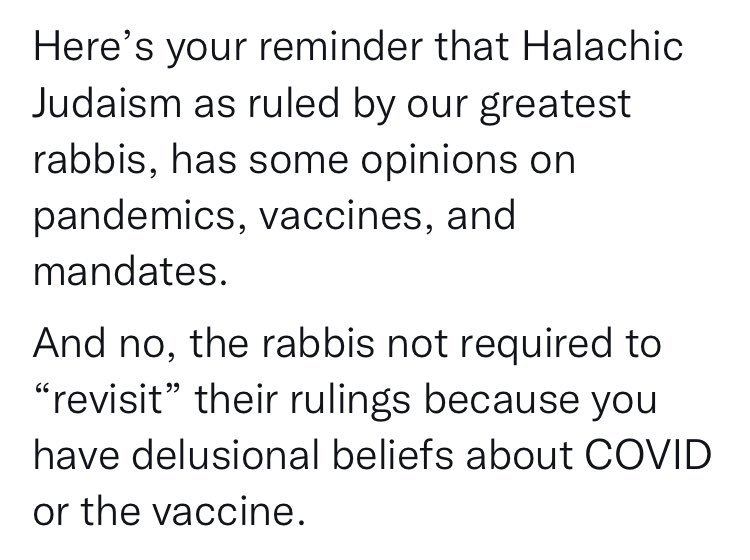
This is a complete distortion, and really the exact opposite of what a sound halachic approach needs to be.
Just because a Rabbi said that the last chicken he inspected was treif doesn’t mean he shouldn’t inspect the next one and can declare it treif without a new inspection.
Just because a Rabbi said that the last chicken he inspected was treif doesn’t mean he shouldn’t inspect the next one and can declare it treif without a new inspection.
Yes, with every plague, every disease, every vaccine, every new medication, every new situation, Halacha requires Rabbis to inspect the new reality all over again from scratch.
A real posek will always treat any question as a completely new one, and start from zero.
A real posek will always treat any question as a completely new one, and start from zero.
So, yes, when it comes to COVID, it is absolutely essential that halachic authorities look into it & formulate an opinion based on current events & current science, and as more facts come out, they need to either reiterate or modify their opinions as they see fit accordingly.
Any side who says ‘Halacha says that you have to do X during covid!’ is simply wrong. You have a variety of opinions and simply because the Rabbis you hold by themselves hold Y doesn’t mean it’s not valid for others to be holding Z, since that’s what their Rabbis hold themselves.
Now you might think they are wrong, just as they think you are wrong, but don’t bring “the Halacha” into it if both parties are both holding by valid authorities who believe differently.
To bring “the Halacha” is to falsely appeal to authority to make your point.
To bring “the Halacha” is to falsely appeal to authority to make your point.
If Rabbi A said that a certain chicken is kosher, while Rabbi B said that it is not, those who follow Rabbi A & eat the chicken would in no way be eating treif. Those who follow Rabbi B would not be eating a chicken that for them *is* treif. Basic Beis Hillel Beis Shammai stuff.
I see this from all sides of the issue, the stronger their political (for lack of a better term) beliefs in one side or another, the more likely they are to bandy about the names of Rabbis to claim the other side is entirely wrong.
“Judaism” & “Halacha” are not rhetorical tools.
“Judaism” & “Halacha” are not rhetorical tools.
On a religious aspect, no side can be called wrong on this issue. They are both free to follow their respective authorities. Now you might think that medically they are wrong and that you are in the right, but that’s an entirely different debate.
Don’t bring Halacha into it.
Don’t bring Halacha into it.
And the most important point of all: be respectful of each other’s. Don’t become the fanatics who plague us & prevent the Temple from being rebuilt because of sinat chinam.
If someone is doing something they have halachic backing for, even if you disagree with it personally
If someone is doing something they have halachic backing for, even if you disagree with it personally
the last thing you should do is insult them or hate them for it ch”vs. They might be wrong for doing what they do, but what you are doing is much worse
We will only bring Mashiach if we have tolerance, love and respect for each other’s, not if we point fingers & scream hatefully
We will only bring Mashiach if we have tolerance, love and respect for each other’s, not if we point fingers & scream hatefully
Especially if the reason we do it is because we both believe something different while both trying to uphold Torah.
May we all merit the coming of Mashiach tsidkeinu b’karov mamash, and that all sicknesses, of the body, mind and soul, be eradicated once & for all.
May we all merit the coming of Mashiach tsidkeinu b’karov mamash, and that all sicknesses, of the body, mind and soul, be eradicated once & for all.
• • •
Missing some Tweet in this thread? You can try to
force a refresh



