This op-ed by @EvelynNFarkas is making rounds: defenseone.com/ideas/2022/01/…. In a nutshell, she argues that the US must go to the United Nations to build a "coalition of the willing" and then demand that Russia withdraw from Ukraine and Georgia or face war.
This op-ed has justly been criticised as out of touch with reality. E.g. in passages like this.
The op-ed has a lot of history. Problem is, the "beginning of the end of the international order" refers to international order created in 1945, which entailed "acceptance of Russian gains," including significant territorial changes. Awful? Yes.But let's not kid ourselves.
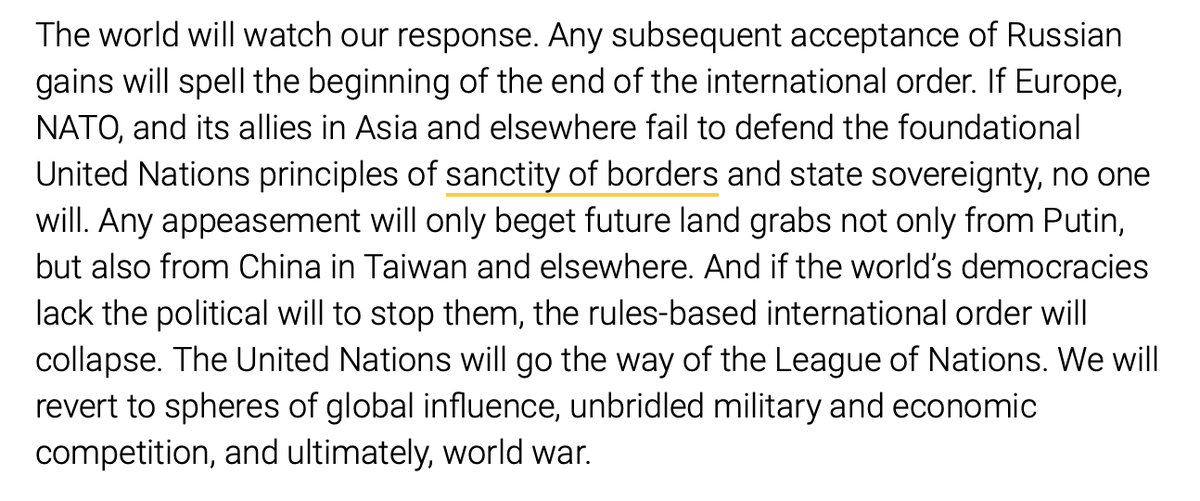
I am surprised that Farkas does not know that the world order as it existed after 1945 precisely entailed "spheres of global influence" and "unbridled military and economic competition." There was no world war, only because sane people agreed that a "roll back" was not an option.
We find the same lack of understanding of the international order in this passage. Not only did the 1945 world order entail the division of spheres of influence (we may not like it but it happened) but both superpowers repeatedly used military force to enforce this division.
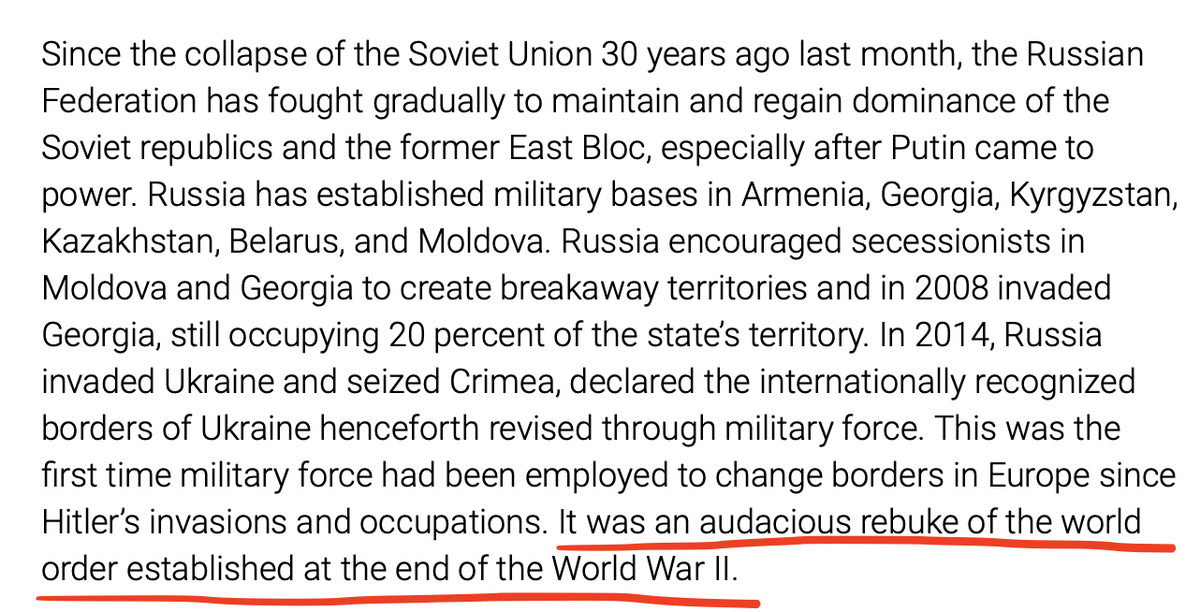
Consider Soviet invasions of Hungary in 1956, Czechoslovakia in 1968, Afghanistan in 1979, but also US operations and invasions from Iran, to Guatemala, to Grenada, to Panama. Arab-Israeli wars entailed pretty serious land grabs, without the order being necessarily undermined.
Also, before we get too excited about the UN going the way of the League of Nations, let's recall that for most of the Cold War the UN was completely paralysed due to the East-West conflict.
Or take this passage. Farkas surely knows that one of the reasons for Russia's paranoia about NATO was that it was used to violate state sovereignty in the absence of UN authorisation. There were good reasons, we know, e.g. in Kosovo in 1999.
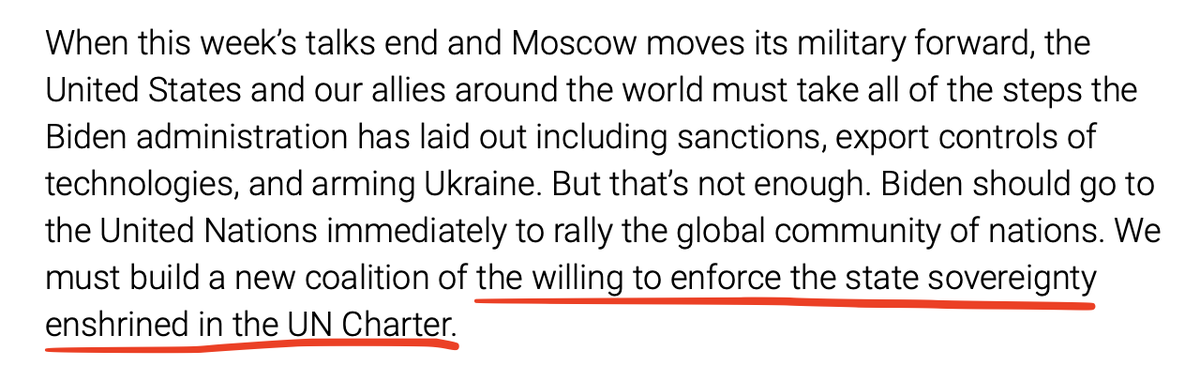
But the point is that the principle is not absolute. International order survives precisely because there's a recognition that different situation require different approaches. You have to have flexibility in the system or it will break.
So at the risk of sounding boring, I would urge against "rallying the global community." In all fairness, the global community could not care less if Abkhazians and South Ossetians live under Georgian sovereignty or as Russia's puppet states.
The global community understand that Crimea and Donbas were unfairly annexed / invaded - but few will join the noble crusade to rescue the long-suffering ethnic Russians in these territories from Russia's monstrous grip.
Look, this is a seriously problematic op-ed. As a historian, as a fellow human being, I am appalled by some of these militant takes (on both sides of the divide). As my favourite French singer George Brassens once put it, "OK, I'll die for ideas but only a slow death."
• • •
Missing some Tweet in this thread? You can try to
force a refresh

A mistaken view imho. Rhetoric in CEE, including in the Baltics, was very much that Russia's weakness represented a unique opportunity to escape Moscow's grip. The (not unreasonable) fear in the early-mid 1990s was that Russia would eventually succumb to its imperial fantasies.
After Zhirinovskii showed stunning results in the 1993 Duma elections, Lech Walesa memorably told Clinton that "every second Russian thought like Zhirinovskii." There followed a prolonged, brutal war in Chechnya that cast further shadow on Moscow's post-imperial credentials.
Walesa basically represented the mood across the region. And when I read this today - as someone who despised Zhirinovskii back then - I know that Walesa exaggerated. But the burden was on *us* to prove him wrong. And did we? What imperial fantasies do we still nurture?
"Asked about Ryabkov keeping the door open to basing troops and equipment in Latin America, Sullivan responded: “I’m not going to respond to bluster in the public commentary.”... “If Russia were to move in that direction, we would deal with it decisively.” apnews.com/article/europe…
So, he says he won't respond to bluster and then... does it anyway. This comment is of course all over the Russian media, presented for maximum effect as evidence of U.S. hypocrisy and so on and so forth.
By the way, in exploring the origins of the Cuban Missile Crisis, I came to the conclusion that Khrushchev's decision to deploy missiles in Cuba was mainly the result of his concern that Moscow was not allowed to do what the US allowed itself to do in Europe.
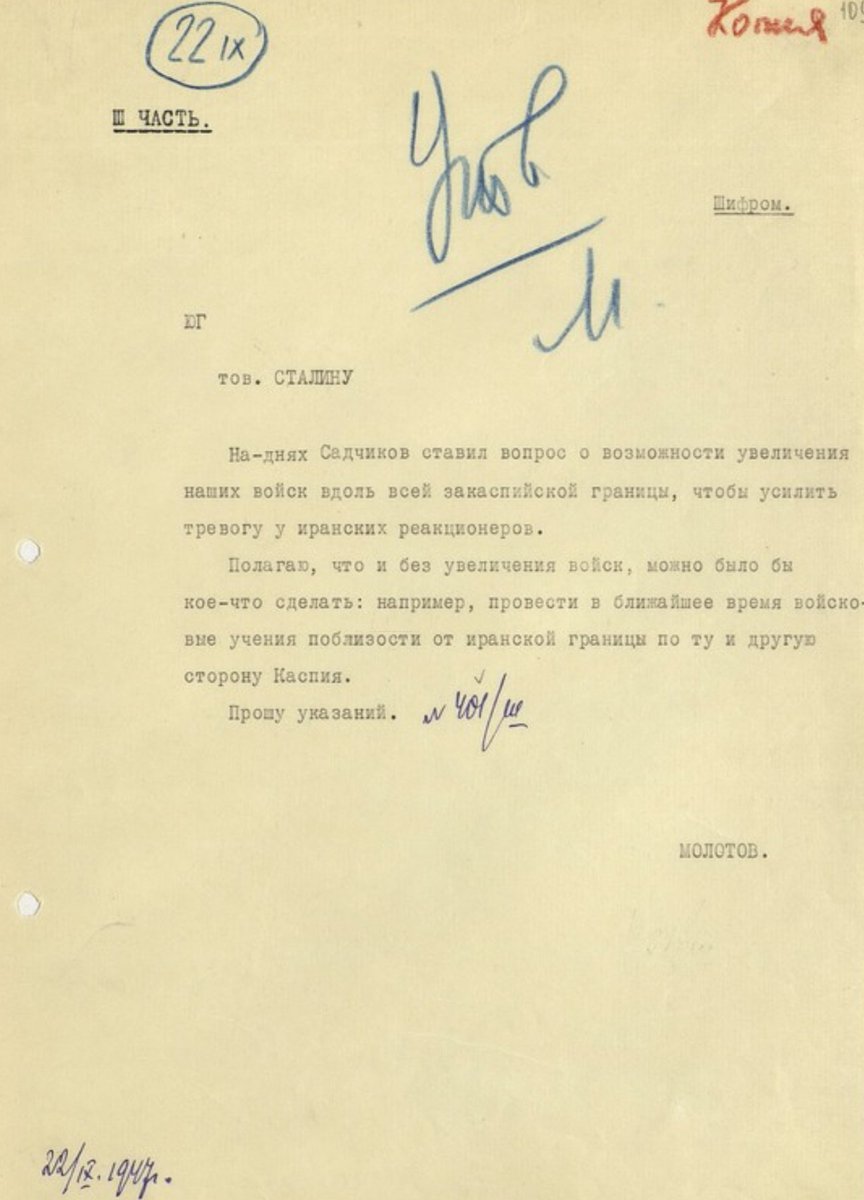
An interesting historical document. Soviet Ambassador in Iran proposes to build up Soviet forces at the Iranian-Soviet border "to raise alarm among Iranian reactionaries." Molotov suggests to Stalin that they could just carry out military exercises in the border area.
The history of the question is as follows: in 1945 the Soviets (who at the time occupied northern Iran) helped foment an ethnic Azeri insurgency. The insurgents were de facto in control of northern Iran by late 1945. But they depended on Soviet protection.
Facing pressure from the US, Stalin was forced to withdraw troops from Iran but he did so after he achieved an agreement with Tehran that 1) they'd respect ethnic rights of the Azeris and 2) they would grant the Soviets an oil concession. Prime Minister Qavam promised to deliver.
A rather uninspiring op-ed by Bret Stephens: nytimes.com/2022/01/11/opi…. Makes some far-fetched claims about Abkhazia and South Ossetia (which inter alia show that he has no idea what he is talking about, which is a familiar feature to those of us who follow Bret Stephens).
But this here is a real jewel of historical comparisons. Ok. The US airlift in 1973 *postdated* Egypt's and Syria's attack. In fact, even after the Yom Kippur war started, Nixon/HAK were reluctant to authorise an airlift to Israel. They only did it after the Soviet began theirs.
By launching an airlift to Ukraine, the US will (most certainly) provoke a war that it is ostensibly trying to avoid. OK what happens then. Oh, I see.
Watched Lavrov's interview on Dec. 22, where he recycled the claim that @mfa_russia uses to justify Russia's demands for guarantees of NATO's non-enlargement. Lavrov: "No participant of the OSCE should ensure their security by damaging the security of others." Let's do a thread.
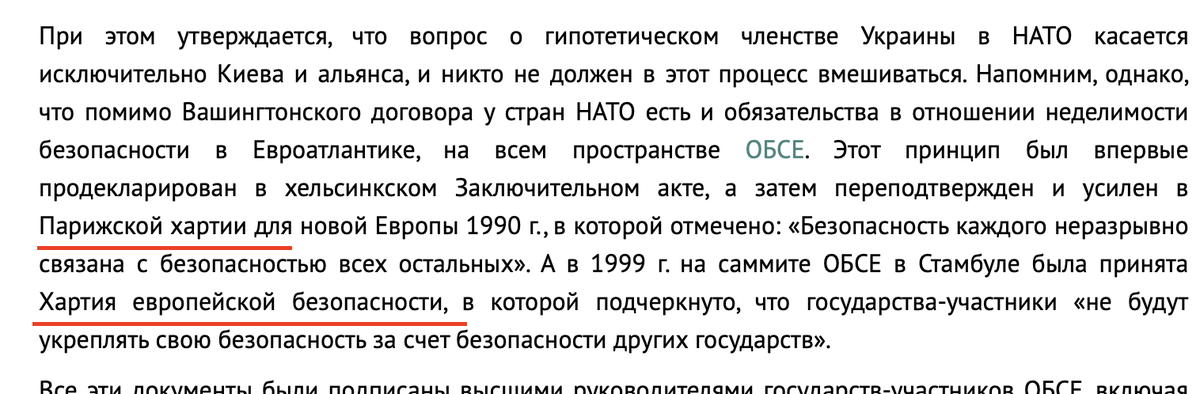
This claim was also mentioned in the recent MFA document that presented Russia's demands. Here are the relevant excerpts. The undertaking not to strengthen one's security at another's expense is traced back to the 1990 Charter of Paris & the OSCE's 1999 Istanbul document.
Let's check the 1990 Charter of Paris first. osce.org/files/f/docume…. Here's the relevant paragraph. What do we see here? We see that Lavrov is right (re "indivisible" security) but we see that he ignored another sentence in the same paragraph about freedom to choose alliances.
What should we do with Russia's security proposals? The obvious temptation is to dismiss them as propaganda and reject them outright. I'd argue this is not the best approach. Instead, the package should be "untied" (to use a term that made the 1987 INF breakththrough possible).
Consider e.g. Article 5 - the undertaking not to deploy INF and shorter-range weapons. This is a constructive proposal that would help strategic stability. Reject? No, pursue and see what happens.
What about Article 3. Russia's proposal to improve coordination to prevent accidental escalation, especially in the Black Sea and the Baltics + an undertaking not to see the other side as the enemy. Reject? No, pursue and see what happens.