Alf Profile picture
Jan 21 7 tweets 2 min read
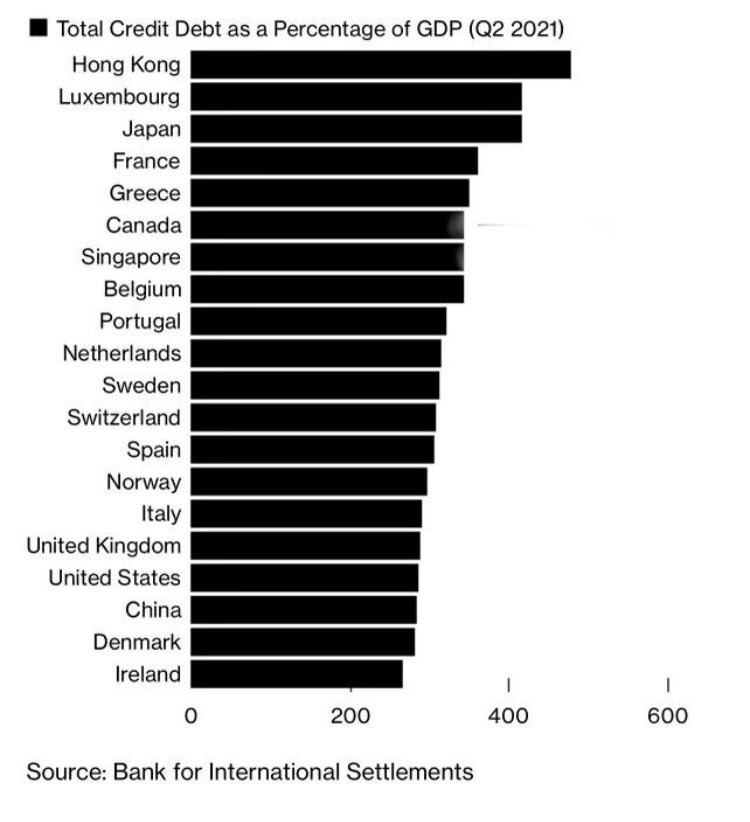
A revealing macro chart: total economy debt as % of GDP.

Many “rich” and “frugal” countries in here, too: surprised?

You shouldn’t be: instead of using public debt, they chose to lever up the private sector.

A short thread on credit (=money) creation and myths around it.

1/7
Our system encourages credit creation.

As the long-term driver of economic growth stagnate & we have a keen interest in growing fast&now, we use credit.

Credit creation is the process of real money printing: the private sector gets more net worth out of thin air.

2/7
Credit creation can end up on the govt balance sheet (public debt) or on the private sector balance sheet (private debt)

Mainstream financial commentators focus 99.9% of their time discussing public debt and ignore private debt - Italy is indebted, Denmark is not

Bulls**t

3/7
Many “rich and frugal” countries have simply leveraged up the private sector instead of their govt balance sheet.

By providing cheap and easy-to-access credit to the private sector, they don’t need to lever up the public sector too.

On top, there are some accounting tricks

4/7
If you guarantee liabilities incurred by government sponsored entities, this often does NOT end up in the government debt to GDP calculations.

Crazy, right?

Look who’s leading that table: yes, the “frugal” countries.

Fannie & Freddie in the US, similar stuff.

5/7
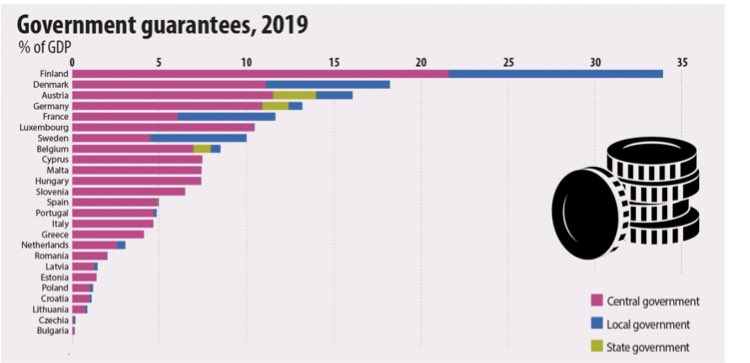
The bottom line?

There is no magic: as trend growth is poor, every country goes for credit creation to boost cyclical activity.

Some lever up the public sector, some the private sector.

They all must create credit to kick the can down the road.

6/7
How long can this go on for?

I recently wrote an article on The Macro EndGame that recorded more than 80.000 unique views.

themacrocompass.substack.com/p/endgame

• • •

Missing some Tweet in this thread? You can try to force a refresh

 

Keep Current with Alf

Alf Profile picture

Stay in touch and get notified when new unrolls are available from this author!

Read all threads

This Thread may be Removed Anytime!

PDF

Twitter may remove this content at anytime! Save it as PDF for later use!

Try unrolling a thread yourself!

how to unroll video
  1. Follow @ThreadReaderApp to mention us!

  2. From a Twitter thread mention us with a keyword "unroll"
@threadreaderapp unroll

Practice here first or read more on our help page!

More from @MacroAlf

Jan 23
New trade!

Short Oil (CL1 future)

Entry: 85.1
First target: 72.4 (15%)
Stop loss: 93.6 (10%)

- Real demand & inflation to disappoint against what's discounted
- Long oil crowded as hell
- Decent backwardation given the macro framework

A short thread.

1/6
Real demand and growth are likely to disappoint from here, in my opinion.

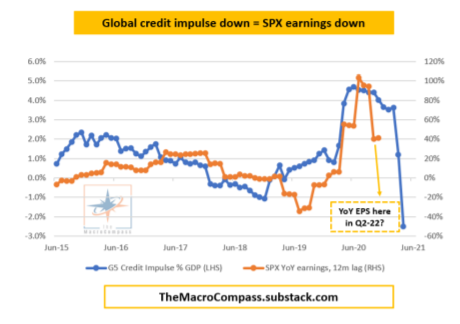
Here are earnings lagged by 12m against credit impulse.

For reference, consensus expectations for Q1-Q2 for S&P500 YoY earnings are +5-6% versus same quarters last year.

2/6 Image
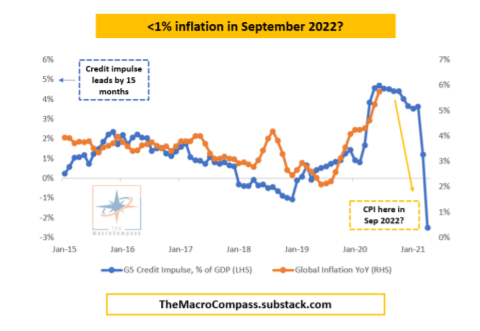
Inflationary pressures are likely to fade away too, and much more quickly than what consensus and breakevens are pricing in here (2022 YoY inflation priced at 3-4%, I expect <2%).

3/6 Image
Read 7 tweets
Jan 22
A short thread on how to fast-track your career in Finance.

I became the Head of a $20 bn Investment Portfolio at 27y old - how the hell did I manage that?

Well, at least 50% was luck

The rest, a mix of hard and soft skills (latter: often overlooked, but super important).

1/5
Hard skills count, a lot.

In my experience, it's all about curiosity and dedication really.

If you don't love what you do and you don't work hard, then leave it.

Getting a bit of math & coding helps, but the drive to learn more every day is the key.

2/5
Soft skills count much more.
In order:

- Communication: you can be the smartest guy in the room, but if nobody understands you...forget it.

- Networking: really, speak to people!

- Diplomacy: there is so much politics in a large corporation. Learn how to handle that.

3/5
Read 5 tweets
Jan 20
Risk management 101: a short thread.

To be a successful investor, you have to skew the odds in your favor.

Yes, the odds.

I AM wrong plenty of times, everybody is.

Be humble, or the market will humble you anyway.

1/5
That’s why I talk about odds.

The magic formula is:

YE P&L = (P&L generated on winning trades) - (P&L hit on losing trades).

The golden trick is to find trades whose payoff limits the P&L hit if you are wrong, and delivers a large P&L gain if you are right.

2/5
I call those skewed risk/reward trades: if you win 50% (or sometimes even less) of those, you are ensured to make money at year-end.

Easier said than done though: if you only buy call options (limited downside, plenty of upside) you are not 100% guaranteed to make money.

3/5
Read 5 tweets
Jan 15
Big flows move markets.

The biggest flows in fixed income come from the so-called “real money”: pension funds, bank treasuries etc.

Let me explain when they go big.
To get there, you have to understand their incentive scheme.

A hugely important thread.

1/7
You might think real money buys or sell big sizes of bonds when they have strong conviction on the next move in yields.

Absolutely not.

CIOs and PMs there are not paid more if they generate alpha, but they can be fired if they mess up: incentive schemes matter.

A lot.

2/7
Instead, they go big for two main reasons.

A) Regulation forces them to
B) They have some market risk to (un)hedge

Notice how in both cases they have their a*s covered.

Nobody can blame you for sticking to regulation or saying “it was a hedge” if you bleed P&L.

3/7
Read 7 tweets
Jan 13
A global macro update.

Focusing on the daily swings might lead you to miss the forest for the trees, but we are still firmly in the secular Quadrant 1 here.

Vol has increased though, which means we are going to temporarily swing through Quadrant 4 and 3 at times.

1/7
The pace of growth of credit injection through the real economy has stalled to very low levels since mid-21.

This implies a weaker impulse to real growth and earnings until at least summer 2022...

2/7
...and a repricing down of inflation expectations too: basically, a still-okaysh nominal growth but on a clearly decelerating trend.

Lower inflation break-evens while the Fed embarks in a tightening exercise lead to higher front-end real interest rates, but...

3/7
Read 7 tweets
Jan 9
QT is a big deal, yes.

But the main reason is not what you think it is.

1/10
To understand QT, you need to understand QE first.

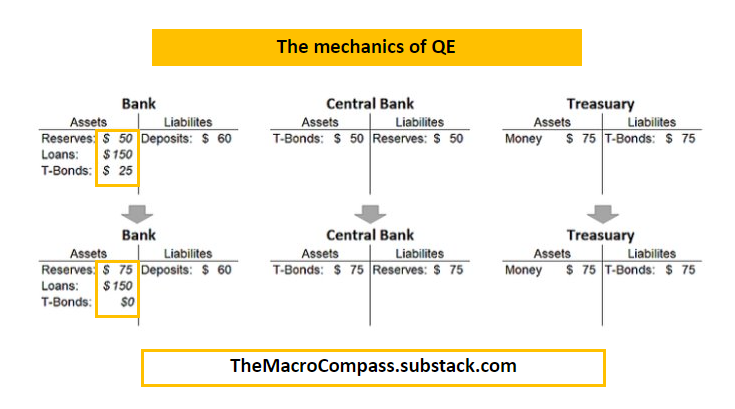
QE happens when Central Banks create bank reserves out of thin air, and purchase bonds from the private sector with them.

The pvt sector asset composition is forcefully swapped from bonds to inert reserves/deposits.

2/10
The private sector does not have more net worth.
Its asset side's composition has just been swapped: less duration intensive & coupon bearing bonds, more zero duration & low-yielding reserves or deposits.

Now, QT is the exact opposite of this.

But before we go there...

3/10
Read 10 tweets

Did Thread Reader help you today?

Support us! We are indie developers!


This site is made by just two indie developers on a laptop doing marketing, support and development! Read more about the story.

Become a Premium Member ($3/month or $30/year) and get exclusive features!

Become Premium

Too expensive? Make a small donation by buying us coffee ($5) or help with server cost ($10)

Donate via Paypal

Or Donate anonymously using crypto!

Ethereum

0xfe58350B80634f60Fa6Dc149a72b4DFbc17D341E copy

Bitcoin

3ATGMxNzCUFzxpMCHL5sWSt4DVtS8UqXpi copy

Thank you for your support!

Follow Us on Twitter!

:(