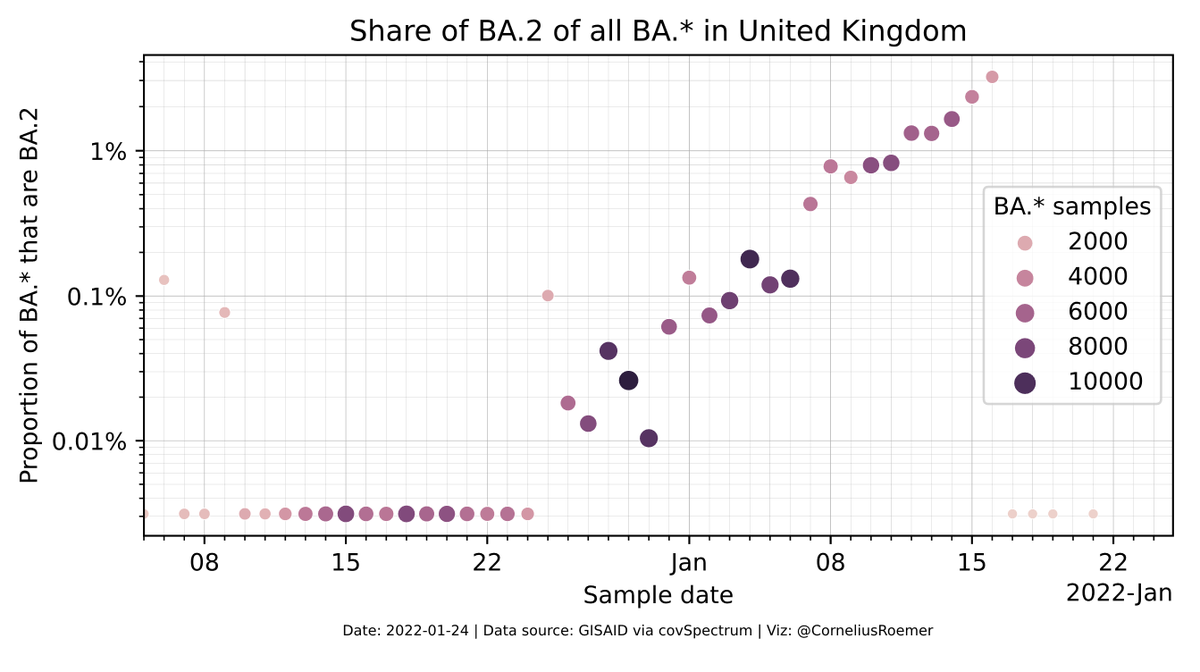
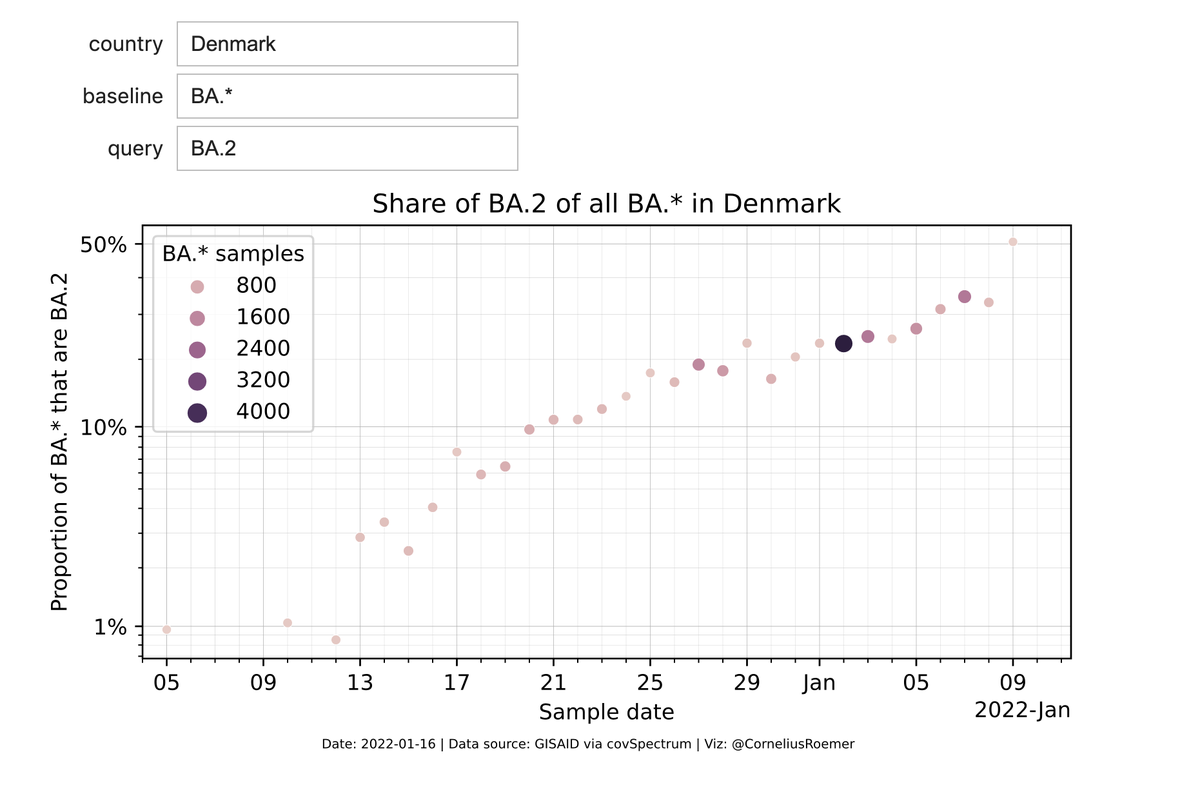
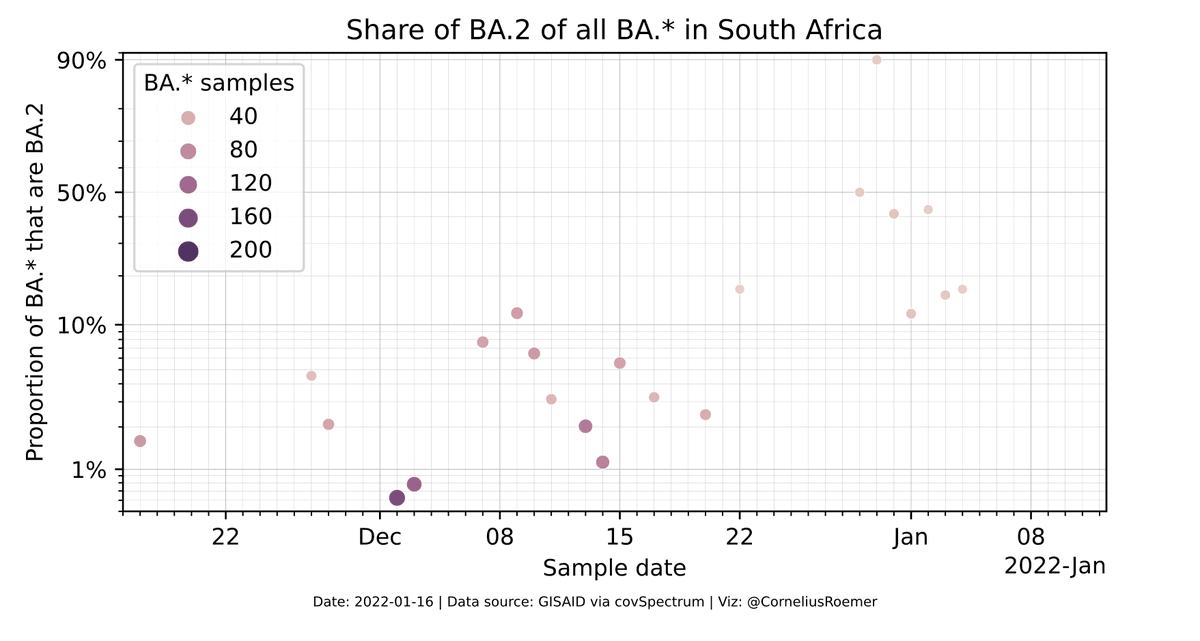
Few plots for BA.3, another one of the Omicron siblings, but apparently the least fit one.
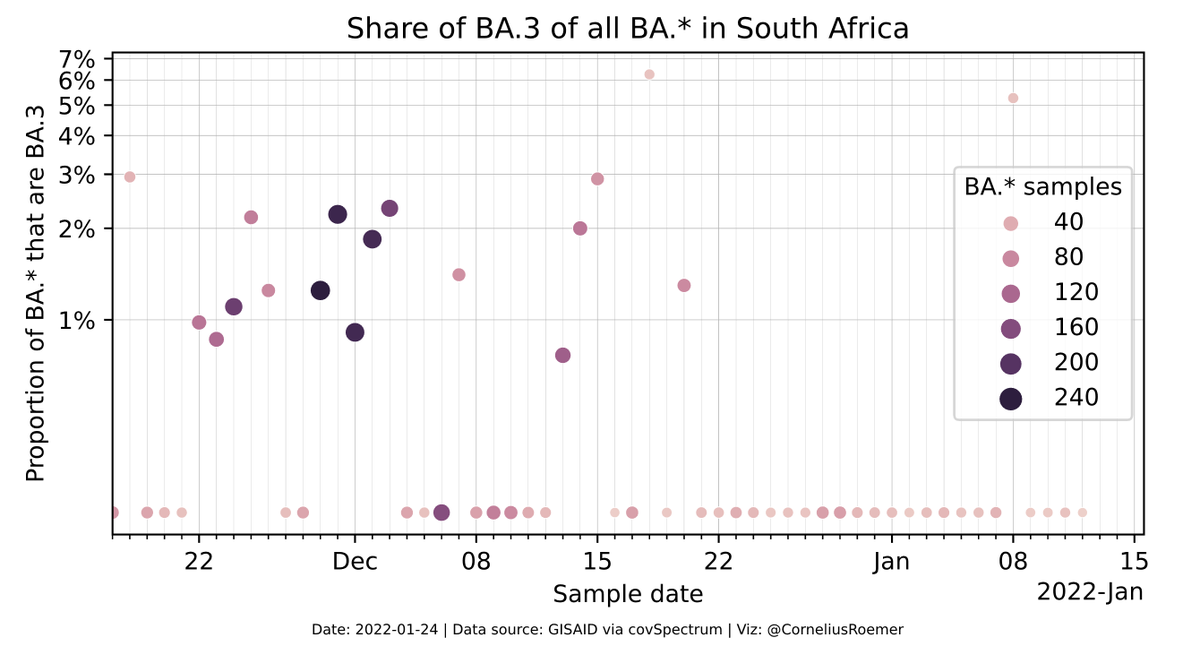
It's never really got above 1% of all Omicrons except for Poland which was presumably just by chance
It was >10% of Omicrons at some point, but has been going down steadily since. 1/
In South Africa, it was at around 1-3% end of November (first detection 18th of November) but seems to have almost disappeared since. It's a bit hard to tell since there are about 40 sequences per day, so you'd only find one every few days, it gets noisy. 2/
So the good news is, BA.3 is unlikely to become dominant. BA.2 is the Omicron sibling to watch. It started out later than BA.1 but has been picking up pretty much everywhere I've looked. Don't think I've found a single country where BA.2 has gone down over time significantly. 3/
You can produce these plots yourself here (best on desktop or desktop mode on phone) 4/ mybinder.org/v2/gh/corneliu…
• • •
Missing some Tweet in this thread? You can try to
force a refresh

Interesting results on protection conferred by previous infection when reinfected (both pre-Delta)
Previous infection reduces death upon infection by 61% (56-65%).
Vaccination clearly increases protection even after previous infection. 1/ journalofinfection.com/article/S0163-…
This was all pre-Omicron, even pre-Delta. The numbers are likely quite a lot worse for people who were infected a year ago and haven't gotten vaccinated since.
One needs to be careful to not compare the numbers directly with vax effectiveness: 2/
Vax effectiveness (against death) is composed of a) protection against getting infected and b) protection against death once infected.
The ~90-95% we got for mRNA vax pre-Omicron included a) and b).
Here, only b) was estimated. 3/
Quick investigation of some putative BA.2 with S:346K (as seen in BA.1.1) as identified by @georgimarinov using new clades.nextstrain.org reversion/contamination feature.
Indian triplet could be real, though all have Ns in critical region S:496-509, so need to wait for more 1/
English sequence has 2 reversions plus 1 canonical 21K (BA.1) mutation and S:346K (common in BA.1). So looks like contamination to me (or very short range template switching). 2/
Singaporean sequence has 7 ambiguous nucleotides, some where BA.2 has mutations. It's a single sequence, can't tell whether this is real or artefact. 3/
I made a new plot type to visualize how sub-lineages are growing with respect to their parent in a country.
Using @ProjectJupyter, Voila, and Binder I managed to make it interactive, so that everyone can type in their lineages/countries.
Try it out here: mybinder.org/v2/gh/corneliu…
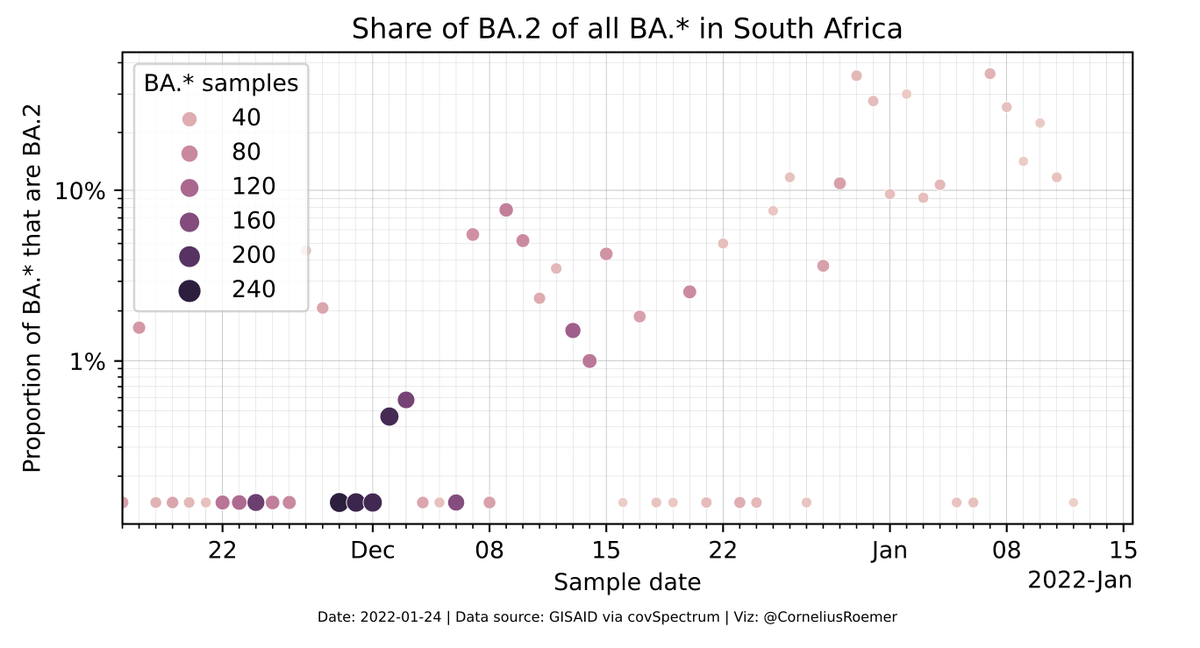
BA.2 is also rising as a share of all Omicrons in South Africa
End of November BA.2 represented around 2% of Omicrons.
Beginning of January, it was about 10 times more, maybe 20%.
In India, BA.2 has become the dominant Omicron variant towards end of December. Growing from ~5% in mid December to >50% by beginning of January.
Omikron hat möglicherweise eine kürzere Generationszeit.
Warum wäre das gut? Weil sich dadurch die Schätzungen für den intrinsischen Übertragungsvorteil ggü Delta verringern und Omikron somit einfacher zu bekämpfen wäre als befürchtet.
Was ist die Evidenz dafür? 1/
@trvrb fasst das in diesem Thread sehr gut zusammen. 1. Die gemessene Inkubationszeit bei dem norwegischen Superspreading-Event war deutlich kürzer als wir es von Delta kennen, 3 Tage statt ~4-5 bei Delta 2/
2. In Südafrika scheint der Peak überschritten. Dafür gibt es andere mögliche Erklärungen, aber dennoch, eine kürzere Generationszeit wäre eine sehr einfache Erklärung im Sinne von Occams Rasiermesser. 3/
Just found out Germany's @rki_de publishes all of their SARS-CoV-2 sequences on @github, with daily updates and very quick turnarounds.
They even run pangolin on the results so one can tell which variant the sequences belong to (e.g. Omicron).
To date there are 1036 Omicrons.
You can find the repo here: github.com/robert-koch-in…
The pangolin calls are in a file called (a bit cryptically) "Entwicklungslinien".
Big thanks to everyone involved, this is amazing.
On GISAID, there are only 274 Omicrons to date, so the delay is much shorted.
The publishing to Github seems to be done by @HannesWuensche, great job, thanks a lot!
Now someone just needs to build a nice graph that can be updated daily to show where we stand with Omicron in Germany.
The metadata is great, contains sampling type (random vs. targeted).
Heute ist Bundespressekonferenz.
Ich wünsche mir eine informierte Frage dazu, wann das @rki_de Omikron endlich ordentlich misst.
Bisher ist es eine Farce, auch wenn Lothar Wieler in der letzten BPK das Gegenteil behauptet hat.
Mehr Details im Thread 🧵⬇️ 1/
Die Verbreitung von Omikron kann auf 2 Arten gemessen werden: 1. Vollgenomsequenzierung 2. Varianten-PCR
In Sachen Sequenzierung ist 🇩🇪 mittlerweile gut aufgestellt. Das Problem ist aber: Sequenzieren ist _immer_ langsamer als die Varianten-PCR, Verzögerung ca. 2 Wochen 2/
Deswegen ist die Varianten-PCR, zum Beispiel durch S-Gene-Target-Failure (SGTF) so wichtig. Weil sie theoretisch so schnell ist wie der PCR-Test.
Dutzende Länder machen das bei Omikron sehr gut. Alle bekannten Kurven kommen durch diese Methode:
UK, Dänemark, Belgien, USA 3/