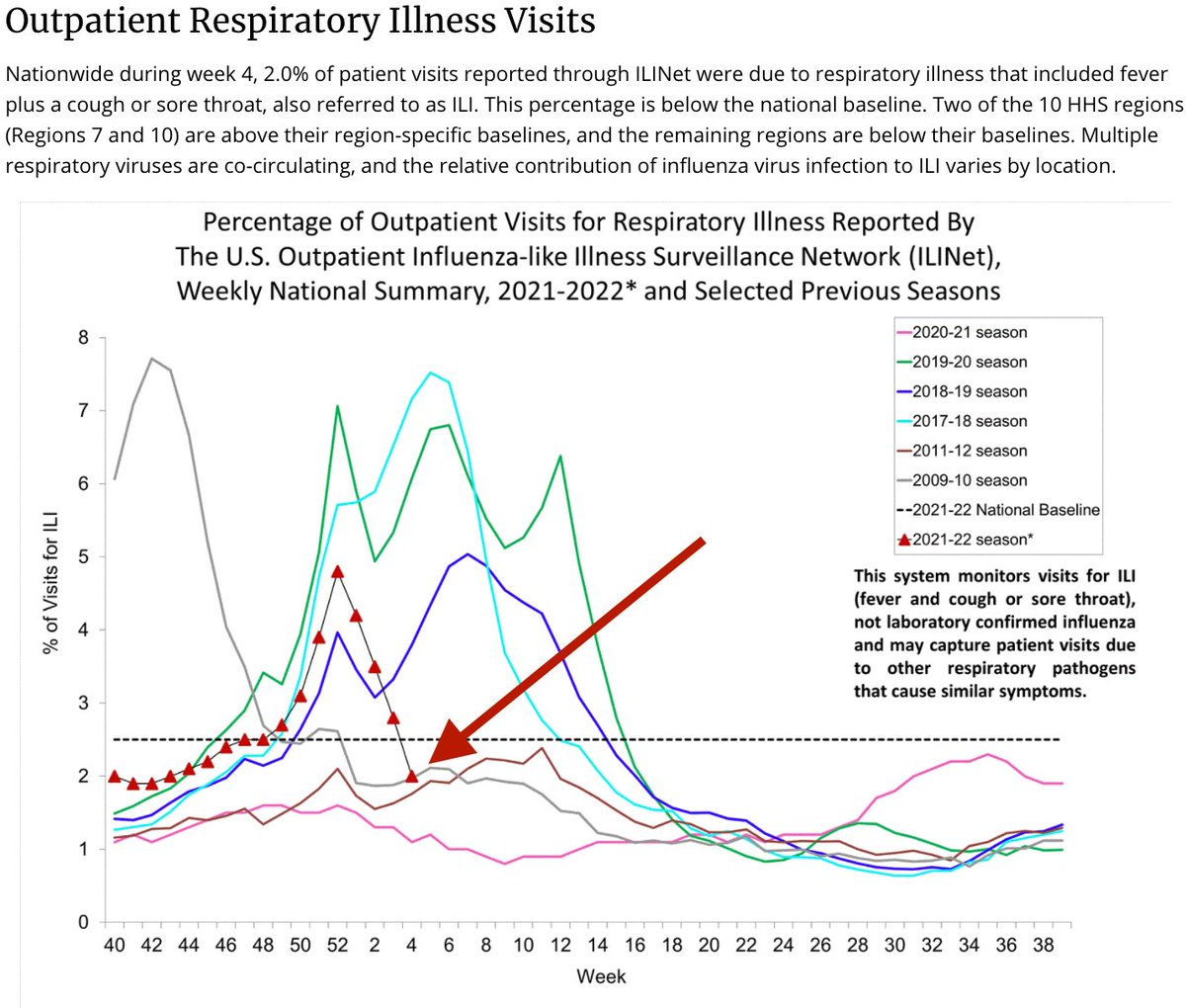
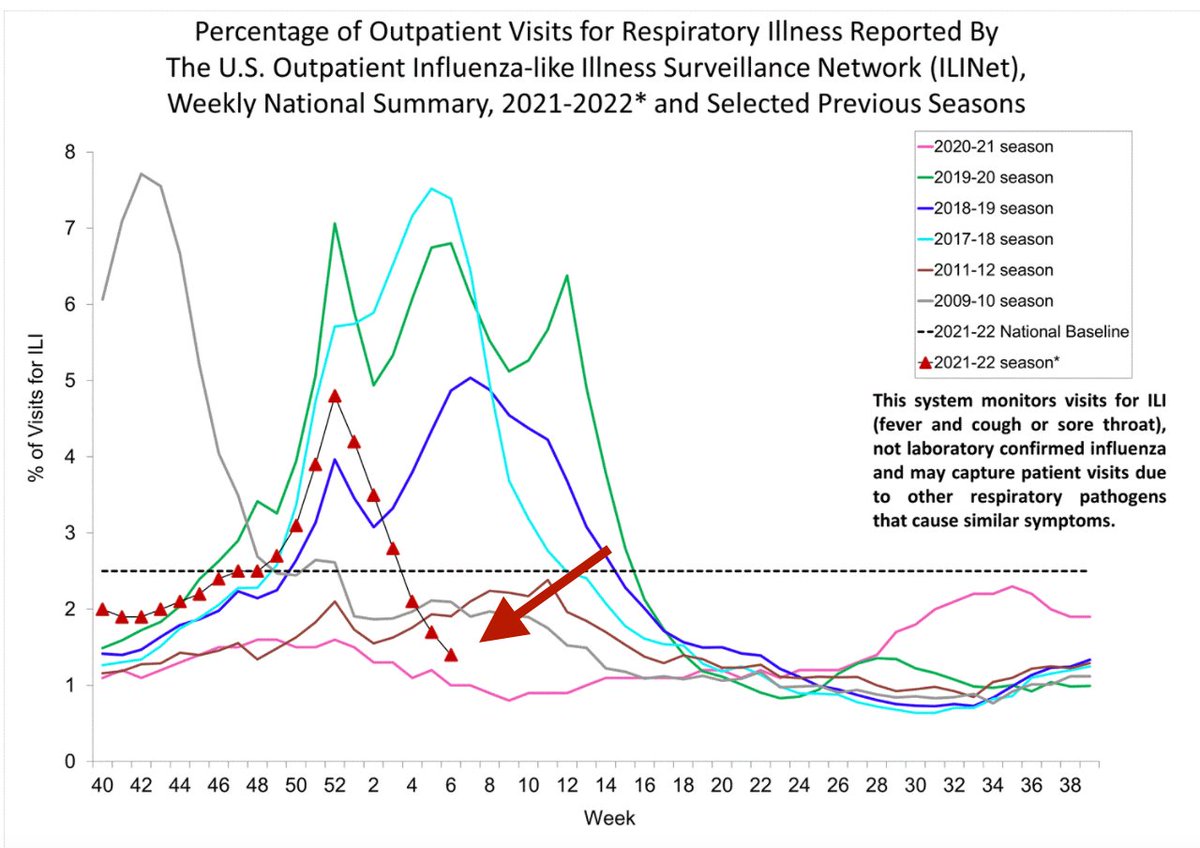
1. A #flu 🧵 @CDCgov has published flu data for the week ending Feb. 12. What is being seen nationally continues a trend that has been evident for several weeks — flu season peaked over the holidays & has been declining ever since. Red arrow points to this year.
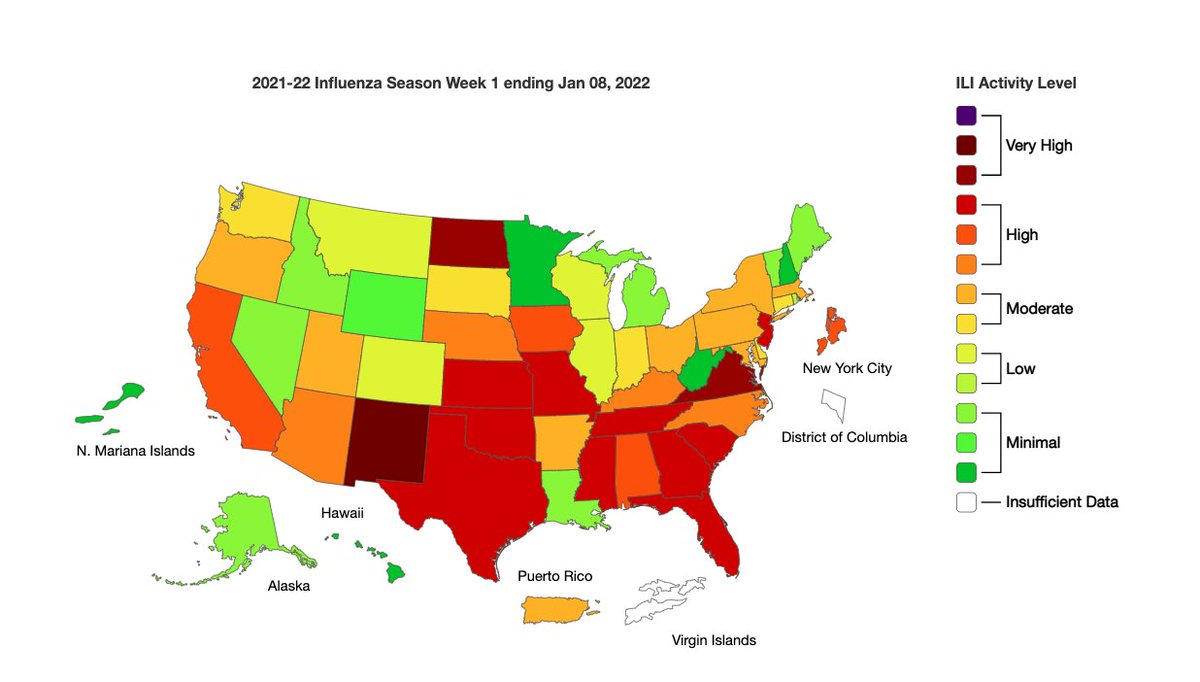
2. #Flu is notoriously hard to predict; there could be late season activity yet to come. And @CDCgov says there are parts of the country where activity picked up a bit in the week ending Feb. 12. Not enough to make parts of this map turn red, though.
3. @CDCgov estimates 1,300 people have died from #flu this year in the US. That's very low. Most flu seasons kill between 12,000 & 52,000 people in this country.
One of the key reasons for this year's low death toll is the low rate of outbreaks in care facilities.
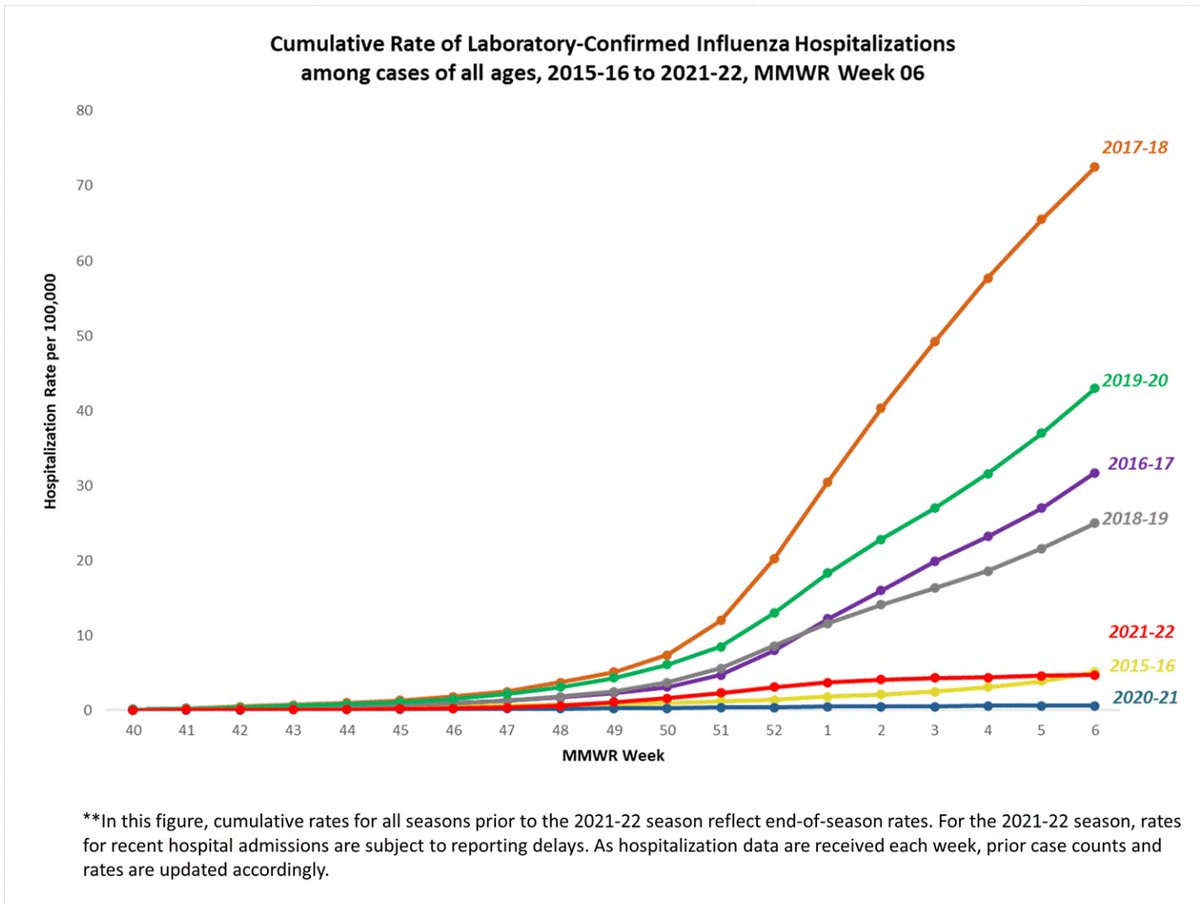
4. The rate of hospitalizations for #flu this winter is also low. Earlier this season it looked like 2021-22 was going to see a higher hospitalization rate than 2015-16, a historically mild season. But it looks like this year's rate is now below 2015-16.
5. @CDCgov reported a case of a person infected with a swine #flu virus. Occurred in California; the person, an adult, had contact with pigs. Some contacts of the individual had respiratory symptoms, but there were other respiratory viruses circulating & no testing was done
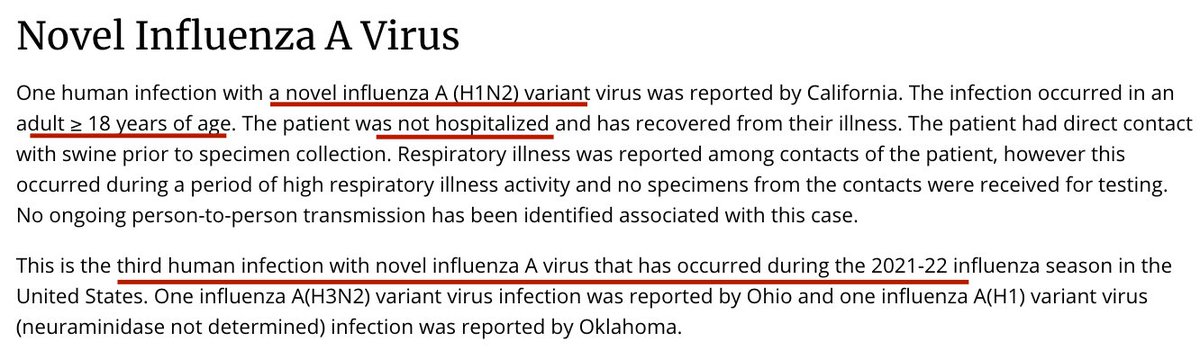
6. That swine #flu case is the third zoonotic flu infection seen in the US this flu season. The other 2 were in Ohio and Oklahoma @CDCgov's Fluview is here: cdc.gov/flu/weekly/
• • •
Missing some Tweet in this thread? You can try to
force a refresh

1. I asked @trvrb last fall whether he thought we'd have a regular #flu season this year. Trevor said he thought flu wasn't yet back to pre-pandemic levels & that this winter likely wouldn't be the year it came back with a vengeance. So far, it looks like he was right. 🧵
2. The latest FluView from @CDCgov shows that flu activity in the US continues to decline. (Latest report from @WHO suggests same is happening globally.) The arrow points to where things stand with influenza-like activity in the US right now.
3. There's always a possibility there will be more #flu later in the season. Flu B often rears its head in March or April. China has has a lot of flu B activity this winter, so maybe the Olympics will seed some of that elsewhere. But if not, flu season could end early.
1. I'm listening to some presentations to #ACIP on myocarditis associated with receipt of Moderna's Covid vaccine or mRNA vaccines in general.
CDC's Tom Shimabukuro was asked about deaths. He said there were 13 deaths reported, but so far none are thought to be vax-related.
2. @CDCgov is doing a study following up on people who reported myocarditis after mRNA vaccination. CDC's Ian Kracalik is presenting on that study now.
3. No surprise by now, most of the people reporting myocarditis after mRNA vaccination were young males.
1. An update on #flu in the US, with data from @CDCgov for the week ending Jan 29.
For the second year in a row the warnings of a "twindemic" of Covid & flu haven't come to pass. There will be winters when we have to deal with both. But this year we may have dodged that bullet.
2. Currently influenza-like activity is "below baseline." That could mean we've passed the peak of flu season for winter 2021-22. That said, #flu B activity often occurs late in the season — sometimes into March & April. So there could be more flu later.
3. @CDCgov estimates that 1,200 people have died from #flu this winter in the US. And it has received reports of 5 deaths of children. In most regular years, there are somewhere between 100 and 200 children who die from flu.
1. Amazing statistic: In the 10 weeks since Omicron was discovered, there have been 90M #Covid cases reported — more than in all of 2020, says @drtedros at today's @WHO press conference.
2. A dangerous narrative on the pandemic has taken root, says @drtedros. With the availability of vaccines & the transmissibility of Omicron, some are assuming the need to fight to reduce transmission is either unnecessary or futile. More infections will lead to more deaths.
3. @drtedros said the #SARSCoV2 virus remains dangerous and continues to evolve. @WHO is monitoring 4 subvariants of Omicron, he said.
1. A short #flu 🧵
Flu activity in the US remains low for this time of year. For the week ending Jan 22, 1.9% of samples tested for flu were positive. To put that in context, in the corresponding week in 2019-20, the positivity rate was nearly 28%.
2. #Flu activity in the week ending Jan. 22 was roughly equal to the previous week, @CDCgov reports. But transmission of other respiratory pathogens has declined, which have brought the epi curve for #influenza-like illnesses (ILIs) for this season almost back down to baseline.
3. It's early in the flu season for this kind of decline; there could be a rebound later.
Is the decline due to precautions people are taking to avoid Covid? Is Covid beating the other ILIs to the punch — it's infecting people before flu or other ILIs can? I'd love to know.
1. A #flu 🧵 based on US data from @cdcgov.
Two children died from flu in the week ending Jan. 15, bringing to 5 the total number of pediatric flu deaths so far this season. It's a such a shame to see this feature of flu season return.
2. #Influenza-like illnesses dropped again last week. The further we get out from the holidays, the more likely it is that's a real thing, not an artifact of reporting delays. Is the Omicron wave crowding out flu? Are measures people are taking to avoid Omicron driving down flu?
3. #Influenza-like illness activity (which is #flu, RSV & a range of other non-Covid respiratory pathogens) is incredibly variable this year. It's unusual to see some areas reporting very little (green) & others lots (deep red). In a regular flu season, it's more homogeneous.