
1/ @VovoFinance
Defi is a degen's playground, but there are also many who are more risk averse, looking to make decent returns while protecting capital.
Principal Protected Products?
Vovo Finance got you covered.
Now live on #Arbitrum, let's take a look behind the scenes 👇🏻
Defi is a degen's playground, but there are also many who are more risk averse, looking to make decent returns while protecting capital.
Principal Protected Products?
Vovo Finance got you covered.
Now live on #Arbitrum, let's take a look behind the scenes 👇🏻

2/ What is Vovo?
Vovo Finance offers structured products to users allowing strategies to be tweaked based on users’ risk profiles and market outlook.
This is offered in two main products:
- Principal Protected Products (Live now)
- Yield Enhancement Products (Coming soon)
Vovo Finance offers structured products to users allowing strategies to be tweaked based on users’ risk profiles and market outlook.
This is offered in two main products:
- Principal Protected Products (Live now)
- Yield Enhancement Products (Coming soon)
3/ Principal Protected Products (PPP)
PPPs, as the name implies, is a product intended to generate a healthy yield, while keep the principal protected.
But how does Vovo do that?
PPPs, as the name implies, is a product intended to generate a healthy yield, while keep the principal protected.
But how does Vovo do that?
4/ The vault takes in $USDC, which is farmed in everyone's favourite @CurveFinance 2pool ( $USDC - $USDT).
Your principal here is safe and sound since it's just plain ol' vanilla stable farming (not to mention, in the highest TVL defi protocol in existence now).
Your principal here is safe and sound since it's just plain ol' vanilla stable farming (not to mention, in the highest TVL defi protocol in existence now).
5/ Ah, but where do the juicy yields come in?
Users have a choice between 4 strategies for the PPP, based on their personal market outlook and strategy:
- ETH Up
- ETH Down
- BTC Up
- BTC Down
Depending on their choice, the strategy used is different.
Users have a choice between 4 strategies for the PPP, based on their personal market outlook and strategy:
- ETH Up
- ETH Down
- BTC Up
- BTC Down
Depending on their choice, the strategy used is different.
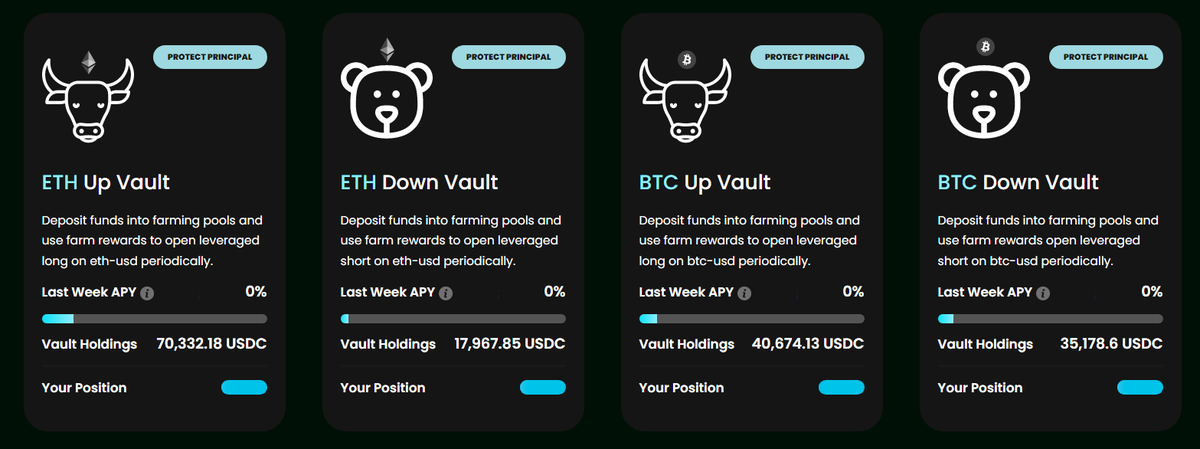
6/ Let's say, I chose the $ETH Up vault. This means that I am bullish on $ETH.
My farming rewards from the the Curve pool is harvested, converted to $USDC and then used to long ETH-USD on @GMX_IO at a 15x leverage.
Profit is taken periodically over the course of the trade.
My farming rewards from the the Curve pool is harvested, converted to $USDC and then used to long ETH-USD on @GMX_IO at a 15x leverage.
Profit is taken periodically over the course of the trade.

7/ $GMX is a cross chain spot and perp exchange, currently live on #Arbitrum and #Avalanche.
GMX is also the largest perp exchange on Arbitrum now, with over 200m in TVL and well over 100m in volume daily.
$GMX has gotta be one of my fav projects (maybe 🧵next week kek).
GMX is also the largest perp exchange on Arbitrum now, with over 200m in TVL and well over 100m in volume daily.
$GMX has gotta be one of my fav projects (maybe 🧵next week kek).
8/ On the other hand, if I chose $ETH Down, the rewards will be used to short ETH-USD on $GMX at a 15x leverage.
Likewise if $BTC vaults are chosen, the trades made would be long/short $BTC on $GMX.
Likewise if $BTC vaults are chosen, the trades made would be long/short $BTC on $GMX.

9/ This allows your stablecoins to farm higher yields while not risking your principal unnecessarily. This is of course assuming you chose the right direction.
Over backtests in the last 4 years, choosing the right direction netted a 1.5-3x APY increase (vs the base Curve APY).
Over backtests in the last 4 years, choosing the right direction netted a 1.5-3x APY increase (vs the base Curve APY).
10/ Choosing the wrong direction, of course, eats into the returns, although it is noted that the return is still generally above half of the base Curve APY.
So, yes, some level of skill is definitely required, but pretty snazzy innit?
So, yes, some level of skill is definitely required, but pretty snazzy innit?
11/ Vovo also has an (upcoming) second product, their Yield Enhancement Product
This product targets higher yields, albeit with of course, more risk.
This product targets higher yields, albeit with of course, more risk.
12/ Strategies under this product include:
- Covered Call options using @PrimitiveFi
- Farming funding rates on Squeeth positions on @opyn_
If you're not sure what Covered Calls are, you can check out my thread on them here 👇🏻
- Covered Call options using @PrimitiveFi
- Farming funding rates on Squeeth positions on @opyn_
If you're not sure what Covered Calls are, you can check out my thread on them here 👇🏻
https://twitter.com/0xKira_/status/1477992947882729472?s=20&t=IHBEHSRUkB_AQq-j-2ftLg
13/ As such, Vovo Finance looks to be a way to increase stablefarm yields without taking on unnecessary risks or having to pay out rewards using the emissions of their own governance tokens (wen token?), which is big as builders look to more sustainable reward models in Defi.
14/ Moreover, the concept of PPPs is definitely an attractive one for more risk averse participants.
Disclaimer: Vovo is in Alpha at the moment, so do use at your own risk.
This thread is not an endorsement of the product, just thought the concept was neat :-)
Disclaimer: Vovo is in Alpha at the moment, so do use at your own risk.
This thread is not an endorsement of the product, just thought the concept was neat :-)
• • •
Missing some Tweet in this thread? You can try to
force a refresh






