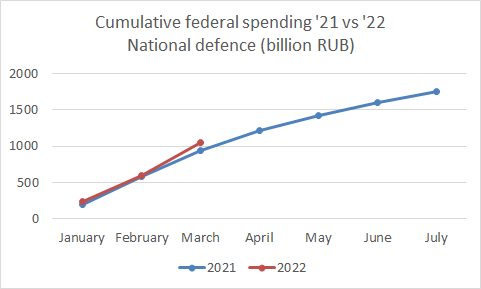
Can we see war costs in #Russia's federal budget? I looked for any indications in monthly budget data. Disclaimer: #Budget execution is often erratic and it's difficult to draw conclusions from one data point. I first looked at National Defence - not much to see here. 1/7
There is a small increase in Economy, but it does not look significant (especially since the data is not adjusted for inflation). 2/7
Maybe the most interesting change: Healthcare. There is a strong increase, but it coincided with a big wave of Covid19 infections. 3/7
The increase in healthcare spending was mostly due to an increase in the unspecified "other" category. There could be war costs in here, but we will only be able to differentiate next month. 4/7
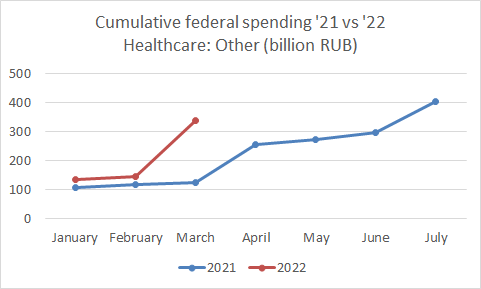
Interestingly, there was a strong increase in the "other" category across several budget positions: Not only in Healthcare, but also Housing, Social Policy and Environment. 5/7
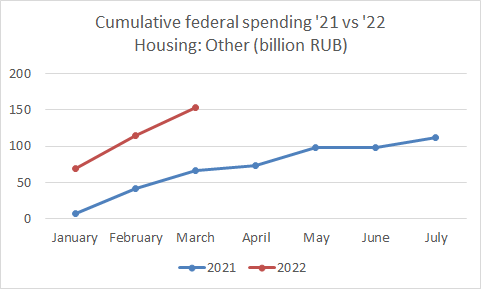
It is very likely that direct war costs will show up outside of the National Defence category, spread out all over the budget (like much of Russia's military costs). April data will help, but it will be hard to differentiate direct war costs from sanctions countermeasures. 6/7
There were some notable changes in smaller subcategories that I didn't mention here. They could also be due to changes in policy unrelated to the war. Overall, budget execution data will not provide a full picture, but the next releases will be extremely interesting. 7/7
• • •
Missing some Tweet in this thread? You can try to
force a refresh

Putin does not have a clear vision for the "end state" of the war in Ukraine. He is happy with the way things are going, but there is no clearly defined goal. The war is more like to shaking a tree and enjoying the fruit that falls.
However, Putin has some clear red lines, i.e. ways in which the war should _not_ end from his point of view. In essence, Ukrainian sovereignty is the red line. Either the Ukrainian state must collapse, or it must become politically dependent on Moscow.
Given Putin's red lines, it is extremely difficult to imagine how the war could end. There is no convincing scenario for a Russian victory. It is unlikely that Putin will be able to control Ukraine. Nor will Europe help Putin to hold Ukraine down.
Europe has to move fast now. The Witkoff/Kushner team has discovered the Russian sovereign assets as a golden opportunity for their own dealings with Moscow. Don't underestimate how attractive $200 billion are to these guys.
The EU has to make sure that the money is spent in Europe's and Ukraine's interest. Once we have taken control over it, US and EU interests will align again, because we will use some of it to buy US weapons. Until then, it is an opportunity for US-Russia collusion.
That's why it is crucial to put the assets out of reach of the more corrupt elements in the US administration. The "28-point plan" already contained a point that would allow the US to benefit from the reserves. This is dangerous.
New data on Russian recruitment: Around 200,000 men signed a contract in the first half of 2025. Dmitry Medvedev claims the number is 210,000 - my latest estimated based on regional budget data indicates 191,000.
By now, I'm pretty confident that my recruitment estimates based on regional budget data are useful. Over the last 1.5 years, they closely tracked the quarterly results based on federal data (which is always published with a big delay).
The great thing about regional budget data is that: It allows for monthly estimates, providing a more detailed and up-to-date picture of recruitment dynamics without relying on official statements.
The discussion about European peacekeepers is deeply dishonest. Is the idea to sneak them in while Russia is not looking? Hoping that Russia will be afraid to attack them afterwards? Should we get Putin drunk so he agrees to the deployment and when he sobers up it is too late?
If anything, these peacekeepers will be an invitation for Russia to test Europeans by attacking them in Ukraine. Are European societies ready to see thousands of their soldiers dying there? Because Putin certainly would be willing to sacrifice his people to expose Europe.
My impression is that European leaders boldly talk about peacekeepers as if they could be deployed tomorrow, knowing very well that the conditions for deploying them (especially: Russian agreement and US protection) will never come. This is a problem.
The current situation: Russia is exploring what it can get from Trump. The minimum it would want for a ceasefire is control over Ukraine, i.e. some form of surrender by Kyiv. This could take a number of forms: a new Russian-controlled president, restrictions on Ukraine's army...
Although the US position has diverged from Europe's, it is still far from Russia's. At least some in the US administration believe that Ukraine could remain independent after a deal, or that the Europeans could send in troops. Both are non-starters for Moscow.
The big question is whether Russia will manage to negotiate a deceptive deal with its inexperienced US counterparts. A deal that - to the US team - looks like Trump gets what he wants (just a ceasefire), while in fact it will lead to what Russia wants (Russian control over Kyiv).