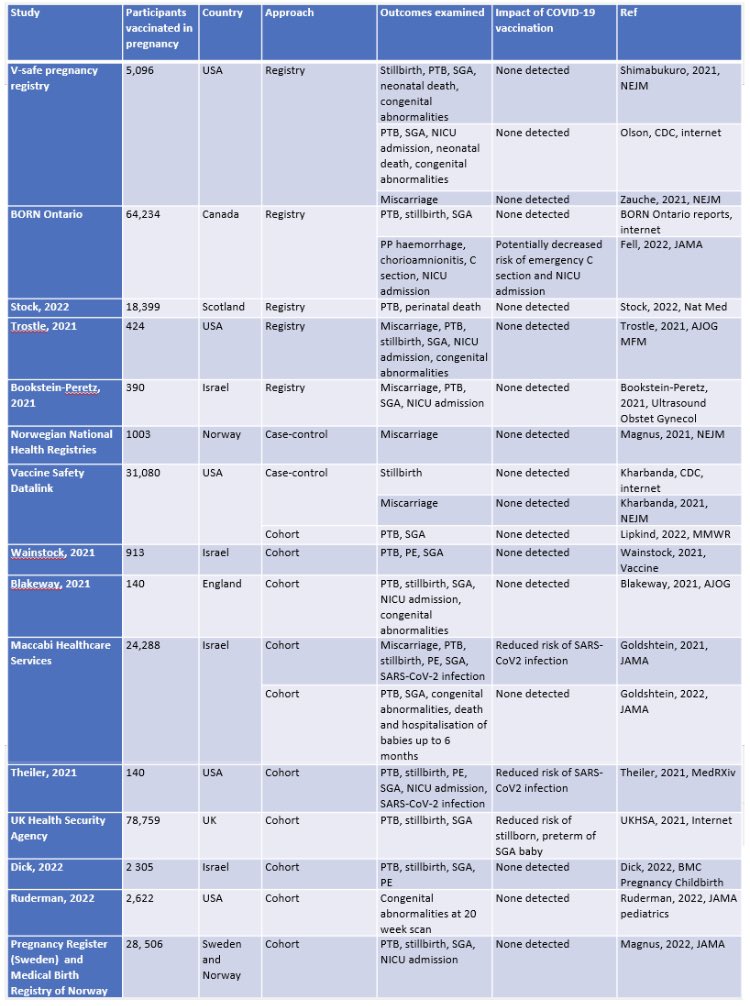
@JoelCraig1 The meta analysis we’re talking about included 23 studies and 117,552 people vaccinated in pregnancy. So if you are looking for evidence, that’s a good place to start.
Link again since sounds like you haven’t looked at it yet… 1/
@JoelCraig1 Some studies didn’t meet the strict predefined inclusion criteria for SR/MA. So you can find more in my own review, published in @NatRevImmunol in March. At the time we had studies on 185,309 ppl vaccinated in pregnancy with no problems appearing. 2/
@JoelCraig1@NatRevImmunol But of course more has been done since March! @UKHSA has updated their data and there’s been a new study published by Rudermann. So the evidence base now stands at 239,760 ppl vaccinated in pregnancy, in formal studies, with no problem appearing. 3/
@JoelCraig1@NatRevImmunol@UKHSA Citations on the right there if you want to just pop them into Pubmed. But for those who don’t know Pubmed, clickable links to studies with a lay summary of the findings available under q8 of this document… 4/
@BerryTartlet@DrLoupis Yes, this is quite an old document. A timeline of UK policy on this might help you.
8 - 31 Dec 2020. Vaccines approved, but using the same exclusions as the trials - no-one who is or could be pregnant. That’s the document you’re looking at there. 1/
@BerryTartlet@DrLoupis Also worth noting that even at that point, there’s nothing saying it’s not safe, only pointing out that we don’t have any evidence yet. 2/
@BerryTartlet@DrLoupis 31 Dec 2020 to 18 April 2021. No requirement to prove you are not pregnant in order to be vaccinated, and vaccines offered to those at particularly high risk due to their profession or medical history. 3/
@jtmayes3@kevinault Let’s begin by taking the 172,000 number at face value. About 190,000 ppl have been vaccinated during pregnancy in the US. So if that were true it’s a miscarriage rate of 90%…
@jtmayes3@kevinault Quite apart from being not plausible, it’s straight up impossible. Miscarriages by definition happen before 20 weeks and about half of those vaccinated were vaccinated after 20 weeks. It was too late for them to have a miscarriage. 2/
@jtmayes3@kevinault So even if *every single person* who received the vaccine before 20 weeks miscarried, and we somehow failed to notice, that’s still an overestimate of the rare by at least 2x.
(Spoiler alert: Obviously it’s a bigger than 2x overestimate…) 3/
The finding that #CovidVaccination does not affect #fertility mirrors what we have already seen in IVF settings, but it is good (if unsurprising!) to see it confirmed among those #TryingToConceive the old fashioned way! 2/
This gives us some homegrown data on vaccine effectiveness in pregnancy, including in the delta wave. Roughly speaking, vaccination reduces the risk of...
Any infection by 30%
Hospitalisation by 72%
ICU by 94%
2/
The findings are roughly in line with what we already know about the outcomes of COVID in pregnancy.
We usually say that stillbirth is 3x more likely following infection. The slightly higher number here may be because they also counted babies dying shortly after birth... 3/
I know ppl have been wondering about this! But up to now the data we had was pretty preliminary. However, with a large, prospectively collected dataset out yesterday, I think it’s time to start putting it all together.... 🧵
Here’s some more on that new study. In short, people who received both doses of the vaccine in a single menstrual cycle found their period came a couple of days late. But it was back to normal a couple of cycles later, so the change was temporary. 2/
This might explain why our UK-based study couldn’t find clear patterns to suggest that Covid vaccination is associated with changes to periods. In the UK, our interdose interval is 8 weeks, so it’s not possible to have both doses in the same cycle. 3/
In summary: on average, periods are delayed by ~half day by dose 2 of the vaccine, and delayed by ~2 days if you get both doses in the same cycle. But it's temporary! 🧵
3959 spontaneously cycling ppl logged at least 6 consecutive cycles with tracking app @NaturalCycles.
2403 were vaccinated. Taking them all together, the average period came 0.64d late after dose 1 and 0.79d late after dose 2. No difference in length of period. 2/
Most of us wouldn’t even notice this! But could the average be hiding some small fraction of people who experience a large change? We define any variation in cycle length of less than 8 days as “normal”. 3/