We are short $Sinch, a swedish telecommunications company. In our opinion, the company misstated its financial statements by billions, read the full report: ningiresearch.com/2022/07/11/res…
As a tech company #Sinch expensed ZERO R&D costs in 2021. All while #Twilio expensed 28% of revenue in the same time, #Sinch self proclaims being profitable for years while growing its business, read the full report: ningiresearch.com/2022/07/11/res…
At first glance, we found material misstatements of net profit and EBIT within #Sinch financial statements. Profit is misstated by SEK 34m and EBIT by SEK 22m, read the full report: ningiresearch.com/2022/07/11/res…
On page 106 of its 2021 report #Sinch used three different synonyms and reported three different figures for the same line item. Unbilled accounts receivable, accrued income and accrued revenue are all the same, so what’s true? Read the full report: ningiresearch.com/2022/07/11/res…
$SINCH.ST booked accrued revenue as accounts receivables to conceal the accrued revenue‘s significant growth in the last years. #Sinch also misstated several line items by #billions, read the full report: ningiresearch.com/2022/07/11/res…
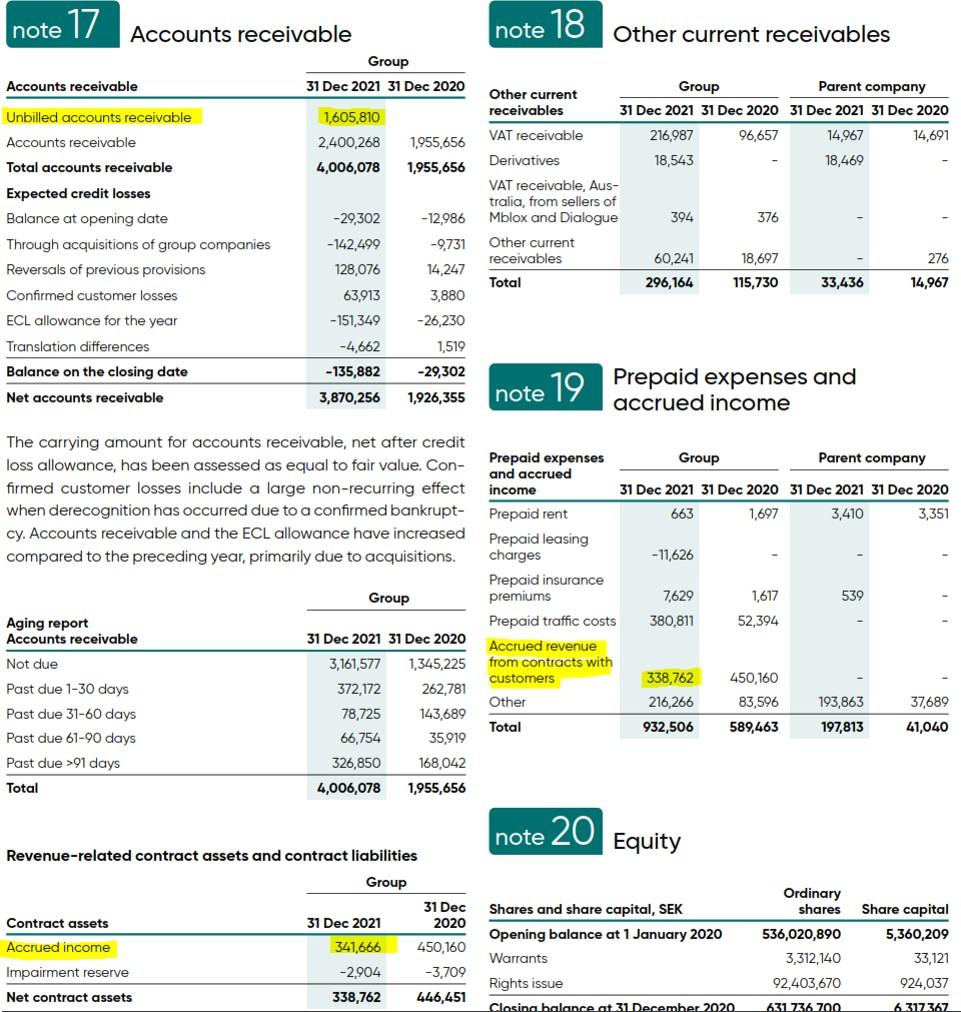
Reconciliation of line items based on #Sinch financials was not possible. There is SEK 7m #missing where it should not be. In our opinion because Sinch booked accrued revenue as accounts receivable, read the full report: ningiresearch.com/2022/07/11/res…
Simple reconciliation of #Sinch balance sheet based on its financials wasn’t possible either. Because $SINCH concealed its growing accrued #revenue there is a significant #mismatch between accounts receivables and other current receivables, read report: ningiresearch.com/2022/07/11/res…
One of #Sinch Australian subsidiary was dissolved in 2016 and got a new obscure name. But it was consolidated since then every year any way and $SINCH.ST used it as an umbrella for other subsidiaries, read the full report: ningiresearch.com/2022/07/11/res…
Another #Sinch Australian subsidiary does not exist based on the information provided by the company. Without a valid ACN or ABN, a company cannot do any business in #Australia. ACN and ABN have to stated on every invoice, read the full report: ningiresearch.com/2022/07/11/res…
In our opinion, 70% of all receivables are from less credit-worthy customers or do not exist. $Sinch changed its approach for customer #credit risk management. An important paragraph was cut from 2020 on, read the full report: ningiresearch.com/2022/07/11/res…
We think, that revenue, #EBITDA, EBIT and #EPS are significantly overstated. Revenue by 18% at worst, EBITDA and EBIT is negative in any case. A grim picture emerges for #Sinch, read the full report: ningiresearch.com/2022/07/11/res…
• • •
Missing some Tweet in this thread? You can try to
force a refresh

1/ We are short Critical Metals Corp. $CRML.
In our opinion, the company is not a legitimate mining venture but an elaborate promotional vehicle. We believe its entire narrative is constructed on geological fantasies and engineering impossibilities.
A thread 🧵
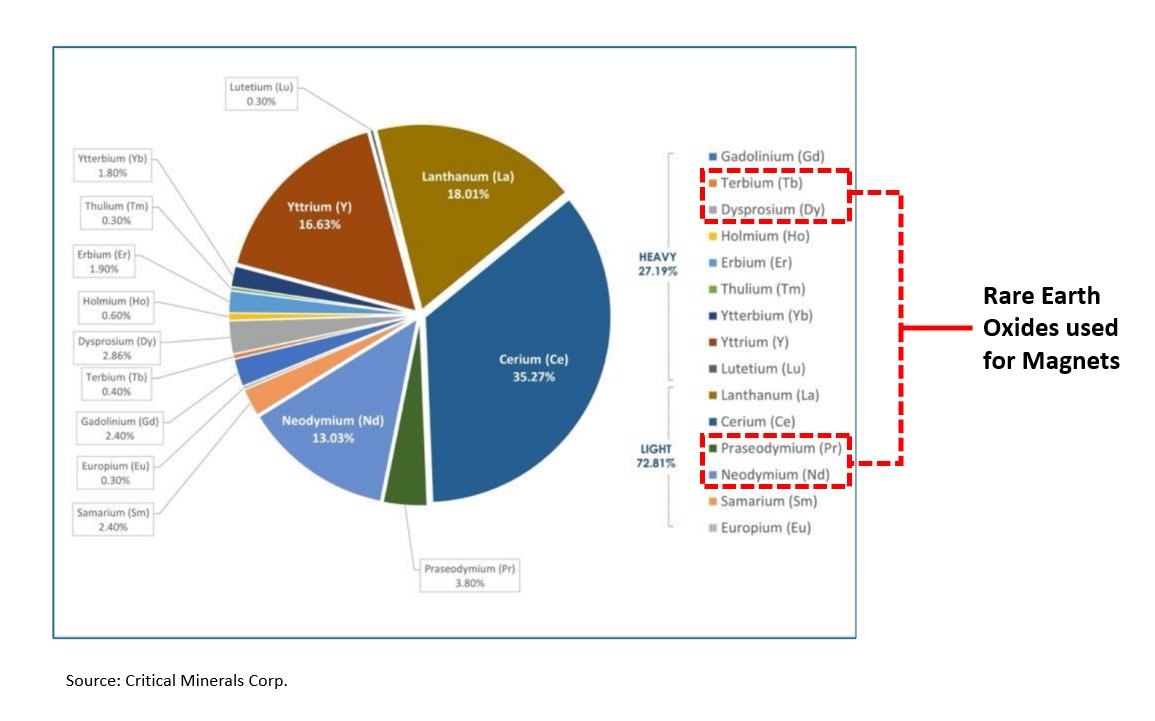
$CRML's flagship pitch is the Tanbreez project, promoted with a "75% of the Rare Earth Oxides are magnet REO" figure.
This is a "metric-gimmick". We checked their own PEA data. The actual share of valuable magnet REOs (Nd, Pr, Dy, Tb) is just 20.08%.
3/ How does $CRML achieves a $2.7bn valuation on its Tanbreez mine?
By, in our opinion, fabricating it. The PEA values their unprocessed concentrate at the final price of fully refined, high-purity oxides.
...while EXCLUDING 100% of the billion-dollar cost to build the refinery.
We are short CCC S.A. (WSE: CCC). Our investigation has uncovered evidence that CCC’s celebrated turnaround is an illusion, engineered through a classic channel stuffing scheme, brazen self-dealing by insiders, and accounting games to hide a rotting core. A thread on $CCC.WA 1/x
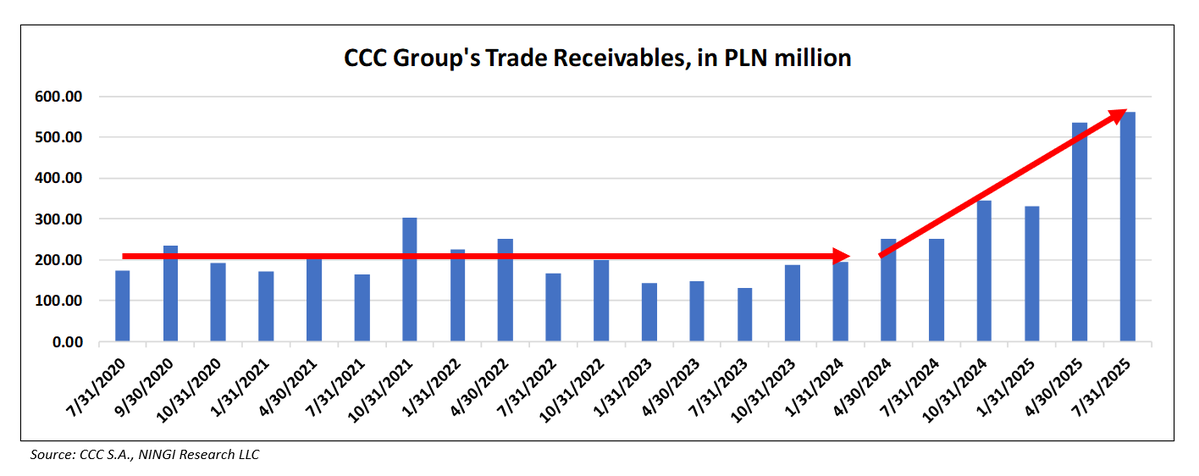
At the heart of the deception is a channel stuffing scheme. $CCC.WA is fabricating growth by "selling" hundreds of millions in unwanted inventory to a captive, insolvent franchisee called MKRI. The clearest footprint of this scheme is CCC’s exploding trade receivables. (2/x)
Since 2024, MKRI has been undergoing a PZU restructuring. Despite sales falling by 32%, MKRI increased its inventory massively (+138% YoY) and funded it through short-term credit (+232% YoY). MKRI even tripled warehouse space due to $CCC.WA inventory dump. (3/x)
The $GRND Buyout Bid Is One of the Messiest We’ve Ever Seen.
One of the supposed buyers — who also happens to be the current board chairman — is being margin called on his pledged $GRND shares.
1/x
That $GRND margin call should’ve been disclosed in a Form 4.
Form 4 requires a two-day filing deadline for reporting changes in a company insider's beneficial ownership.
But the filing for the Oct 10 sale? Delayed. Conveniently. 2/x
30 minutes before the first buyout rumors hit the news on Monday, someone snapped up 2,500 call options.
We are short Marex Group $MRX. Our research concludes it's a financial house of cards built on a multi-year scheme of accounting manipulation, intercompany transactions, and fake profits. This thread breaks down our findings.
The scheme starts with an opaque fund structure in Luxembourg. In 2020, we believe $MRX bailed out a failing volatility fund (VPF) to conceal a ~$27M loss. This crucial decision was never approved by the board's acquisition committee—a major governance failure.
After the bailout, $MRX created a new, off-balance-sheet vehicle: the "Marex Fund." It holds at least ~$930M in derivatives, with Marex as the sole counterparty. Strikingly, group auditor Deloitte resigned from this specific entity, a material event Marex never disclosed.
$COCO's supply chain, touted as a competitive advantage, is a mess. Inventory shortages have upset retailers, with Walmart downgrading shelf placement & reducing SKUs, leading to double-digit sales declines.
$COCO's private-label story is cracking. Investors expect small customer losses in 2025, but we found Costco, representing ~25% of net sales, is terminating their partnership due to supply chain failures.
We are short Merchants Bancorp, $MBIN, because, our investigation uncovered that MBIN has been aggressively expanding its loan book by lending money to bad actors that have a history of:
fraud,
housing code violations, and
running properties into the ground.
The most significant expansion has taken place in $MBIN's multifamily and healthcare loan book, growing from $529 million in 2017 to $6.6bn in Mid-2024.
Multiplying its bridge loan portfolio by a factor of eleven in less than seven years.
(2/n)
$MBIN claims to be different from other banks facing over-exposure to risky commercial property, at 411%, MBIN actually has one of the highest CRE concentration ratios in the US.