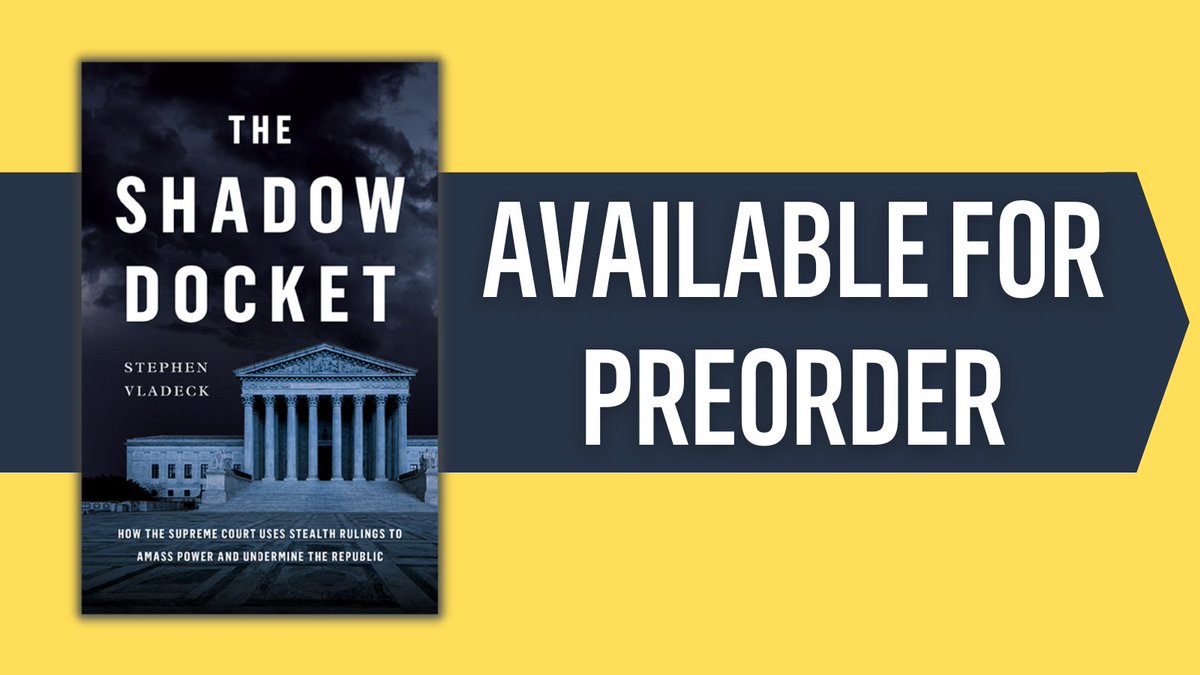
I'm *really* excited to share that my book THE SHADOW DOCKET — an in-depth introduction to the problematic rise of unsigned and unexplained #SCOTUS rulings affecting all of us — is now available for pre-order (and due out from @BasicBooks next May):
The "shadow docket" is the less-accessible side of #SCOTUS's workload — the 1000s of unsigned (and usually unexplained) orders the Justices hand down each year.
Historically, these orders have been limited in both their scope and impact. But that's changed *a lot* since 2017.
From immigration to elections; from abortion to the death penalty; from religious liberty to the power of federal executive agencies; #SCOTUS has — with increasing frequency — intervened preemptively, if not prematurely, in some of our country’s most fraught political disputes.
The book aims to make this technical aspect of the Court's work more accessible to lawyers and non-lawyers alike.
Situating the Justices' contemporary behavior within the Court's broader history, my goal is to help folks see why recent developments are both new *and* troubling.
And although the release is still a ways off, pre-orders are really important. A groundswell of pre-orders tells the publisher (and others) to pay attention to a book, and sets all kinds of other cool stuff in motion. If you're planning to buy the book one day, now's a good time!
Finally, none of this would've been possible without my superstar agent @AliaHanna; my terrific (and patient) editor @emmafberry; a crew of fantastic @UTexasLaw student research assistants and research librarians; and @KSVesq — just because.
Thanks for all of your support!
/end
• • •
Missing some Tweet in this thread? You can try to
force a refresh

Key point in AG Garland's statement: DOJ was willing to do this quietly, *without* making a public spectacle of the search.
It was *President Trump's* decision to make it public that turned this all into a spectacle (and is leading DOJ to move to unseal part of the application).
(1) This underscores the professionalism on the government's side; (2) it's a rather powerful counterweight to the claim from Trump and his supporters that this is about scoring political points (how do you do that silently?); and (3) it puts the ball in Trump's court ... again.
The immediate question now is whether President Trump will *oppose* DOJ's request to unseal parts of the search warrant application and seized property list. Judge Reinhart can do it *anyway,* but Trump's response will be one to watch.
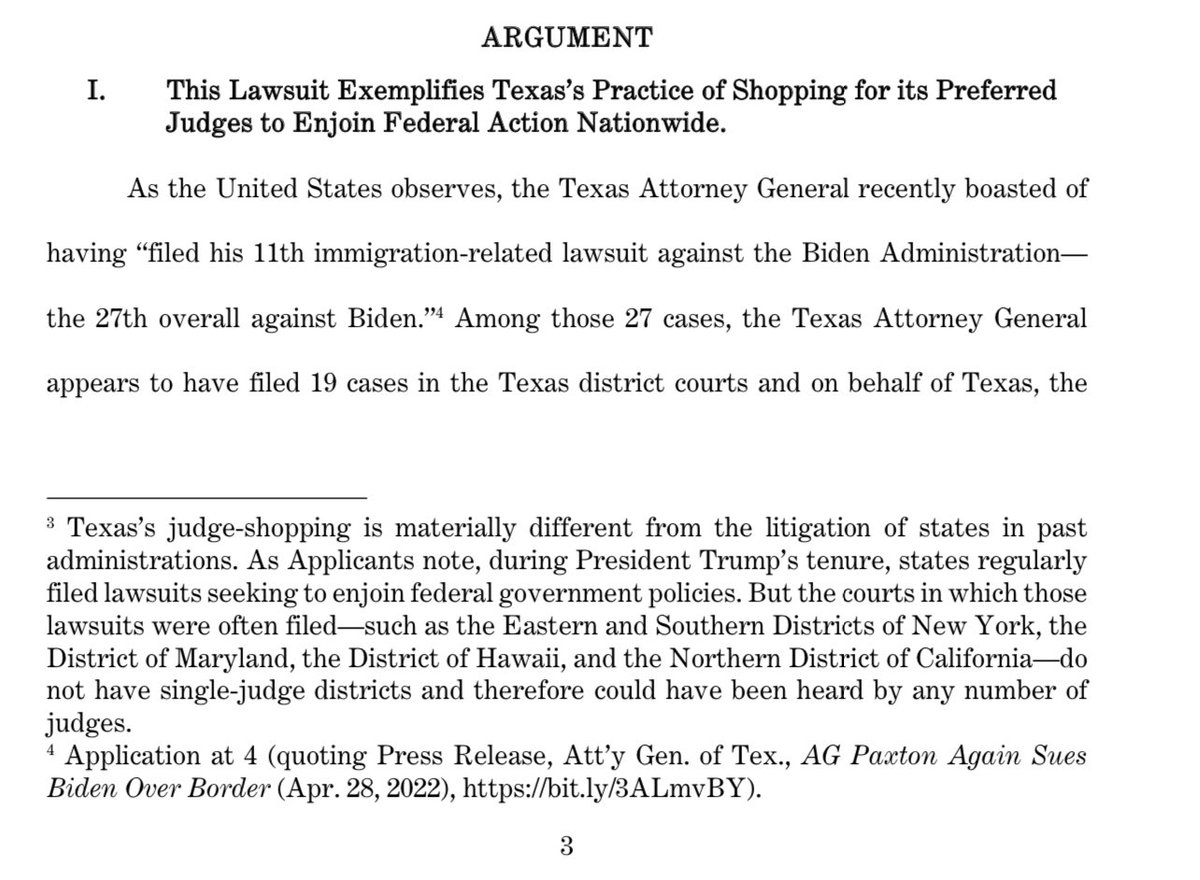
This @WashTimes piece about the #SCOTUS amicus brief we filed re: Texas’s blatant judge-shopping in its 28 suits against the Biden Administration might’ve been more thorough if the two “critics” it quotes had actually … read the brief:
For its first 101 years, and most of its first 135 years, #SCOTUS decided the cases Congress *told it* to decide.
It's only a post-1925 innovation that the Justices have so much control over their docket. Maybe it's time for Congress to consider taking back some of that control?
To be clear, this is *not* about "jurisdiction-stripping." It's the opposite: this is the third straight Term #SCOTUS decided < 60 cases — a total it hadn't fallen below since 1864. To me, having Congress take more of a role in shaping the Court's docket can only be a good thing.
Many will want more aggressive reforms. Fair enough. My only point is that here is relatively low-hanging fruit that ought not to be seen as an *attack* on the Court, but rather the salutary and long-overdue restoration of a healthier interbranch dynamic:
1. #Thread on the two #SCOTUS decisions we expect at 10 and 10:10 ET this morning — West Virginia v. EPA (climate change) and Biden v. Texas ("Remain in Mexico").
We *don't* know the order in which we'll get them; we just know they're coming because they're all that's left.
2. First of the two is climate change. For the six conservatives (with Breyer, Sotomayor, and Kagan dissenting), Chief Justice Roberts holds that Congress did *not* give EPA the authority to impose emissions caps:
3. The majority relies on "major questions" doctrine to hold that Congress was not sufficiently clear in the scope of the power it was delegating to the EPA. This has *enormous* implications not just for climate change, but for administrative law more generally. A huge decision.
1. Here's my #thread with coverage of this morning's #SCOTUS decisions in merits cases.
We expect the Court to post decisions to its website in between one and three of the remaining four cases starting at 10 ET (and every 10 minutes thereafter):
2. First (but *not* last) decision from #SCOTUS this morning is in Castro-Huerta. For a 5-4 majority (with Gorsuch joining the more liberal Justices in dissent), Kavanaugh holds that Oklahoma *can* try non-Indians for crimes on reservations:
3. Today's decision significantly limits the Court's 2020 ruling in McGirt, in which Justice Gorsuch wrote for himself and the four more liberal Justices in the majority. Here's a powerful example of Justice Barrett flipping the Court; she's joining the McGirt dissenters here.
1. Here's my #thread for this morning's #SCOTUS decisions in argued cases. We expect the Court to hand down 1+ of the 7 remaining decisions in cases argued earlier this Term starting at 10 ET, but we do *not* expect all 7. My best bet is 3–4.
2. First (but *not* last) #SCOTUS ruling this morning is in Kennedy. For a basically 6-3 Court (conservatives vs. liberals, with Kavanaugh concurring in most of it), Justice Gorsuch sides with football coach in Kennedy:
3. Sotomayor's dissent: "It elevates one individual’s interest in personal religious exercise, in the exact time and place of [their] choosing, over society’s interest in protecting the separation between church and state, eroding the protections for religious liberty for all."