Italy has been on an economic decline for quite sometime. It’s threatening the existence of EU completely.
Excessive debt (330% of GDP), corrupt politicians, poor demographics, mismanagement of COVID crisis, soaring energy bills.
A thread 🧵 for your awareness 👇
The root of the problem is a demographic crisis that is set to accelerate over the next 10 years. Italy is running out of working age people. An economy needs people aged 15-64. This is considered the working age population, and this is critically important for an economy.
Working age (15-64) people who are actively working consume more, spend more, and earn income that can be taxed to support a country's debts. If there are no people or fewer people aged 15-64, the country will have fewer workers, less tax revenue.
The projections for the future population growth rate are the real problem.
Japan has long been the poster child for the worst demographics in the developed world, but Italy will surpass Japan in the next 2-3 years and hold the title for the worst demographics in the 🌍 title.
The US doesn't have great demographics, but relative to the rest of the world, the US is expected to have positive population growth in the 15-64 year-old bracket. At the same time, China, Japan, & broader Europe are all negative. Italy has the worst demographic future.
Italy is one of the most indebted countries in Europe, with public and private debt equal to more than 330% of GDP.
Most academic research shows that when total debt to GDP surpasses 300%, economic growth starts to fall, and the standard of living starts to decline.
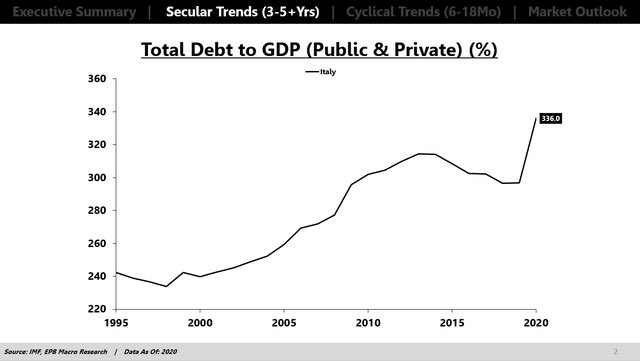
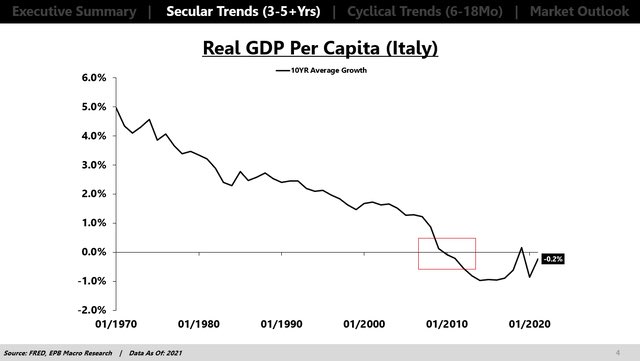
Italy crossed this 300% threshold of excessive indebtedness around 2010, and its growth started to decline right on schedule. Real GDP per capita is synonymous with the standard of living, when growth is -ve, it means the standard of living is declining, & people feel worse off.
Political instability is a common result when standard of living starts to decline. We see instability in many countries around the world as inflation is high and is eroding the purchasing power of the people. The situation in Italy is no different, and it's devolving rapidly.
Not only does Italy have a debt crisis that they cannot solve, but they have a political crisis, with Prime Minister Mario Draghi offering his resignation on July 14 of 2022. Italy's acting President rejected Draghi's first resignation attempt. A week later, he resigned again.
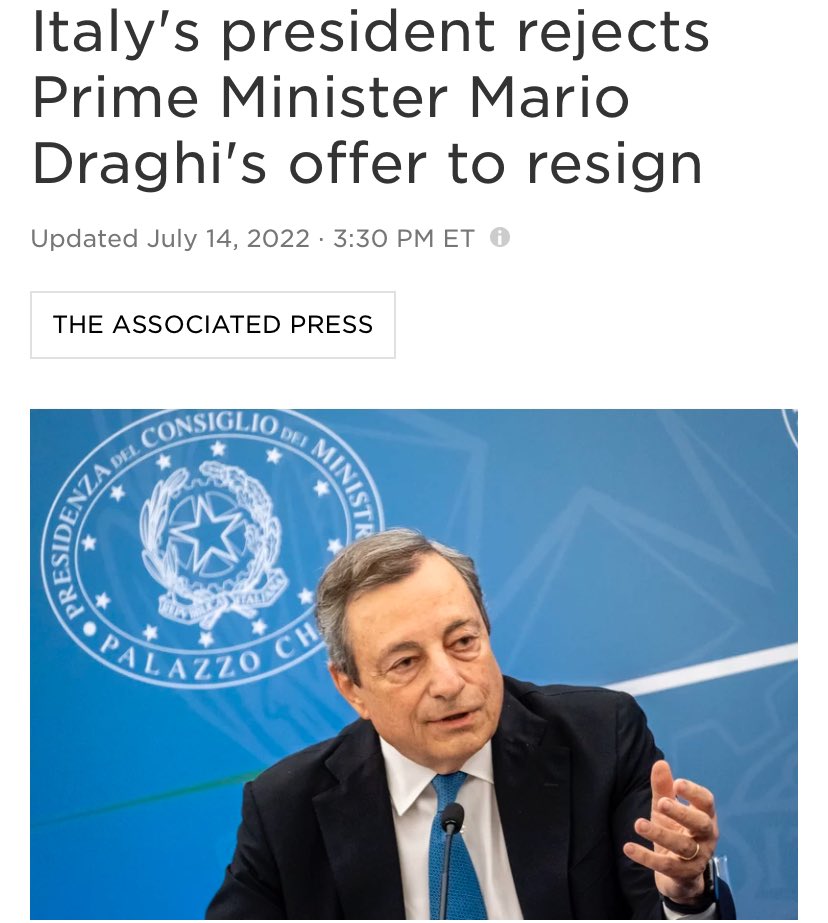
A new election was set for September 2022, but until then, Italy was essentially acting with no one firmly in charge. The elections happened and right wing candidate Giorgia Meloni becomes the first ever woman Prime Minister of Italy.
Giorgia Meloni doesn't want Globalist control, she doesn't want the Italians to essentially be melted into a pot of all Europeans and treated like a number instead of a unique, individual human being.
If you’re wondering why all the globalist people on the planet are having a meltdown over Giorgia Meloni’s victory in the Italian elections, here’s a reason why
Britain 🇬🇧 exited the EU with #Brexit
Sweden 🇸🇪 elected right wing in 2022
Italy 🇮🇹 elected right wing in 2022
Are they next to exit the European Union, only time will tell if it happens 🤷♂️
WEF is a globalist organization pushing countries & corporations towards green technology, limiting fossil fuels, stopping animal protein, imposing nitrogen/carbon emissions quotas, adopting digital identity & currency, implant biological chips etc.
Georgia Meloni has spent the last 2 years as one of the few politicians in Italy fighting against the covid travel passports and for peoples freedom.
Now the Italian people elected her as their first woman Prime Minister🇮🇹
#EnergyCrisis has hit a fever pitch in Italy 🇮🇹. Most of the average working people and small businesses aren’t able to afford their energy bills. They’re resorting to public bill burning.
If Germany goes down, it drags the entire EU. At present Germany is one country funding the EU mostly. PM Meloni needs to make sure Italy reduces its debt burden for sure.
For decades, vulnerable British children, predominantly young girls from working-class backgrounds, endured unimaginable horrors at the hands of organized grooming gangs. These predators, often operating in tight-knit networks, targeted preteens and teenagers with calculated manipulation, luring them with gifts, alcohol, and false affection before subjecting them to repeated sexual abuse, trafficking, and violence. Cities like Rotherham, Rochdale, and Oxford became epicenters of this nightmare, where thousands of victims were passed around like commodities, their cries for help drowned out by a culture of denial. The scale was staggering—reports later revealed over 1,400 cases in Rotherham alone, spanning years of systemic exploitation that shattered lives, leaving survivors with lifelong trauma, addiction, and shattered trust in society.
The police played a complicit role through inaction and willful blindness, often dismissing victims' accounts as unreliable or fearing accusations of racism, as many perpetrators hailed from specific ethnic communities. Investigations were shelved, evidence ignored, and arrests delayed to avoid stirring community tensions, allowing the abuse to fester unchecked. Politicians, particularly in local councils and national parties reliant on bloc votes from immigrant communities, turned a blind eye for electoral gain, prioritizing political correctness and vote banks over child protection. This toxic mix of cowardice and self-interest meant reports were buried, whistleblowers silenced, and justice delayed for years, exposing a profound failure of leadership that betrayed the nation's most vulnerable.
In response to this madness, the Reform Party has emerged as a vocal force pushing for radical change, advocating stricter immigration controls, enhanced child safeguarding measures, and accountability for authorities who failed. By championing policies that prioritize integration, border security, and zero-tolerance for exploitation, the party aims to dismantle the conditions that enabled such gangs to thrive, rallying public outrage into actionable reform. Their platform seeks to restore faith in institutions by demanding transparency, tougher sentencing, and community-led prevention, positioning themselves as the antidote to decades of neglect and political expediency.
The implications of mass immigration without assimilation ripple across broader Europe, fostering parallel societies where cultural clashes erode social cohesion and breed exploitation. In countries like Sweden, Germany, and France, unchecked influxes have led to no-go zones, heightened crime rates including sexual violence, and strained public services, as unintegrated groups form insulated enclaves resistant to host norms. This fragmentation fuels populist backlash, economic burdens from welfare dependencies, and a loss of national identity, ultimately threatening democratic stability and amplifying divisions that could spiral into widespread unrest if not addressed through enforced integration and controlled borders.
The time has come for the UK government to reclaim sovereignty over its borders and protect its citizens by decisively repealing the Human Rights Act and withdrawing from the Refugee Convention. For too long, these outdated frameworks have handcuffed our ability to deport dangerous individuals who exploit the asylum system, leading to a surge in abuse, rapes, and violence perpetrated by immigrants who refuse to assimilate into British society. High-profile cases, such as the Ethiopian asylum seeker charged with sexually assaulting a 14-year-old girl in Epping just days after arrival, or the Sudanese migrant convicted of attempting to rape a woman in Wakefield, illustrate the grim reality. With over 200 asylum hotel residents charged with violent and sexual offences in 2025 alone, including multiple rapes, it's clear that the current system prioritizes the rights of foreign criminals over the safety of British families. Repealing these acts would empower swift removals, deter exploitation, and restore public trust in a immigration policy that puts Britain first.
By leaving the Refugee Convention and scrapping the Human Rights Act, we can end the cycle of unchecked migration that has brought chaos to our streets and communities. Immigrants who fail to integrate often form isolated enclaves where criminality festers, as evidenced by reports of arson, theft, and assaults linked to asylum accommodations. The government's own data reveals thousands of assaults and hate crimes within these facilities, but the real victims are ordinary Britons facing elevated risks from those who game the system. A bold exit from these international obligations would allow us to craft bespoke laws that prioritize assimilation, rapid deportation of offenders, and the protection of our values—ensuring a safer, more cohesive United Kingdom for generations to come.
BRITAIN MUST SECURE ITS BORDERS AND STOP THE MASS IMMIGRATION MADNESS
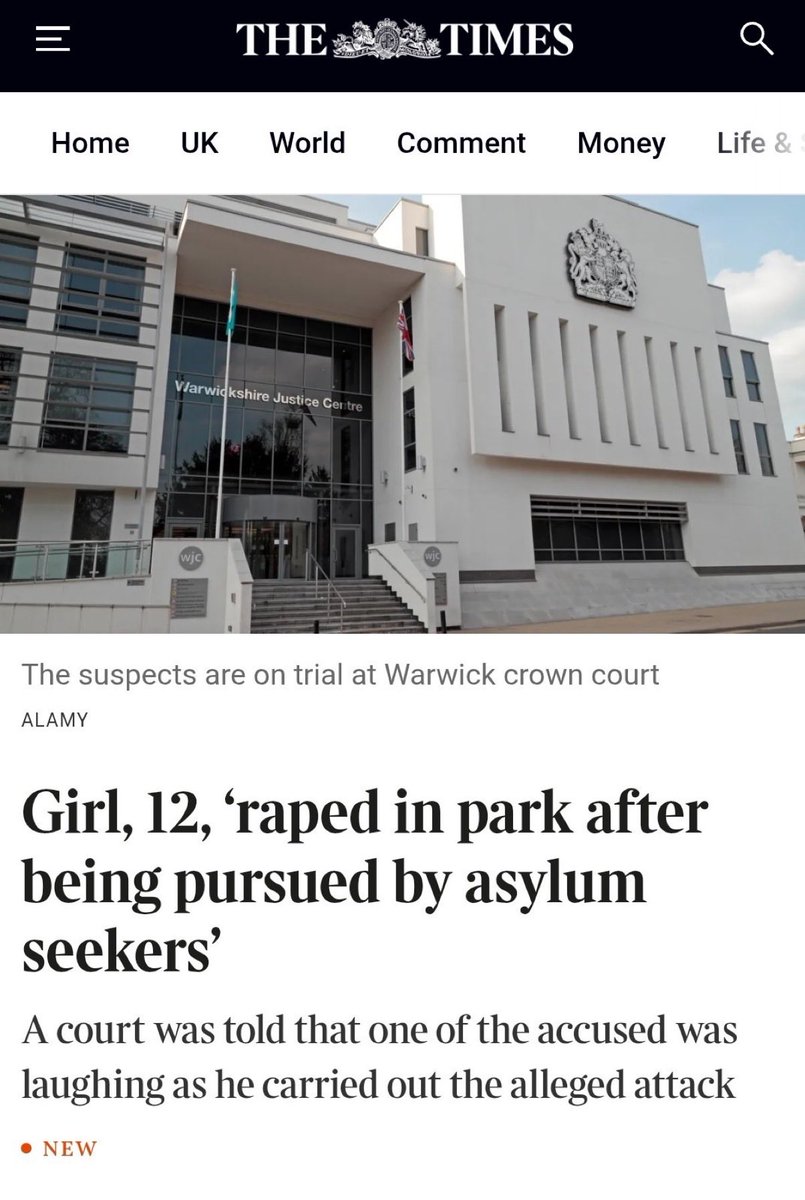
In a deeply disturbing case at Warwick Crown Court, a 12-year-old girl in Nuneaton, Warwickshire, was allegedly targeted and raped last July by two asylum seekers, 23-year-old Ahmad Mulakhil and 24-year-old Mohammad Kabir, after they pursued her while she played in a park. The prosecution detailed how Kabir first grabbed and attempted to strangle the visibly young child, trying to force her away, before she escaped—only to later encounter Mulakhil, who led her to a secluded cul-de-sac, where he orally raped her, committed further sexual assaults, took indecent photos, laughed during the attack, and threatened to kill her family if she spoke out. DNA evidence from Mulakhil was found on her, and while he admits to the oral rape, he implausibly claims she consented and appeared in her twenties—a notion dismissed given her childlike appearance. This brutal assault, marked by the perpetrators' callous disregard for her age and vulnerability, exposes the perilous risks of unchecked mass immigration, demanding immediate action: the UK must halt the influx of unvetted asylum seekers and secure its borders to prevent such atrocities and protect its citizens from predatory threats.
Across the United States, an intricate web of non-governmental organizations (NGOs), daycares, autism treatment centers, transportation services, and related facilities has been uncovered in schemes that systematically divert billions in taxpayer dollars intended for child nutrition and care programs. Originating prominently in Minnesota with cases like the Feeding Our Future scandal, this network expanded to involve similar operations in states such as Washington, New York, and California. These entities often pose as legitimate providers for underserved communities, particularly immigrant groups, but exploit federal and state funding streams by fabricating enrollment numbers, inventing fictitious meal services, and establishing shell companies to funnel money. The scale of the fraud has grown to encompass COVID-19 relief funds, leading to federal indictments of dozens of individuals and the recovery of luxury assets purchased with ill-gotten gains.
The mechanics of this money laundering involve sophisticated tactics to steal public funds while maintaining a facade of charitable work. Operators submit inflated reimbursement claims to government programs, claiming to serve thousands of children daily when in reality, facilities may be empty or non-existent. Funds are then cycled through a series of interconnected NGOs and businesses, often involving wire transfers to overseas accounts or investments in real estate and vehicles. In Minnesota alone, prosecutors have described this as the largest pandemic-related fraud in the country, with over $250 million siphoned off initially, ballooning to estimates of up to $9 billion when including related schemes. This laundering not only depletes resources meant for vulnerable families but also undermines trust in social safety nets, as audits reveal minimal oversight allowed the fraud to persist for years.
Enabling this widespread theft are allegations of political complicity, where elected officials in affected states—predominantly Democratic-led—have benefited from campaign contributions tied to fraud perpetrators, potentially influencing lax regulations and delayed investigations. Reports indicate over $50,000 in donations from indicted individuals to Minnesota Democrats, including figures like the state attorney general, raising questions about kickbacks disguised as legitimate political support. This symbiotic relationship allows the network to thrive, as politicians secure election funds while turning a blind eye to red flags, prompting federal interventions like funding freezes across multiple states to curb the abuse. While some claims of direct kickbacks remain unproven, the pattern suggests a cycle of corruption that prioritizes personal and party gains over taxpayer accountability.
A Somalian Democrat in Maine started a money transfer business
- He then bought a commercial real estate building
- In it there are 4 Medicaid funded home health care businesses
- Large bags of cash are being seen sent from it headed to Somalia