Ok @profthomlambert here is my full response.
1. As the legislative history makes abundantly clear, Congress expressly enacted the Clayton Act in response to Standard Oil's (primordial) RoR. So it wouldn't make sense for a statute to use the RoR when it was enacted to avoid it.
1. As the legislative history makes abundantly clear, Congress expressly enacted the Clayton Act in response to Standard Oil's (primordial) RoR. So it wouldn't make sense for a statute to use the RoR when it was enacted to avoid it.
https://twitter.com/profthomlambert/status/2062265748404183423
2. Contrary to the brief you signed on to, no where does Tampa Electric use the phrase "rule of reason."
You would think "explicitly prescribed" used in your brief would mean SCOTUS specifically said it, but you admit in your tweet "The Court may not have used the magic words"
You would think "explicitly prescribed" used in your brief would mean SCOTUS specifically said it, but you admit in your tweet "The Court may not have used the magic words"
3. Tampa Electric *AFFIRMS* Standard Stations which itself completely refutes a RoR analysis because "such an investigation would be to stultify the force of Congress’ declaration" and "a standard..most ill-suited for ascertainment by courts."
337 U.S. at 310, 313 (1949)
337 U.S. at 310, 313 (1949)
4. Let's address the specific paragraph you (and your ICLE friends) anchor your argument to. You leave out the rest of the Court's content in that section of the opinion - which gives much needed context that undermines your argument. So we actually need to start with that.
5. The first part of this section (image below) is where the Court gives details on its prior holdings. Again affirming them, and in none of those cases was the RoR used. 

6. The next set of paragraphs the Court gives "guidelines" based on the "earlier decisions" on when an exclusive deal " foreclose[s] competition in a substantial share of the line of commerce affected."
Guideline 1 and 2 are the relevant product and geographic market.
Guideline 1 and 2 are the relevant product and geographic market.
7. Guideline 3 is about substantiality. This is where the meat is.
8. Let's read the grammar and word structure. The sentence starts with what can be called a "purpose clause" (i.e., what the paragraph is about), which is “To determine substantiality in a given case..” So everything that follows must be about that determination.
9. So, the entire discussion here is about "substantiality," that is whether the foreclosure was substantial enough to matter under § 3.
The Court IS NOT detailing whether the restraint produced net anticompetitive effects (as what would be used under Section 1 RoR analysis).
The Court IS NOT detailing whether the restraint produced net anticompetitive effects (as what would be used under Section 1 RoR analysis).
10. With this context, we know what "probable effect" is referring to. Its meaning is restricted to the significance of the market foreclosed, NOT what are all the competitive effects of an ED as would be done under the RoR.
11. IOW, “probable effect” is subordinate to the “substantiality.” It tells courts how to assess substantiality, not what to do after substantiality has already been found. Competitive effects of the ED matter only insofar as they bear on whether the foreclosure is substantial.
12. So, what are those probable competitive effects that matter? The answer does not involve an open ended RoR. Instead, SCOTUS states exactly what "competitive effects" matter...
...and there are only three considerations it deems to be valuable in this determination (which by definition would not be a RoR analysis). The considerations are 👇
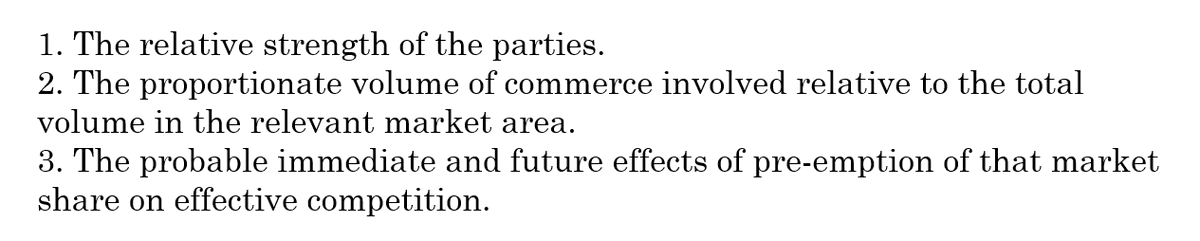
13. The Court then goes into painstaking detail about exactly what each of those considerations mean. Relative strength is determined mainly by asking whether either party had market power comparable to the defendants in earlier § 3 cases. It found no such dominance in Tampa Elec
14. For proportionate volume of commerce involved relative to the total volume in the relevant market area, the Court looks at various data points.
1.Production and sales in the broader supplier market.
2.The relevant market consumption data.
3.Interstate sources of supply.
1.Production and sales in the broader supplier market.
2.The relevant market consumption data.
3.Interstate sources of supply.
15. The Court then states: “From these statistics it clearly appears that the proportionate volume of the total relevant coal product as to which the challenged contract pre-empted competition, less than 1% is, conservatively speaking, quite insubstantial.”
16. So, the Court’s proportionate-volume analysis was: the contract looked large in absolute dollar terms, but dollar values aren't enough as it represented less than 1% of the relevant coal market. That made the foreclosure insubstantial.
17. The probable immediate and future effects of pre-emption of that market share on effective competition is determined by three situations that that the Court expressly listed that trigger it.
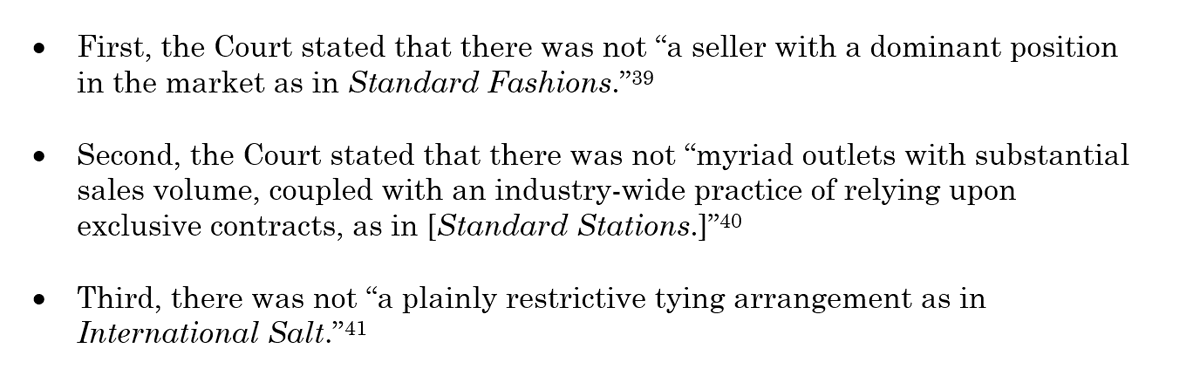
18. When read in full, the opinion (as well as the legislative history) supports a RoR analysis under Section 3.
/End
/End
• • •
Missing some Tweet in this thread? You can try to
force a refresh