
An award-winning public history project committed to sharing the history of state-sanctioned violence against Mexicans and Mexican Americans in Texas.
 Little is known of Lopez's early life, but in 1912 he was probably in his late teens and worked as a miner in Bingham Canyon, Utah. According to popular accounts he became a wanted man after allegedly killing another Mexican man. /2
 Raiders from Mexico had ridden onto their Hidalgo County ranch and stolen horses and other supplies, so the men were faced with a predicament. /2
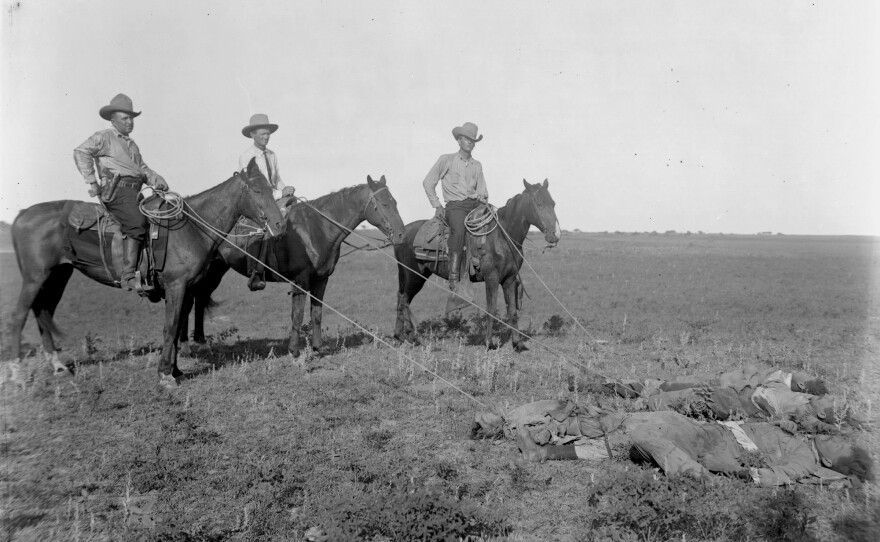
 Newspapers reported the men were shot while trying to escape Ranger custody. While technically possible, ‘shot while escaping’ was a common Ranger excuse for executing prisoners, especially ethnic Mexicans, in cold blood. /2

 The provision creating the Border Force is a change from the original bill, which allowed for the deputization of any “law-abiding” citizen, who would be granted criminal and civil immunity for actions against those thought to be migrants. /2 hrw.org/news/2023/04/1…
 This attack was firmly understood as continuous with the “Indian Wars” more broadly and the governor, Hardin Runnels, was calling for “a major punitive expedition into Comanches Territory” for the damages they had apparently inflicted on Texans. /2
 The story began with the murder of Anthony M. Conklin, editor of the Socorro Sun, in Socorro, NM in December 1880. Conklin and his wife had attended a church festival that brothers Abran and Onofrio (sometimes Enofrio or Onofre) Baca, and a cousin, Antonio, also attended. /2

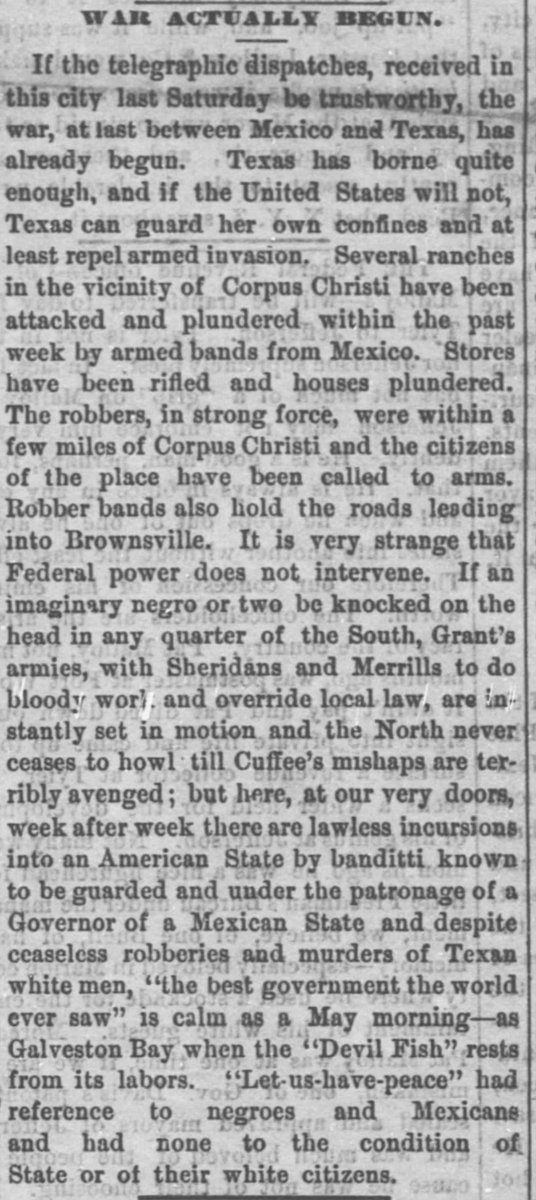
 The raid began when approx. 15-30 outlaws swept Nueces Strip and began robbing farms and shops on the outskirts of Corpus Christi. They also took a number of hostages, all of whom were subsequently released. Having plundered the area, the raiders departed at nightfall. /2
 Bonnie Parker, Clyde Barrow, and their gang robbed banks and stores and killed at least 9 people between 1932 and 1934. They repeatedly evaded police capture, until a posse led by Hamer and Gault ambushed and killed them in Louisiana on May 7, 1934. / 2
 The Rangers and militiamen were under the command of legendary Texas Republic military leader and Ranger Edward Burleson, and including the famous Ranger James Callahan. /2
 The Comanche people were not a unified nation but consisted of affiliated bands. Penatekas were the southernmost, occupying land from the Edwards Plateau to the headwaters of Central Texas rivers. They were central actors in the Texas Republic and later U.S. expansion. /2
 ![2: Penateka Marker] [alt text: this photo shows picture of](https://pbs.twimg.com/media/FrlYHurXsAAIN95.jpg)
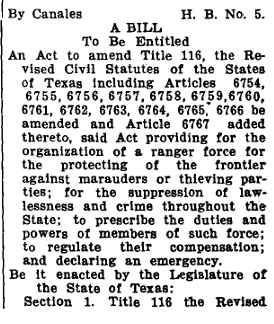
 Canales originally wrote HB 5 in Jan 1919, before the Canales Investigation. Titled "An Act reorganizing the State Ranger force, prescribing the pay, qualifications and duties of State Rangers, and declaring an emergency," it proposed "police professionalization" of the force. /2
 The day’s hearings brought out little new information about specific incidents, but the discussion of 1915-18 border violence repeatedly showed the blurred lines between Rangers and vigilantes, state and private violence, lynching and law enforcement. /2

 Pharr had seen many instances of police violence, including in recent years. For example, Sergeant Mateo Sandoval beat two men, Manuel Mata, who received two broken ribs from his beating, and Guadalupe Salinas. These types of beatings proved common. @elprofe_Robles. /2

 On this day, evidence documenting some of the worse state violence, including the Porvenir Massacre, was introduced in affidavits and testimony. Canales pressed for consequences not just for Rangers in the field, but for their leaders in Austin. /2
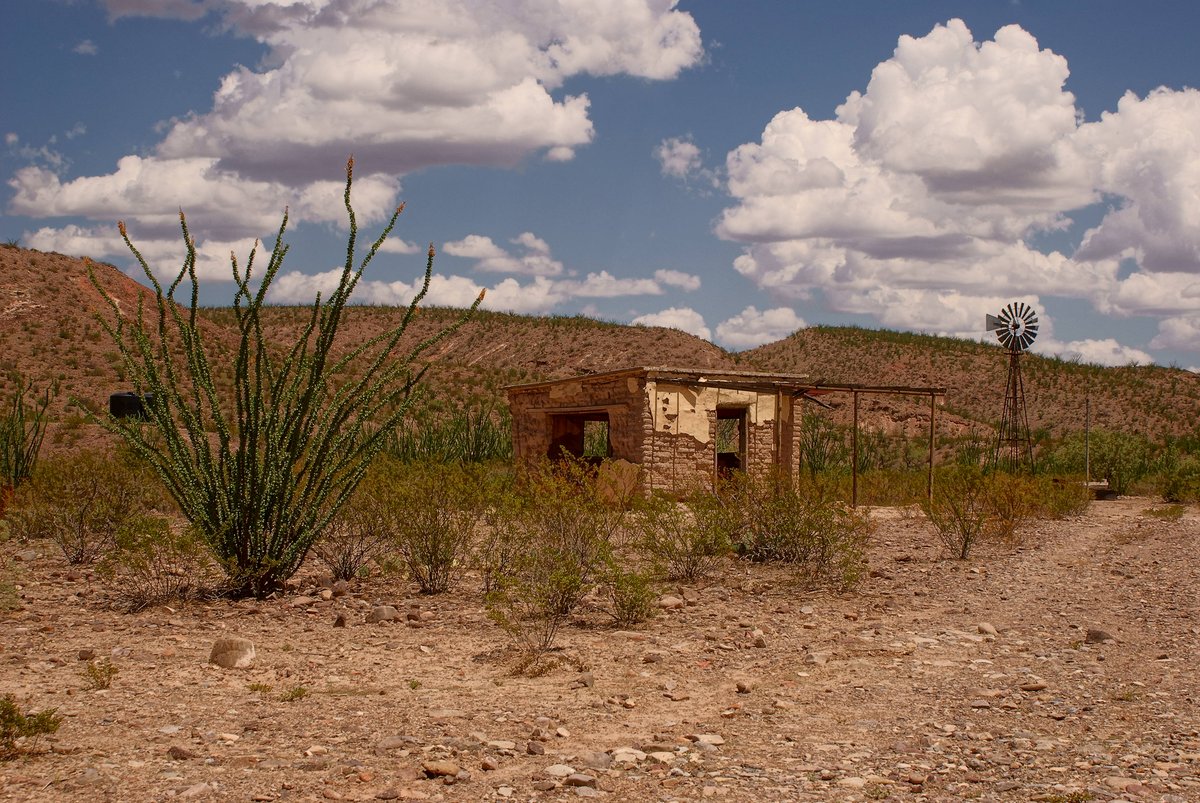 Porvenir was a small and remote, but proudly independent community. Mexican-descent families raised livestock, grew produce and cotton, irrigated their lands, and maintained a school in the harsh Chihuahua desert on the banks of the Rio Grande in northwest Presidio County. 2/
 . . . by producing evidence of violence by Rangers and others still used by scholars of policing, Mexican American, and border history more than a century later. The resulting hearings lasted 12 days, featured 80 witnesses, and generated 1400 pages of testimony. /2
 Born as John Cromwell Orrick Jr., in Alabama in 1844, Orrington had a history of violence long before joining the Ranger Force in 1874 or 1875. After serving as a Confederate soldier, he did his part to resist the enfranchisement of Black men during Reconstruction. /2
 On June 12, 1901, sheriffs in search of a “medium-sized Mexican” alleged horse thief accosted Cortez and his brother Romaldo on their farm in Karnes County, Texas. Misunderstanding the men’s responses in Spanish, the officers thought them guilty and shot and wounded Romaldo. 2/