>310,000 people died from gun injuries in the U.S. from 2009-17. But unlike #Covid19 stats, the total # of cases is not well established due to data gaps.
Proud of @ElinoreJKaufman who led our new paper (jamanetwork.com/journals/jamai…) that dives deep into this epidemic
THREAD👇
Proud of @ElinoreJKaufman who led our new paper (jamanetwork.com/journals/jamai…) that dives deep into this epidemic
THREAD👇
2/ We can get exact counts of how many deaths there are per year. Those data are available on death certificates (wonder.cdc.gov/ucd-icd10.html) collected by @CDCgov. Here’s a nice overview by @jasongoldstick @cartpatr @StrohCunningham
jamanetwork.com/journals/jamap…
jamanetwork.com/journals/jamap…
3/ However, estimates of nonfatal cases have been shaky because these stats are traditionally sampled from ~100 of nation's 5,000 ERs. That sample changes year to year and there’s wide variability in ER gunshot injury volume. See @fivethirtyeight @trace:
fivethirtyeight.com/features/the-c…
fivethirtyeight.com/features/the-c…
4/ Why is this a problem? Because every firearm injury in the U.S. is a failure of public health, particularly accidental ones. Can't make progress if we don’t actually know case numbers, who they are happening to, etc. Nonfatal cases like this abound:
pittsburgh.cbslocal.com/2020/11/16/tod…
pittsburgh.cbslocal.com/2020/11/16/tod…
5/ To overcome this problem, we combined data collected from death certificates with a newer, much larger data source, the Nationwide Emergency Department Sample, which collects data from 900-1000 ERs per year (10 times the sample size), providing much more stable estimates
6/ The key findings:
From 2009-17 there was an average of 120,234 cases of firearm injuries per year, or 329 per day.
In the most recent year of data (2017), there were 138,725 cases of firearm injury. This is 380 per day, with 109 deaths and 271 people who go onto survive
From 2009-17 there was an average of 120,234 cases of firearm injuries per year, or 329 per day.
In the most recent year of data (2017), there were 138,725 cases of firearm injury. This is 380 per day, with 109 deaths and 271 people who go onto survive
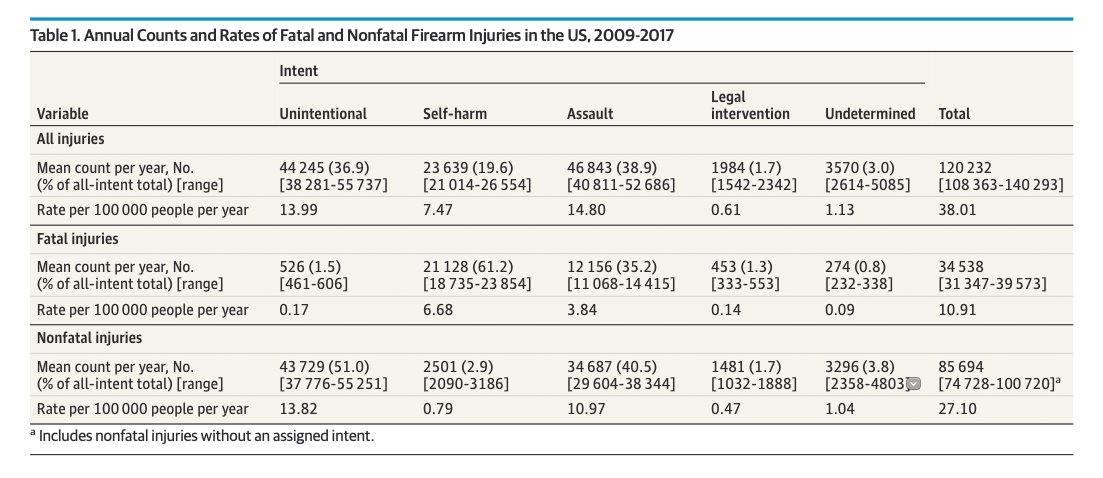
7/ While suicide has been known to be the leading cause of firearm deaths, our data show once nonfatal injuries are counted, that assault injuries are the leading cause of firearm injuries (39%), followed by unintentional injuries (37%)
8/ Combining fatal and nonfatal injury counts, we now see a more complete picture of the firearm injury rates by urban vs. rural geography and by age. The hidden burden of unintentional injuries now becomes clear, particularly in rural areas and among children and young adults

9/ We find that roughly 3 out of 4 deaths occur outside the hospital, with suicide accounting for the vast majority of these cases. Of those who make it to the hospital, 93% go on to survive. Here’s some twitter only content that didn’t make it in the paper breaking this down
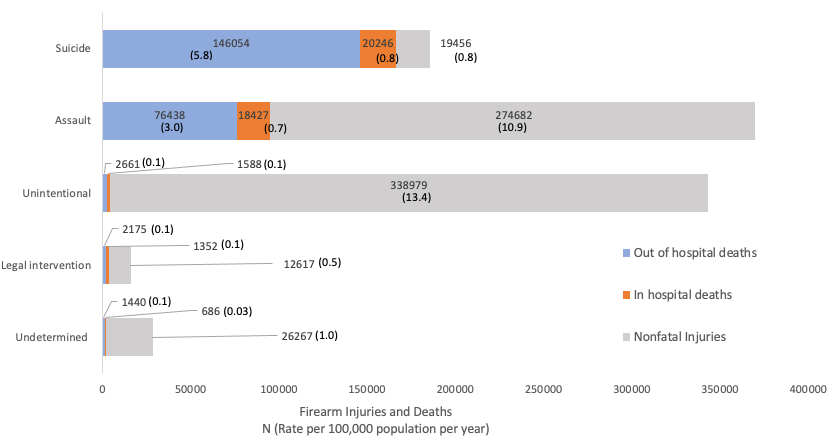
10/ Think about the focus on pinpointing a #COVID19 case fatality rate (CFR). Think about all we know about every type of cancer. With these data, we can now provide CFRs by firearm injury mechanism
Self-harm: 89.4%
Assault: 25.9%
Legal intervention: 23.4%
Unintentional: 1.2%
Self-harm: 89.4%
Assault: 25.9%
Legal intervention: 23.4%
Unintentional: 1.2%
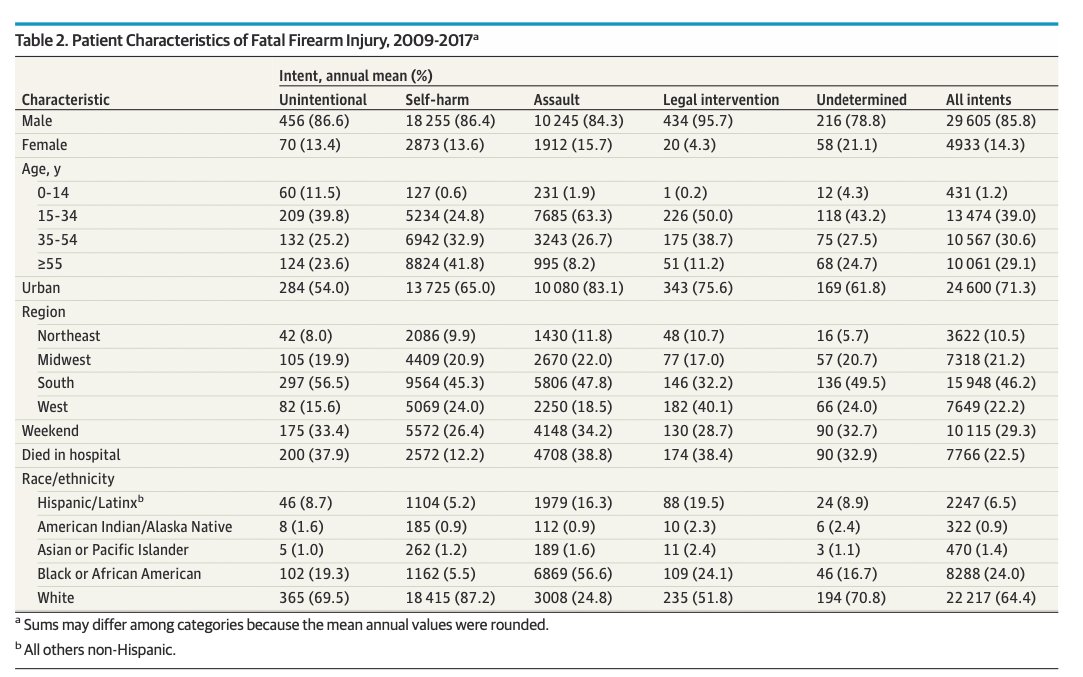
11/ This has been shown numerous times before, but there are marked racial/ethnic differences in fatalities with young Black and Latino males making up a disproportionate share of those who die in firearm assaults and middle age/older White men making up the majority of suicides
12/ Examining the data on patients who survive after emergency care, we find extremity injuries are the most common serious injury, followed by chest and abdominal. Hospitalizations last on average 4 days, with 25% lasting 9 days or more. 19% underwent major operations
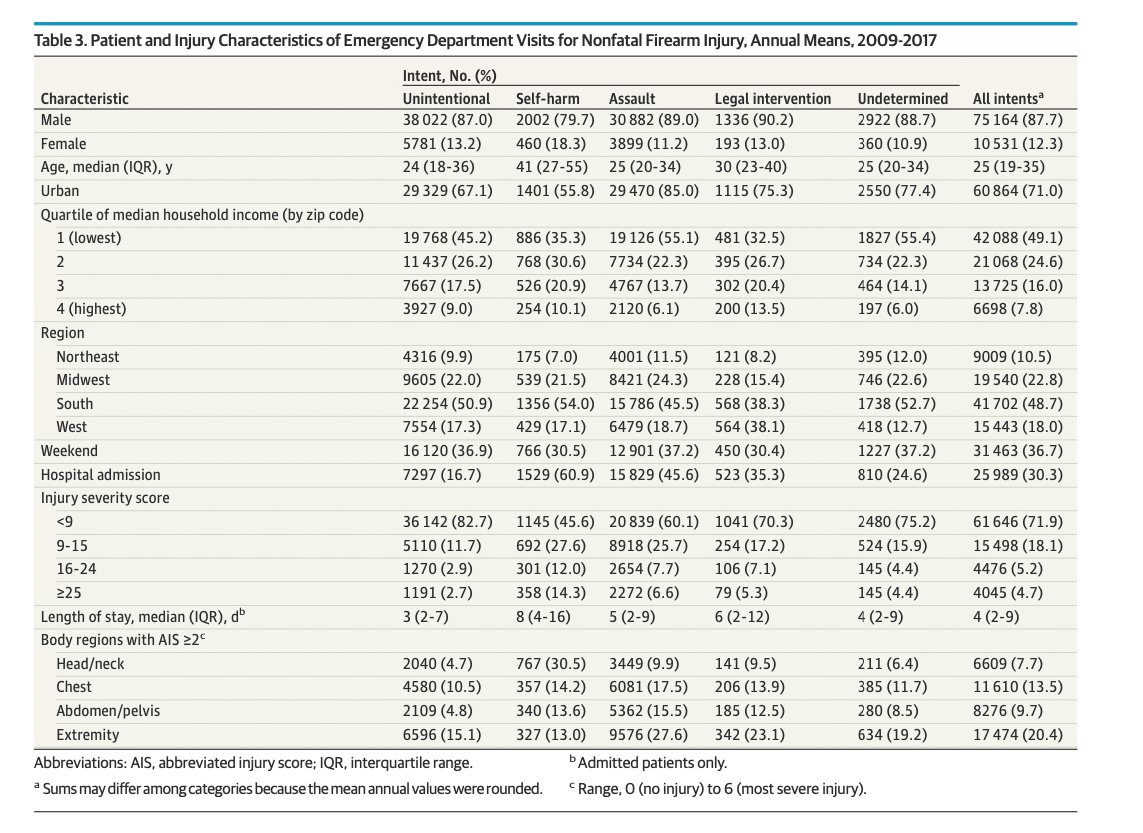
13/ So while there’s a been a focus on fatalities, for every death there are twice as many survivors. However, survival comes with a substantial burden of physical and long term post-trauma stress as co-author @MarkSeamonMD and colleagues have shown
jamanetwork.com/journals/jamas…
jamanetwork.com/journals/jamas…
14/ While 2017 is the most recent year of data, that seems like a lifetime ago. Our superstar lead author, trauma surgeon @ElinoreKaufman wrote this @nytimes piece on the surge in gun violence in the post #COVID19 era
nytimes.com/2020/04/01/opi…
nytimes.com/2020/04/01/opi…
15/ I honestly can’t remember the last time we had an ER shift without a gunshot victim. It's always been bad, but now it's worse. It's stuff like this that shakes you to the core
https://twitter.com/kit_delgadoMD/status/1296634626895761408?s=20
16/ So where do we go from here? If you are clinician, educate yourself further about what you can do. This is an excellent review article by @meganranney @EmmyBetz and colleagues (acpjournals.org/doi/10.7326/AI…) and check out these tools from @BulletPtsProj: bulletpointsproject.org
17/ You can support research and education aimed at developing and implementing public health approaches to prevent firearm injury via @ResearchAFFIRM
affirmresearch.org
affirmresearch.org
18/ You can support apolitical, innovative, community and placed-based interventions proven to reduce #gunviolence such as cleaning up and greening vacant lots.
Read @EpiProfCharlie's work who has been a pioneer in this space
jamanetwork.com/journals/jamap…
Read @EpiProfCharlie's work who has been a pioneer in this space
jamanetwork.com/journals/jamap…
19/ We can to support federal research to develop, test, and implement effective preventive interventions just like we do for any other disease. For example, see what my colleague @Rsbeidas is doing with promoting safe firearm storage among parents
pennmedicine.org/news/news-rele…
pennmedicine.org/news/news-rele…
20/ Promoting safe firearm storage is of particular importance with the recent increases in gun sales. See this piece by @HoskinsKatelin and @Rsbeidas fusion.inquirer.com/opinion/commen…
21/ We can promote responsible firearm ownership by not leaving firearms unsecured in vehicles, which in turn get stolen and used in violent crimes. This has been an increasing problem npr.org/2019/05/09/717…
22/ And we can use "hot spotting" to learn from counties that have successfully reduced firearm injury deaths rates and contrast them with counties in which death rates have increased to inform prevention polices as we’re doing in our ongoing research
cceb.med.upenn.edu/WiebeGunResear…
cceb.med.upenn.edu/WiebeGunResear…
23/ Lastly, here’s the press release on @ElinoreJKaufman's paper. You need to follow her. She’s one of the most brilliant researchers I’ve ever worked with. This is her *5th* JAMA journal paper and she’s only been on faculty for 5 months. Truly a superstar
pennmedicine.org/news/news-rele…
pennmedicine.org/news/news-rele…
24/ Thanks for following along. Be safe out there
cc: @WYCDinitiative @pcgvr @GunDeaths @EFSGV @Everytown @ctcfip @GunResearch @FACTS_Safety @NSCsafety @PennInjury @CDCInjury @choo_ek @RWalensky @vivek_murthy @ACEPNow @EmergencyDocs @SAEMonline @traumadoctors @EAST_TRAUMA
cc: @WYCDinitiative @pcgvr @GunDeaths @EFSGV @Everytown @ctcfip @GunResearch @FACTS_Safety @NSCsafety @PennInjury @CDCInjury @choo_ek @RWalensky @vivek_murthy @ACEPNow @EmergencyDocs @SAEMonline @traumadoctors @EAST_TRAUMA
• • •
Missing some Tweet in this thread? You can try to
force a refresh