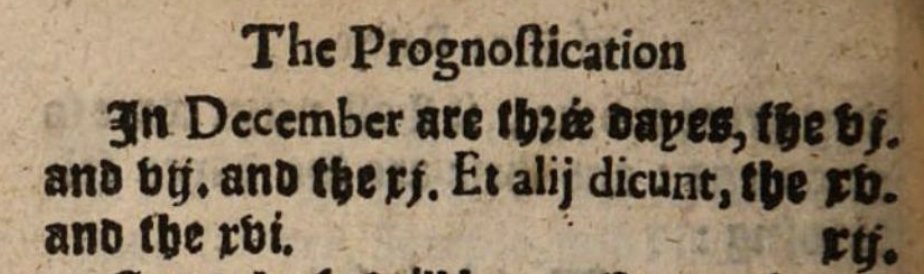
Since New year's is upon us, let's look at an ancient European method of mundane astrology: Annual predictions based on the weekday of January 1st.
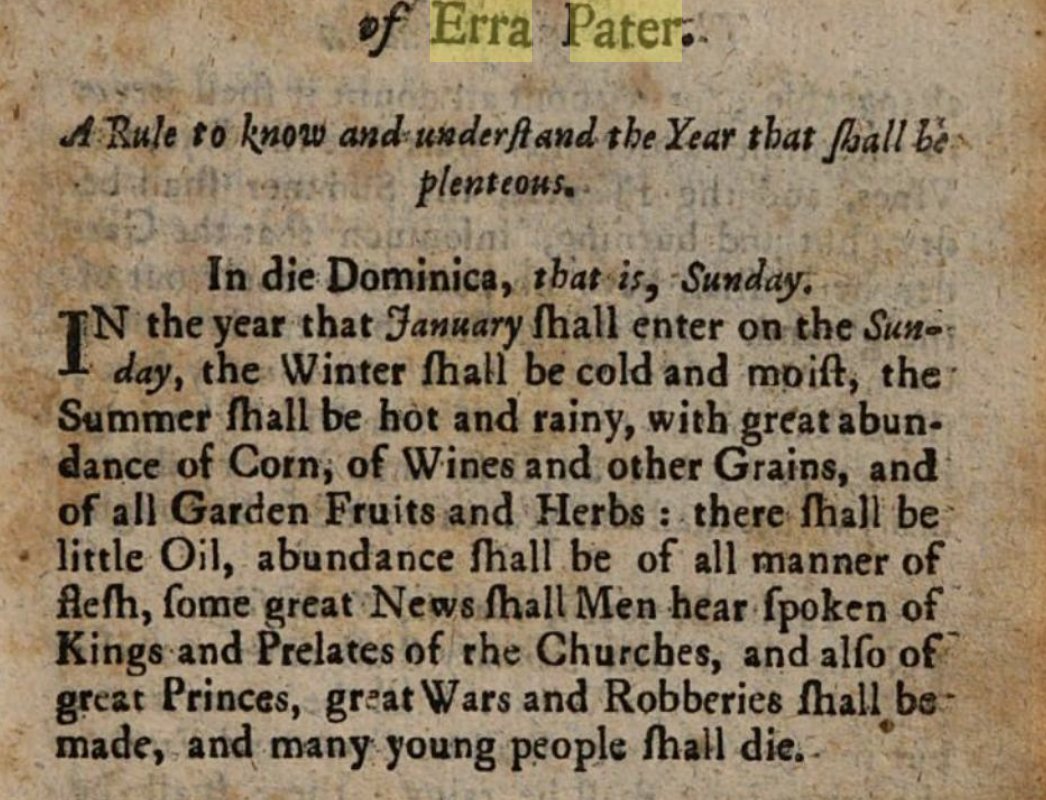
I am taking this from a copy of the divination manual "Erra Pater" printed in 1606. books.google.com/books?id=Z19jA…
I am taking this from a copy of the divination manual "Erra Pater" printed in 1606. books.google.com/books?id=Z19jA…

~Jan 1 is a Sunday~
books.google.com/books?id=Z19jA…
In the year that January shall enter on the Sunday, that winter shall be cold and moist, the summer shall be hot, and the time of the harvest shall be windy and rainy, with great abundance of corn, of wines and other grains...
books.google.com/books?id=Z19jA…
In the year that January shall enter on the Sunday, that winter shall be cold and moist, the summer shall be hot, and the time of the harvest shall be windy and rainy, with great abundance of corn, of wines and other grains...

... and of all garden fruits and herbs, there shall be little oil, abundance shall be of all manner of flesh, some great news shall men hear spoken of Kings and Princes, great wars and robberies shall be made, and many young people shall die.
~ In Die Lua[e?], that is Monday~
In the year that January shall enter on the Monday, the winter shall be peaceable enough, & the simmer shall be very temperate . Then shall be great flows of water that shall break out of their limits and bonds,
In the year that January shall enter on the Monday, the winter shall be peaceable enough, & the simmer shall be very temperate . Then shall be great flows of water that shall break out of their limits and bonds,


<Mon ct'd>
and many ships upon the sea shall perish, and in that year shall reign diverse sicknesses, and changes of great lords shall be made, many women shall perish in travailing with child, many great lords shall die. That year shall be but little grass & mustard seed, nor...
and many ships upon the sea shall perish, and in that year shall reign diverse sicknesses, and changes of great lords shall be made, many women shall perish in travailing with child, many great lords shall die. That year shall be but little grass & mustard seed, nor...
<Mon Ct'd>
... but little oil, but there shall be plenty of corn and wines, and flesh shall be good cheap.
... but little oil, but there shall be plenty of corn and wines, and flesh shall be good cheap.
~ In Die Martis, That is Tuesday~
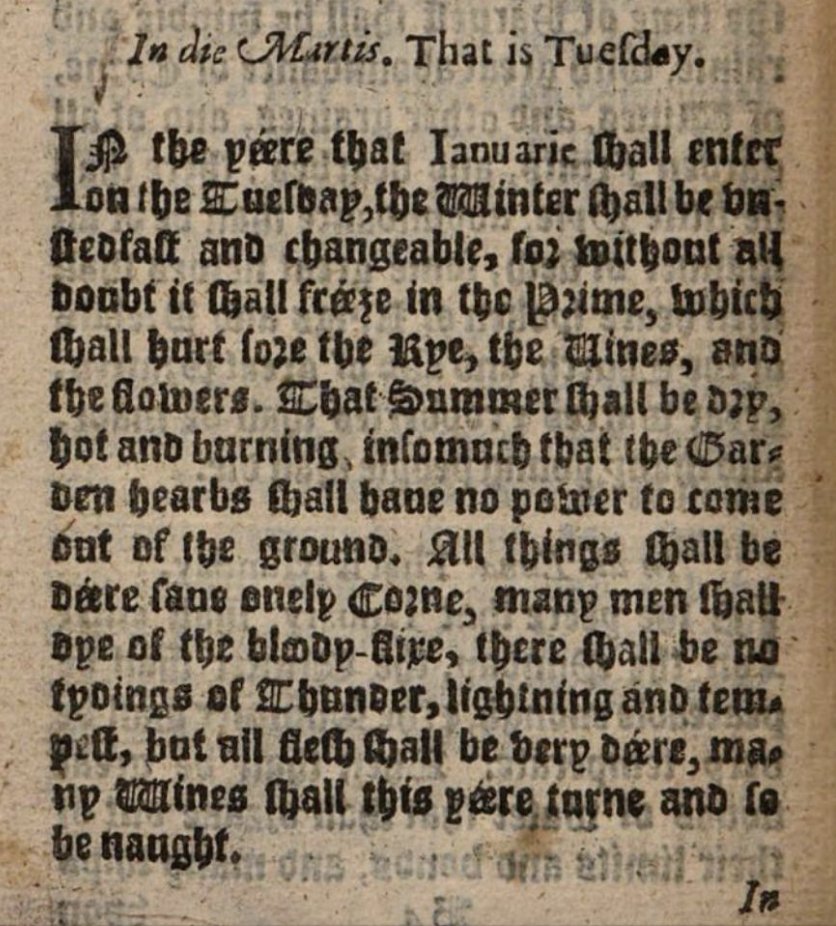
In the year that January shall enter on the Tuesday, the winer shall be unsteadfast and changeable, for without all doubt it shall freeze in the prime, which shall hurt sore the rye, the vines, and the flowers. That summer shall be dry, hot...
In the year that January shall enter on the Tuesday, the winer shall be unsteadfast and changeable, for without all doubt it shall freeze in the prime, which shall hurt sore the rye, the vines, and the flowers. That summer shall be dry, hot...
<Tue>
and burning , insomauch that the garden herbs shall have no power to come out of the ground, All things shall be dear sans only corn, many men shall die of the bloody flux, there shall be no tidings of thunder, lightning & tempest, but all flesh shall be very dear...
and burning , insomauch that the garden herbs shall have no power to come out of the ground, All things shall be dear sans only corn, many men shall die of the bloody flux, there shall be no tidings of thunder, lightning & tempest, but all flesh shall be very dear...
<tue>
Many wines shall this year turn, and so be naught.
Many wines shall this year turn, and so be naught.
~In Diei Mercurii that is,Wednesday~
In the year that January shall enter on the Wednesday, the winter shall be temperate,but in the end there shall be snow and frosts, the prime time shall be rainy, there shall be great abundance of grass, of hay, of corn, of fruits, of wines...
In the year that January shall enter on the Wednesday, the winter shall be temperate,but in the end there shall be snow and frosts, the prime time shall be rainy, there shall be great abundance of grass, of hay, of corn, of fruits, of wines...
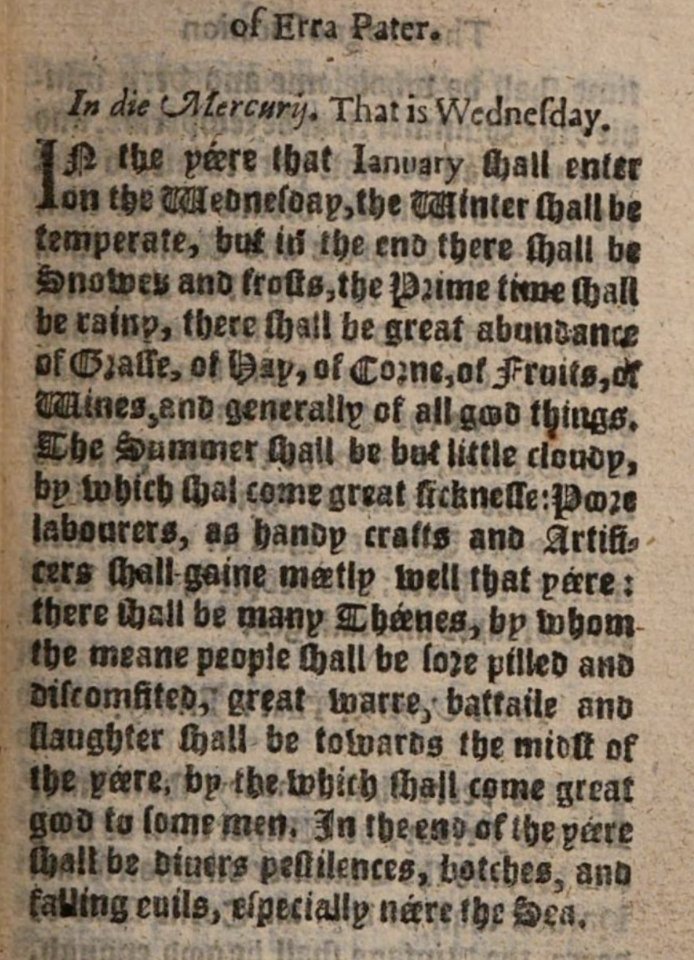
<wed> and generally of all good things. The summer shall be but little clouds, bu which shall come great sickness; poor labourers, as handicrafts and artificers shall gain meetly well that year; there shall be many thieves, by whom the mean people shall be sore pilled and...
<Wed> ...discomfited, great war, battle and slaughter towards the midst of the year, by which shall come great good to some men. In the end of the year there shall be diverse pestilences, botches, and falling evils, especially near the sea.
~In Dies Jovis, that is Thursday~
In the year that January shall enter on the Thursday, the winter shall be long and most part dry, and the year shall be very wholesome. The prime time shall be very wholesome and very windy, the summer shall be temperate, and harvest shall be...
In the year that January shall enter on the Thursday, the winter shall be long and most part dry, and the year shall be very wholesome. The prime time shall be very wholesome and very windy, the summer shall be temperate, and harvest shall be...


<thu> rainy,so that the waters shall sore break out of their bounds; the wheat and the wines shall be good cheap, there shall be of oats, hay, grass and of fruits competently enough. Great war and division shall be between the Church & the Kings & Princes, and in the end...
<Thu> the princes shall have victory of their enterprises . This year women shall set themselves much to lechery; also people shall be well eased of taxes and talliages.
~In Die Veneris, that is, Friday~
In the year that January shall enter on the friday, the winter shall be long and dry, and the summer unwholesome; harvest shall be dry, all the corn shall be dear, the vintage shall be good enough, and abundance of oil, of fruit, of hay...
In the year that January shall enter on the friday, the winter shall be long and dry, and the summer unwholesome; harvest shall be dry, all the corn shall be dear, the vintage shall be good enough, and abundance of oil, of fruit, of hay...
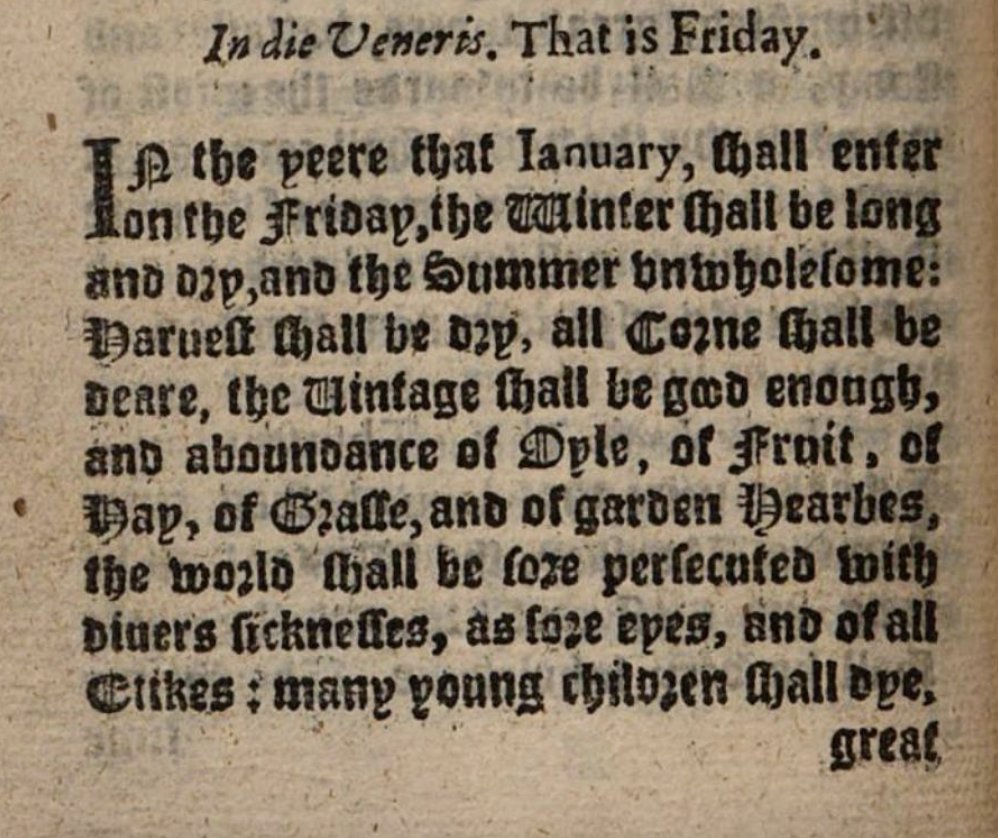

<Fri> of grass, and of garden herbs, the world shall be sore prosecuted with diverse sicknesses, as sore eyes, and of all [Etikes?]*; many young children shall die, great thunder, lightning and tempest shall be,that shall grieve sore all the ground...
*I cannot read this word
*I cannot read this word

<Fri> There shall be earthquakes, all cloth shall be good cheap, poor people shall gain little or nothing, many beasts shall die with hunger though the scarcity of the time.
~In Dii Sabbati, that is Saturday~
In the year that January shall enter on the Saturday, the winter shall be temperate sufficiently, and in the prime time shall be frosts, the which shall destroy the trees, the vines, the oils, and the fruits; the summer shall be meetly...
In the year that January shall enter on the Saturday, the winter shall be temperate sufficiently, and in the prime time shall be frosts, the which shall destroy the trees, the vines, the oils, and the fruits; the summer shall be meetly...

<Sat>
temperate, the harvest time shall be dry, the oats and other corn shall be good cheap, all garden herbs shall be cheap, all flesh shall be good cheap, many old people shall die; Fever Tertians shall grieve sore the world, and many shall be sick through evil heat;
temperate, the harvest time shall be dry, the oats and other corn shall be good cheap, all garden herbs shall be cheap, all flesh shall be good cheap, many old people shall die; Fever Tertians shall grieve sore the world, and many shall be sick through evil heat;
<sat>
many Murmurations, wars, and murders shall be done by one against another, and neighbour against neighbour, and many other causes shall be oftentimes committed and done.
many Murmurations, wars, and murders shall be done by one against another, and neighbour against neighbour, and many other causes shall be oftentimes committed and done.
***
Even though this passage may strike us as simplistic, superstitious even, it is a fascinating look into the life and concerns of its authors-- for example, the incredible amount of detail bestowed on the dangers of frosts, and which commodities would be cheap...
Even though this passage may strike us as simplistic, superstitious even, it is a fascinating look into the life and concerns of its authors-- for example, the incredible amount of detail bestowed on the dangers of frosts, and which commodities would be cheap...
It is perhaps no surpise that these are concerns common to agricultural communities everywhere. The traditional Chinese almanac, for instance, supplies short poems about which crops shall be fruitful in what places...
https://twitter.com/Zhongnin/status/1341708370282045440
and indeed, occasional warnings about diseases. (see also
https://twitter.com/edwardW2/status/1317159397529841665)
Returning to Erra Pater, note that his method of mundane astrology is exceptionally democratic. Anyone who had a knowledge of the day of the week could use it to predict what life would be like for the coming year.
In turn, any literate person could use tables of the the dominical letter (a way of classifying years based on the weekday of jan 1; used to calculate Easter, iter alia ) calculated for years in advance, thereby allowing them to predict what fate would have in store...
This set of predictions was highly persistent ; It found its way into Ramesey's "Astrologia restaurata"books.google.com/books?id=EyZlA…
Erra pater was himself republished well into the 18thc:
books.google.com/books?id=-4aG9…
Erra pater was himself republished well into the 18thc:
books.google.com/books?id=-4aG9…

• • •
Missing some Tweet in this thread? You can try to
force a refresh