If youβre building products for creators, youβll eventually need to generate revenue. VC money or not.
Get familiar with the most common monetization models π§΅π
π€ Share of earnings
β Aligns incentives between creator & platform.
β Harder to monetize creators with low sales.
β Creates a graduation problem (successful creators are incentivized to leave).
β Platforms negotiate special contracts for top earners to solve this.
β Can earn more from creators with low sales.
β Successful creators keep more of their revenue.
β Doesn't create a graduation problem.
β Can leverage freemium or free trials.
β Can incentivize annual plans with discounts.
β Option to charge for usage (e.g. contacts).
β Mix share of earnings, subscription, and usage to widen offering and add monetization layers.
β Bundle share of earnings with subscription add-ons.
β More complicated/confusing for creators.
- "Running a live course is like organizing a music tour, but having to develop the music before every single new show."
- Curriculums aren't set in stone. The advantage of live classes is you can adjust the curriculum to cater to students needs.
- A day or two before every session, they typically spend between seven to nine hours preparing the next lecture.
- How? They have existing building blocks and assets, adjust based on where students are getting confused, and reassembling the blocks into the next lecture.
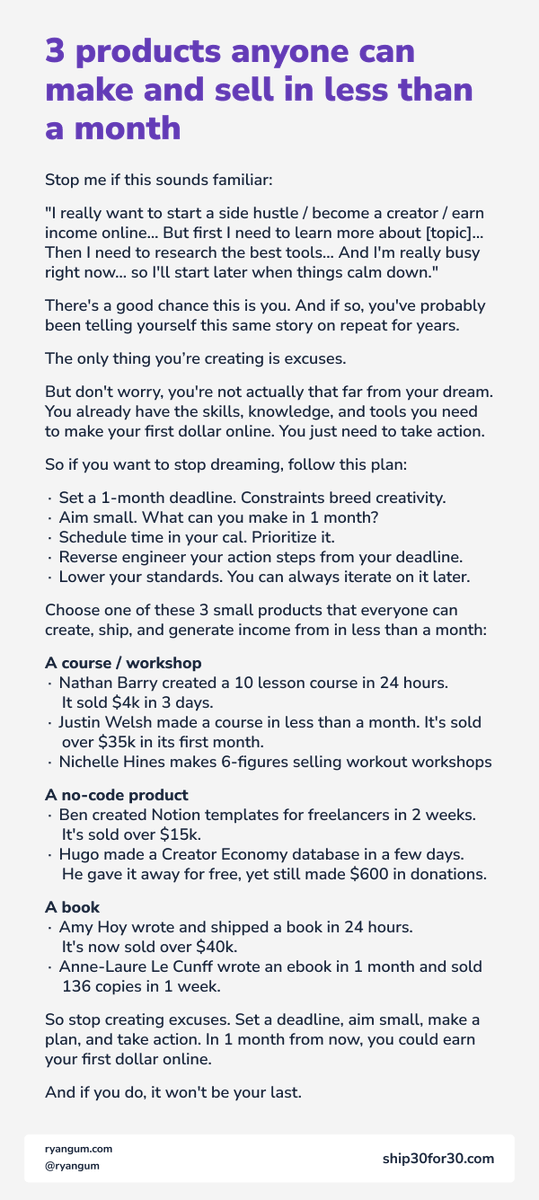
"I really want to start a side hustle / become a creator / earn income online... But first I need to learn more about [topic]... Then I need to research the best tools... And I'm really busy right now, so I'll start later when things calm down."
Sound familiar? π§΅π
There's a good chance this is you. And if so, you've probably been telling yourself this same story on repeat for years.
The only thing you're creating is excuses.
But don't worry, you're not actually that far from your dream. You already have the skills, knowledge, and tools you need to make your first dollar online. You just need to take action.
So if you want to stop dreaming, follow this plan:
With a good pre-sale you can validate audience/idea fit with real money in the bank... Before you even create the product.
The secret to a good pre-sale? Treat it like a Kickstarter.
4 examples in the thread π§΅π
π― Set a goal
How many customers / much revenue will you need to continue working on your product? How long will you give it to hit that target? 1-2 weeks at most. Donβt drag it out.
π Create a lean sales page
Don't focus on the design or layout too much. Messaging is what's important. Include:
β What the pain point is
β Why your product is the solution
β What's included. Be specific, e.g. chapter outlines.
@APompliano publishes 5 podcasts, 5 newsletters to 35k paid subs, 5 YT vids, while running an investment firm. @anthilemoon publishes 2 articles, a newsletter to 25k subs, while running a paid community with 1500 subs.
What separates top creators from the rest? π§΅π
They're prolific.
Content platform algorithms reward publishing good content frequently over great content sporadically. B-grade content with A-grade consistency beats A-grade content with B-grade consistency.
And the more you create, the faster you learn and grow. Your first article, video, or podcast will suck. Your 100th won't.
β Yesterday by The Beatles
β Single Ladies by Beyonce
β Your Song by Elton John
β Skyfall by Adele
β Royals by Lorde
What do they have in common? ππ§΅
They were all conceived and written in less than 1 hour.
Is this the result of creative genius that's only accessible to superstars? Unlikely. It's more probable that they were tapping into a level of creativity that only exists when striking while the iron's hot.
The most passionate you'll ever be about an idea is moment the epiphany strikes.
β 56 Teachable creators made over $1M.
β 10 Patreon creators made over $1M (est).
β 10 Substack writers collectively made over $10M.
β 8 Gumroad creators made over $1M.
β 8 Twitch streamers made over $1M (est).
What's their secret? π§΅π
At this level, almost no one is doing it alone. Theyβre supported by YouTube editors & writers, podcast producers, online course coaches, agents that find and negotiate brand sponsorship deals, and assistants.
These are the people behind the growth of many successful creators.
Leverage makes the creator economy unique. Individuals can reach wider audiences more than ever before. But while creators run businesses with atypical leverage, they still have typical business needs.