

A belated Christmas quiz question for you - what do puzzles, poker, and misinformation have in common? The answer is at the bottom of this thread.
1/
1/
Easier question first. In Santa’s workshop, if it takes five elves five minutes to wrap five presents, how long does it take 50 elves to wrap 50 presents?
2/
2/
You probably know the answer to that one; it follows a classic formula for a trick question. But as you groped towards the correct answer you may have had to fight off your instinct to blurt out a tempting wrong answer: 50 minutes.
3/
3/
The arithmetic is no challenge; the difficulty is pausing for the brief moment necessary to carry that arithmetic out, while fending off the obvious but incorrect answer that pops into your mind unbidden.
4/
4/
An even more famous example is the “bat and ball” question: if a bat and a ball together cost $1.10, and the bat costs a dollar more than the ball, how much does the ball cost?
5/
5/
Ten cents, screams the instinctive response, but it does not require a spreadsheet to work out that that is not right. It just requires one to stop and think.
6/
6/
And here’s a less famous one: if you flip a coin three times, what is the probability of flipping at least two heads?
7/
7/
A naive response is that two out of three flips need to come good, and the chance of that is one-third. A more sophisticated response recognises that three coin flips produce eight possible combinations — so perhaps the probability is three out of eight?
8/
8/
Work through those eight combinations, however, and you realise that the true chance is 50-50.
9/
9/
Questions such as these are called cognitive reflection problems. They were made famous by Daniel Kahneman in his book Thinking, Fast and Slow, but they were developed by the behavioural economist Shane Frederick @ShaneFs5cents .
10/
10/
They vary in difficulty, but the ideal cognitive reflection problem has an answer that is simple, obvious, and wrong — as well as a correct answer that is not too hard to calculate.
11/
11/
The behavioural scientists Gordon Pennycook and David Rand, sometimes working with other colleagues, have published studies drawing the connection between cognitive reflection problems and misinformation.
12/
12/
Often people see and share false claims, not because they cannot figure out that the claims are false, but because they didn’t stop long enough to try.
13/
13/
Spotting fake news, like realising the ball costs just five cents and the 50 elves wrap 50 presents in just five minutes, requires us to stop and think for a moment. And who has time for that these days?
14/
14/
Let’s move from puzzles to poker. To the uninitiated, poker is a game involving: luck, calculation and deception. But professional poker players tell me that a fourth element is just as important: controlling your emotions, or failing to do so — “going on tilt”.
15/
15/
In her spellbinding foray into professional poker, The Biggest Bluff, the psychologist @mkonnikova describes “tilt” as “letting emotions — incidental ones that aren’t actually integral to your decision process — affect decision making.” amzn.to/3r2VnpG
16/
16/
We cannot escape our emotions, but clear decision-making requires that we notice them and take them into account. And just as a poker player can go on tilt, so can any of us as we read the headlines or scroll through social media.
17/
17/
Indeed, we should expect those headlines to be “tilting”: headline writers aim for impact, while social media thrives on emotional engagement from joy to fury.
18/
18/
“The goal,” writes @mkonnikova , “is to learn to identify our emotions, analyse their cause, and if they’re not actually part of our rational decision process . . . dismiss them as sources of information.”
19/
19/
Good advice for poker players. But good advice for anyone doomscrolling through Twitter or shouting at the radio during the morning news bulletin.
20/
20/
Would you like to see ANOTHER cognitive reflection puzzle? This one is a doozy - and not widely circulated. @ShaneFs5cents kindly shared it with me...
21/
21/
How can we stop these puzzles - and more importantly, online misinformation - from hijacking our brains? My advice is simply to take note of your emotional reaction to each headline, sound bite or statistical claim. Is it joy, rage, triumph?
22/
22/
Having noticed it, keep thinking. You may find clarity emerges once your emotions have been acknowledged.
23/
23/
So what do puzzles, poker, and misinformation have in common? Some puzzles — and some poker hands — require enormous intellectual resources to navigate, and the same is true of certain subtle statistical fallacies...
24/
24/
... But much of the time we fool ourselves in simple ways and for simple reasons. Slow down, calm down, and the battle for truth is already half won.
25/
25/
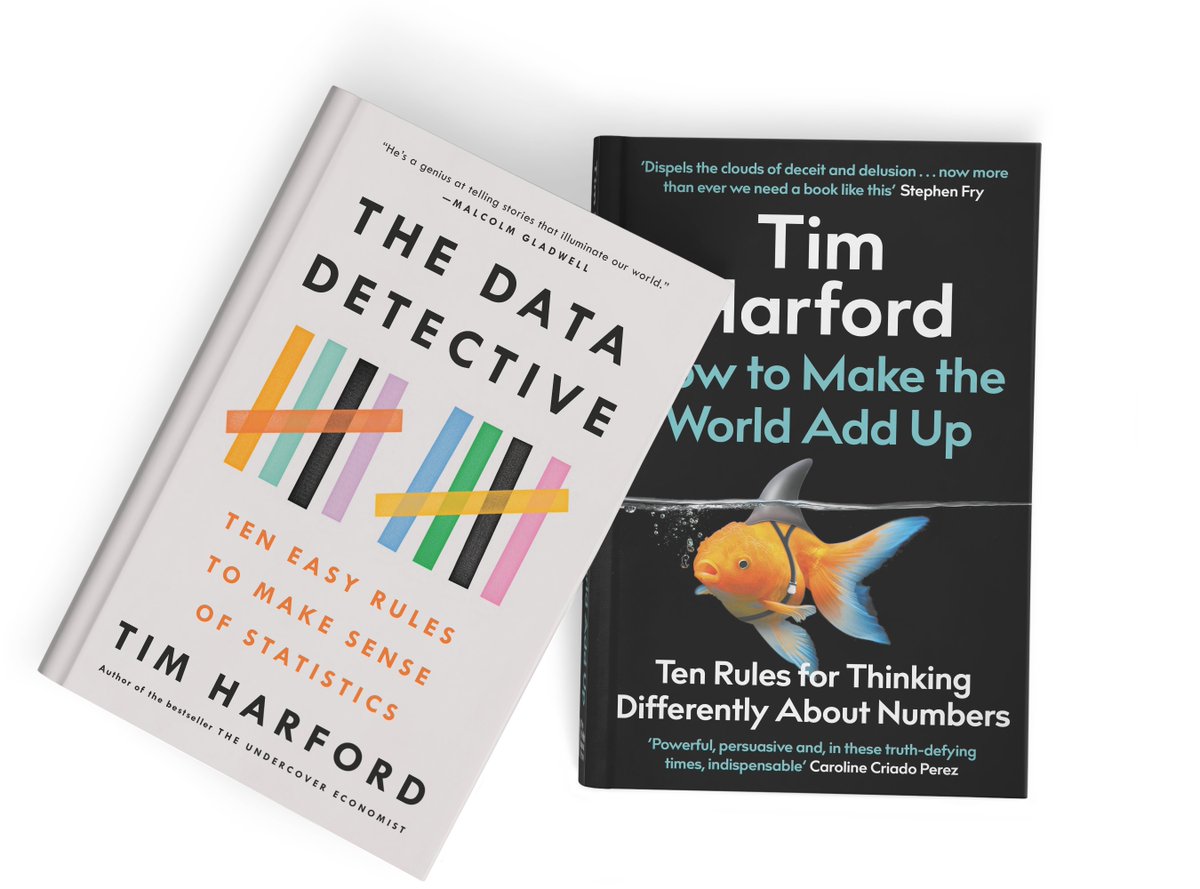
And if you want to find out more - much more - about how to think clearly about the world, the US edition of my book is out this week. Title: "The Data Detective" (UK title of the same book; "How To Make The World Add Up".)
Enjoy - and spread the word!
timharford.com/books/datadete…
Enjoy - and spread the word!
timharford.com/books/datadete…
By the way - if you want to read this thread as a blog post (and subscribe to receive my writing via email) then this is the place: timharford.com/2021/01/what-p…
And on a not-unrelated topic:
https://twitter.com/FinancialTimes/status/1355896384243830786
• • •
Missing some Tweet in this thread? You can try to
force a refresh


