All right, my book on baseball goes on sale in two days, so let's do a quick thread on some of my favorite baseball strips in "Peanuts." 

I've always been partial to the baseball strips from the late 1950s to the early 1960s, when the pain of losing felt most acute to Charlie Brown, less leavened by sight gags or quick quips.

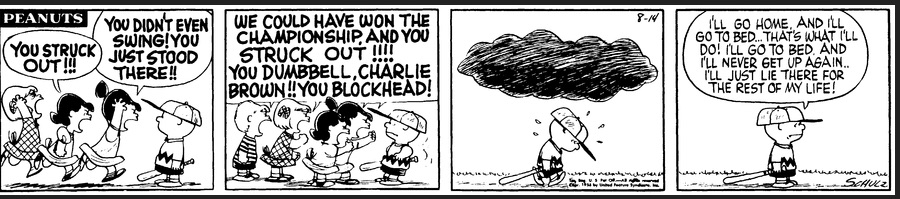
There were a series of years where Charlie Brown's team, despite being terrible, always had a chance at winning the championship, and of course, Charlie Brown screwed it up. The pain he felt afterward can be almost unbearable.
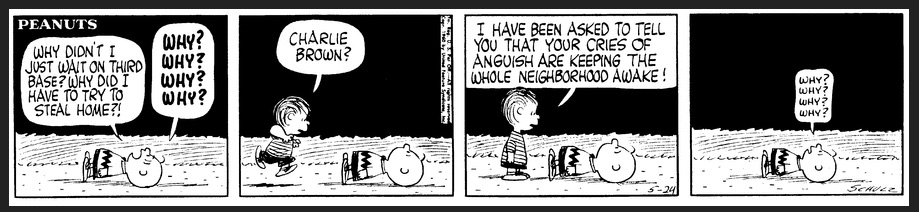
My favorite sequence was from late May 1960, where Charlie Brown gets on base and then decides to steal home to win the championship. He's called out and there's a great two-panel sequence where he stays there on the ground and day becomes night.

I've always found this strip from May 24, 1960, to be hilarious, with its "cry of anguish" line, but it's also just utterly naked in its heartbreak.
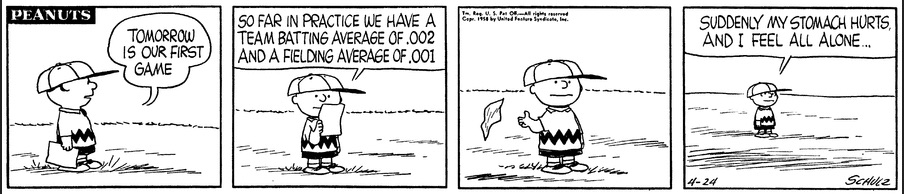
This strip from April 24, 1958, has a familiar trope from this time period where Charlie Brown would utter a depressing statement, and then Schulz would pull back in the final strip, underlining how alone and small he seems and feels.
It's popular nowadays to state that Charlie Brown is admirable because he tries and fails and never gives up. I suppose, but what I've always admired is how Schulz never sugarcoated Charlie Brown's genuine anguish.
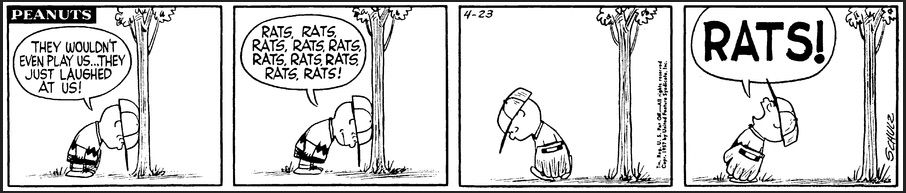
It can be a bit much, and sometimes the whole point of the strip is to pile on layer upon layer of misery. But they've always been the ones I've gravitated toward.

Anyway, baseball is the longest running theme in "Peanuts," and my love of the strip is entwined with my love of baseball. This is one of my favorite Sunday strips, from October 18, 1964. Poor Charlie Brown.

And as a reminder, my book, "Our Team," goes on sale on Tuesday. It takes place mainly in 1946-48, before the start of "Peanuts," but it couldn't have been written without my love for baseball and the strip. I'd appreciate it if you all checked it out. us.macmillan.com/books/97812503…
I should add once again that if you wanted a signed copy, order my book through Astoria Bookshop. astoriabookshop.com/?q=h.tviewer&u…
• • •
Missing some Tweet in this thread? You can try to
force a refresh