👀The FDA and CDC are calling for a pause in the use of J&J’s vaccine after a series of blood clots in six women.
Statement:
Statement:


So far, about 6.86 million doses of J&J’s vaccine have been used in the U.S., so that’s a known rate of less than 1 in 1,000,000.

Many of the J&J doses have also been targeted, by the feds, at harder to reach populations. If there are vaccine-hesitant among those, this news may not help.
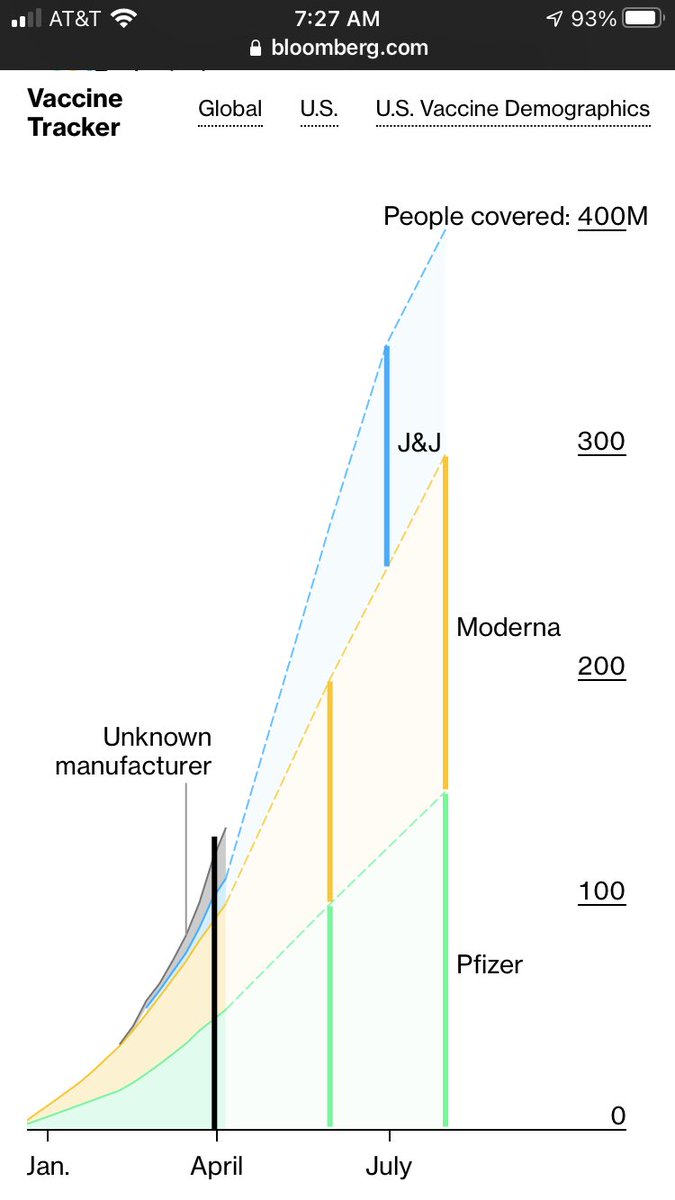
The J&J supply is a tiny fraction of what’s in the U.S. right now. But it’s expected to play a bigger and bigger role as the rollout goes on, in part because of the convenience a one-dose shot represents. Here’s what supply expectations look like:
☝️These events are rare, yes, but health regulators tend to take this stuff very seriously.
FDA is holding an advisory meeting tomorrow to discuss; we may see news after that.
This will likely also launch more investigation that could uncover more events or rule out some.
FDA is holding an advisory meeting tomorrow to discuss; we may see news after that.
This will likely also launch more investigation that could uncover more events or rule out some.
Useful context on the rate/denominator, which should be lower than 6M
https://twitter.com/bertrandbio/status/1381934057966166017
It’s also worth noting that whether it’s 1 in 6M or 1 in 3M, that’s still better than your odds vs a Covid infection.
That ALSO said, it’s crucial to catch warning signs early, assess risk, figure out if some groups shouldn’t get a certain vaccine, or if it’s fine to continue.
That ALSO said, it’s crucial to catch warning signs early, assess risk, figure out if some groups shouldn’t get a certain vaccine, or if it’s fine to continue.
All drugs and vaccines have risks. The FDA and health regulators elsewhere asses risk-benefit BALANCE. (With vaccines, weighing safety very very heavily.)
If the balance is okay, they’ll likely recommend resuming use.
If the balance is okay, they’ll likely recommend resuming use.
Situations like this, or the concerns about AstraZeneca’s vaccine in the EU, are why countries doubled down and diversified vaccine R&D/purchasing and OVER-bought vaccines.
You don’t want you vaccine campaign to fall apart because one vaccine.
You don’t want you vaccine campaign to fall apart because one vaccine.
Here's our full story on the J&J vaccination pause, from @angelicalavito @rileyraygriffin + @LauermanJohn
bloomberg.com/news/articles/…
bloomberg.com/news/articles/…
• • •
Missing some Tweet in this thread? You can try to
force a refresh