As part of a six-month investigation, the @nytimes Visual Investigations team synchronized and mapped thousands of videos and police audio of U.S. Capitol riot on Jan. 6 to provide the most complete picture to date of what happened — and why. nytimes.com/video/us/polit…
Our investigation revealed at least eight locations where rioters breached the building, more than previously known. In some, the police battled rioters before being forcibly overwhelmed. In others, officers stepped aside.
We identified a security delay that may have cost a life. Rather than evacuate, members of the House resumed their work — meaning they were visible to the mob when it reached the doors of the chamber. Incensed and trying to reach them, Ashli Babbitt was shot and killed.
A common thread in our investigation is how rioters echoed former President Trump’s rhetoric. His attacks and tweets of his Vice President made Mike Pence a target of the mob, and his call to march on the Capitol was parroted throughout the day.
The crowd was a combustible mixture of radicalized individuals and organized groups. We analyzed several incidents where a move by an organized actor — for example, a Proud Boy identifying a weakness in the police line near the building’s scaffolding — set off a mob surge.
Synchronizing thousands of videos also allowed us to identify how a domino effect took hold of the mob that day. We tracked rioters from one side of the building around to the other, in an inciting incident that left the Capitol completely surrounded.
Law enforcement were effective in clearing the Capitol once they had appropriate numbers and crowd control weapons. It's evident how preparation could have helped stem the violence of the day. For more, watch the full investigation and read takeaways here: nytimes.com/2021/06/30/us/…
• • •
Missing some Tweet in this thread? You can try to
force a refresh

Hace más de un mes, Colombia protesta contra la desigualdad; al menos 43 personas han muerto. El @nytimes combinó análisis de video con entrevistas a víctimas, y muestra las formas atroces, y a veces mortales, en que la policía quiso sofocar las marchas. nytimes.com/es/2021/05/27/…
Nos centramos en cinco casos que ejemplifican la forma violenta, y a veces mortal, en que la policía sofocó las protestas. Los incidentes van desde apalear a manifestantes ya detenidos hasta disparar mortalmente a un joven de 17 años en la cabeza mientras huía.
Primero: agresiones a detenidos. Veamos este ejemplo del 1 de mayo en Pereira. Un video capta a los manifestantes huyendo. Dos de ellos intentan esconderse, pero los agentes los encuentran. Un oficial patea a un manifestante contra un escaparate que se rompe.
An analysis of videos, combined with witness interviews, shows egregious and indiscriminate use of force by Colombia's national police. At least 44 have been killed during protests over economic disparity that started over a month ago. nytimes.com/2021/05/27/vid…
From clubbing protestors in custody to fatally shooting a 17-year-old in the back — the @nytimes Visual Investigations team highlights five instances that exemplify the violent, and sometimes deadly, ways Colombia’s police quelled the protests. ⤵️
First, let's look at an instance of assault in custody. This video, from Pereira on May 1, captures demonstrators running away. Two of them attempt to hide, but officers find them. An officer then kicks one of them into a glass display case that breaks. nytimes.com/2021/05/27/vid…
In March, insurgents besieged Palma, a town north of a multi-billion dollar gas project in Mozambique. Using survivor testimonies, video, satellite images and ship-tracking data, we reconstructed an attack which many felt wasn't a question of if, but when. nytimes.com/video/world/af…
Known as al-Shabaab, the insurgents have been active in the northern Cabo Delgado province since 2017. Its recruitment is mostly local, drawing on grievances over poverty and corruption. The group pledged allegiance to Islamic State, but how close these ties are is hotly debated.
The attack on Palma is one of many — over 600,000 people have been displaced as the insurgents gained territory. But the Mozambican government downplays the threat, exaggerating its own response and harassing local journalists. We see that pattern again in Palma.
As Nick is saying, high-res satellite imagery has repeatedly allowed open source investigators to hold the powerful to account and to establish verifiable facts. I agree: it isn't acceptable that most services continue to deliberately degrade imagery of Palestine.
Here's @Zena_Agha's article once again, because it's important: an obscure US law concealed satellite imagery of Israel's activities in the Occupied Territories. But that's reversed now — so time to use it to defend Palestinians' human rights. foreignpolicy.com/2020/08/03/isr…
So, for reference, this kind of high-resolution satellite imagery is rare to see. Hopefully that'll change.
In 2012, I hitchhiked from the Netherlands to South Africa with @NedaBoin and @sierrrd — covering 25,000 kilometers entirely based on the kindness of random strangers. The 155 rides 👇
Our first ride was in a (in the Netherlands well-known) bakfiets. It brought us from the city center (where we said goodbye to our loved ones) to the best hitchhiking spot in town toward Germany.
Ride 1: Vismarkt to Europaweg, Groningen, Netherlands (2.5km) 🇳🇱
The first car to stop for our destination “Cape Town (no joke)” cart board sign was this Mercedes. She saw our sign, stopped, and was like, “I can take these three kids“ as she was on her way home to Winschoten.
Ride 2: Groningen to Scheemda, Netherlands (26km) 🇳🇱
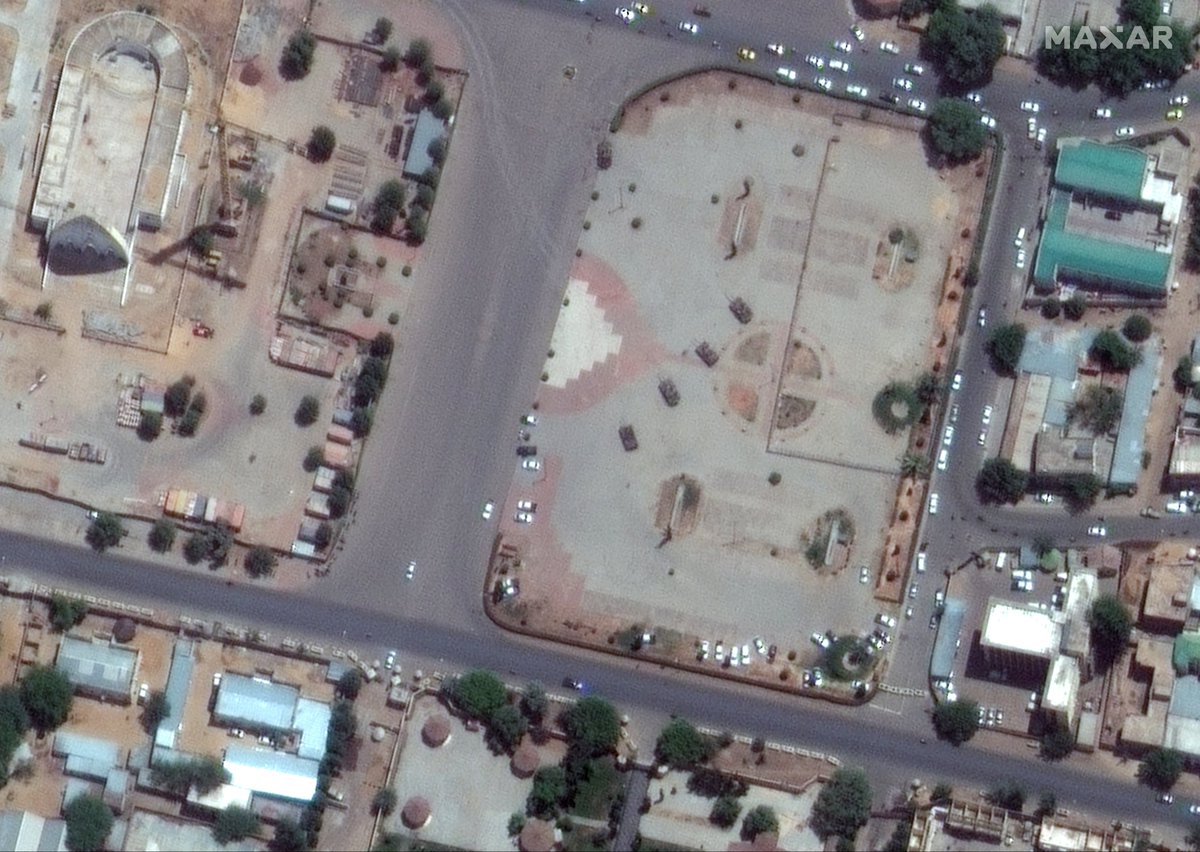
Satellite imagery of Ndjamena reveals the heightened state of alert in the Chadian capital after President Idriss Deby was killed whe commanding troops at the front on April 20. 🛰️📸: @Maxar (google.com/maps/@12.11039…)
The death of Déby, who ruled the country with an iron fist for three decades, comes barely a week after FACT rebels crossed from Libya into Chad. One of their shells apparently exploded near Déby's vehicle. More by @declanwalsh/@AdamouNdjam/@ElianPeltier: nytimes.com/2021/04/22/wor…
The FACT (Front for Change and Concord) rebels threatened to march on Ndjamena this weekend. Whether they can deliver on that threat is unclear: Chadian Army claim heavy rebel losses and foreign officials are unsure how far they are from the capital.